The death toll from catastrophic flash floods that struck communities along the Nepal-China border has risen past 470, as rescue teams continue searching for hundreds of people missing across remote Himalayan valleys.
Nepal’s Prime Minister’s Office said on Friday that 469 people had been confirmed dead, while 977 others remained missing. Chinese authorities reported at least three deaths in Tibet, with another 558 people still unaccounted for. Nepalese authorities said 644 of those missing were foreign nationals, underlining the international scale of the disaster in a region frequented by tourists, trekkers and pilgrims.
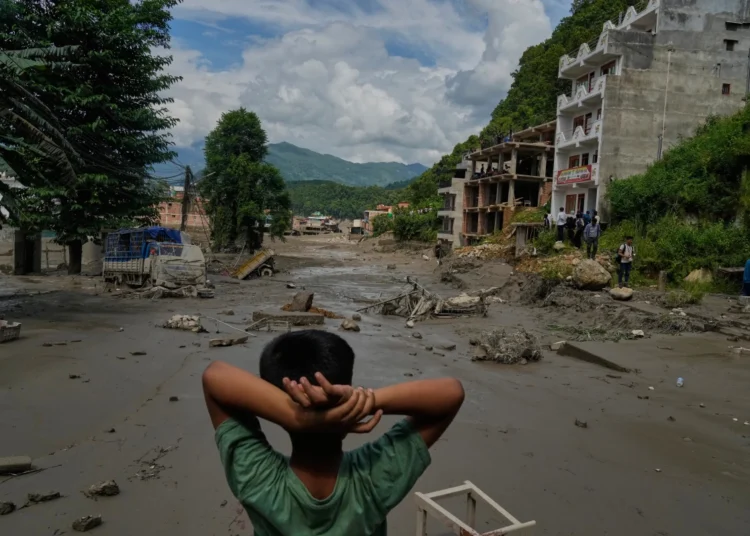
About 1,550 people have been rescued since the disaster struck on Wednesday. The floods were triggered after a glacier collapse sent a powerful surge of ice, water, rock and mud through Himalayan river valleys, burying communities and destroying roads, bridges and hydropower facilities. The scale of destruction has made access to some of the affected areas extremely difficult, forcing rescuers to rely heavily on helicopters to reach isolated communities.
Nepal’s army said that it had rescued around 900 people from some of the worst-hit areas, including Rasuwa and Nuwakot districts. Among those rescued were 119 foreign nationals, including 92 Indian citizens. Indian nationals represent the largest group of foreign visitors affected by the floods, with many travelling through the Himalayan region for pilgrimage or tourism.
Brigadier General Rajaram Basnet, a Spokesman for the Nepalese army, said all 900 people rescued by the military were injured and had been taken to hospital for treatment. Speaking to reporters at a helicopter landing site outside an army barracks, Basnet acknowledged that difficult weather conditions were complicating rescue efforts. “But we’re trying to… intensify the rescue operations, in close coordination with all stakeholders,” he said. Reflecting on the scale of the destruction, Basnet added, “I haven’t seen this kind of disaster in my life.”
Nepal has deployed around 30,000 security personnel to assist with search and rescue operations across the affected region. Teams are searching remote valleys, damaged settlements and infrastructure sites where people may have been trapped or cut off by the floods.
The army has also dispatched two helicopters to search for people missing near a hydropower tunnel in the Trishuli area. Authorities have not yet determined how many people may be trapped or missing at the site. Each helicopter can carry up to 25 people, according to the army. Several people, including labourers and residents from surrounding communities, were rescued from the area on Thursday.
However, continuing rainfall and unpredictable weather have created further difficulties for emergency operations. Rescue teams are also facing the possibility of additional flooding.
Attention has increasingly focused on a newly formed barrier lake near the Nepal-China border, which authorities in both countries have warned could pose another serious danger. Barrier lakes can form when landslides or flooding block the natural flow of a river, causing water to accumulate behind debris that acts as a temporary natural dam. If such a barrier fails, the stored water can be released suddenly, causing severe flooding downstream.
Chinese state media reported that water had begun overflowing from the barrier lake formed after Wednesday’s landslide. Authorities said the lake was full and that water was gradually escaping, prompting officials to suspend rescue operations in the immediate area while monitoring the situation.
Chinese national broadcaster CCTV reported that the lake is located about 10 kilometres from Gyirong port and contains more than two million cubic metres of water. Rescue operations in parts of Tibet were suspended on Friday amid concerns that the natural barrier could collapse and trigger another major flood.
Chinese authorities have begun installing surveillance cameras around the lake to monitor changes in water levels and assess the risk over the coming hours. Earlier, Nepali police issued a warning saying that a water barrier had “breached on the Tibetan side,” raising fears among communities downstream. Chinese authorities have confirmed that overflow has occurred but continue to monitor the stability of the debris barrier.
The formation of the lake has added a new layer of uncertainty to an already devastating disaster that has affected communities on both sides of the Himalayan border. The floods have destroyed critical infrastructure, including dozens of bridges and large sections of roads, making it harder for emergency teams to reach survivors and transport the injured to medical facilities.
Search operations remain focused on locating hundreds of missing people, including local residents, foreign tourists, workers and pilgrims. The disaster has also displaced communities, with authorities working to provide shelter, medical assistance and emergency supplies to survivors. As rescue efforts continue, officials remain concerned that unstable weather and the newly formed barrier lake could further complicate operations.