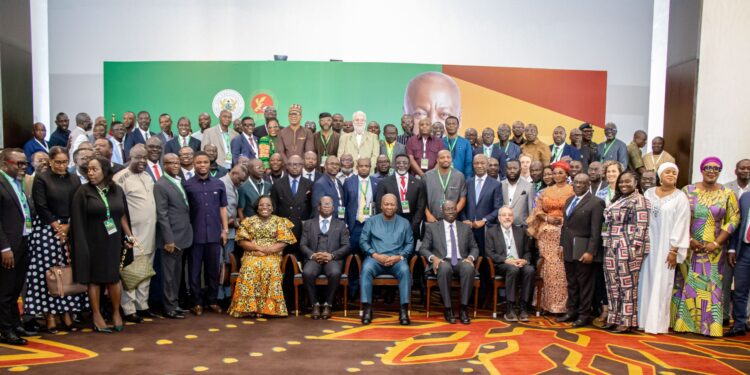
Government Communications Minister and Presidential Spokesperson Felix Kwakye Ofosu has highlighted a sharp financial turnaround in Ghana’s state-owned enterprises, citing figures from the State Interests and Governance Authority showing the sector moved from a GH¢2.25 billion net loss in 2024 to a GH¢19.8 billion net profit in 2025, ending four consecutive years of losses.
The figures come from SIGA’s 2025 State Ownership Report, released on Sunday, August 30, 2026, the tenth edition of Ghana’s flagship assessment of state-owned enterprises and the fifth published since SIGA’s establishment in 2019.
The report examined 162 of 175 approved specified entities, comprising 53 SOEs, 36 joint venture companies and 73 other state entities.
Revenue Up 28 Percent, Losses Reversed
Hon Kwakye Ofosu’s figures track directly with SIGA’s headline findings. Total SOE revenue rose from GH¢137.64 billion in 2024 to GH¢176.43 billion in 2025, a 28.12 percent increase driven largely by strong performance in the agriculture, manufacturing and infrastructure sub-sectors.

The underlying profitability metrics support the scale of the reversal. SIGA reported that Profit Before Interest and Tax reached GH¢25.49 billion in 2025, a firm recovery from a GH¢502 million loss recorded in 2023.
The sector’s net foreign exchange position also swung positive, generating net earnings of GH¢11.72 billion in 2025 compared with a GH¢12.01 billion loss the previous year, a shift SIGA attributed partly to a stronger local currency.
Four Years of Losses Before the Turnaround
The scale of the reversal becomes clearer set against the sector’s recent trajectory. SIGA’s 2024 report, published in August 2025, showed the SOE sector’s net loss deepened to GH¢9.67 billion that year from GH¢7.14 billion in 2023, driven primarily by GH¢9.39 billion in finance costs, which eroded operational gains despite 28.30 percent revenue growth.
A 2022 State Ownership Report had earlier recorded a cumulative loss of GH¢5.3 billion across the sector, with the Ghana Cocoa Board and the Electricity Company of Ghana among the largest contributors to that deficit.
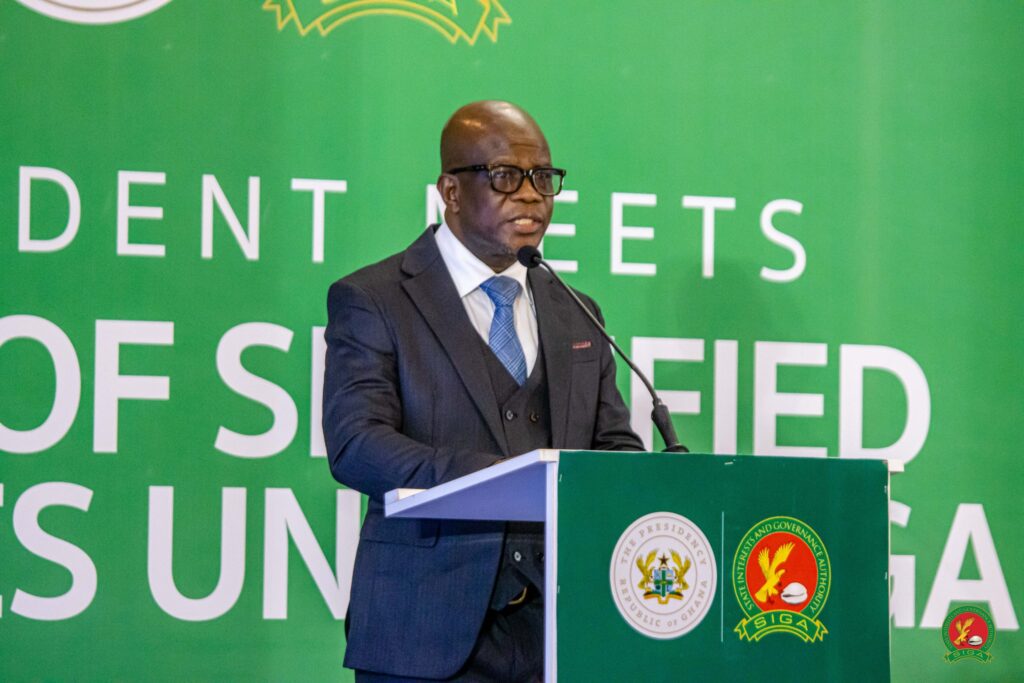
SIGA Director-General Prof. Michael Kpessa-Whyte framed the 2025 results as particularly significant given the political moment they capture.
“This edition is significant because it documents the performance of Specified Entities for the first year of President Mahama’s second administration”.
SIGA Director-General Prof. Michael Kpessa-Whyte
Not Every Entity Shared in the Turnaround
SIGA’s report cautioned that the sector-wide recovery masks persistent problems at specific entities. Five SOEs, including the Electricity Company of Ghana, Ghana Cylinder Manufacturing Company, GNPA Limited, Graphic Communications Group Company and Ghana Digital Centre, recorded losses in every year from 2021 through 2025.
Six entities continue to carry negative equity, and dividend payments to government have declined even as overall sector profitability improved.
Several entities did post sustained five-year profitability, among them the Ghana Ports and Harbours Authority, Bui Power Authority, Ghana National Gas Company, BOST Energies Company, Minerals Income Investment Fund and TDC Company Limited.
A Pattern of Individual Entity Disclosures
Hon Kwakye Ofosu’s post on the sector-wide figures follows a pattern of similar disclosures he has made throughout the year, highlighting turnarounds at individual state enterprises.
He announced in May that the Ghana Publishing Company’s profit after tax rose from GH¢2.227 million in 2024 to GH¢16.959 million in 2025, an almost eightfold increase he attributed to reforms introduced by the company’s management.
SIGA separately credited the National Food Buffer Stock Company with reversing a GH¢19 million loss into a GH¢91.7 million profit over the same period, and highlighted a GH¢1.24 billion profit at the Tema Oil Refinery, which it described as a historic financial turnaround.
Only 61 of 185 SOEs met the April 30 deadline for submitting 2025 financial statements, a compliance gap SIGA has flagged separately as an ongoing constraint on the completeness of its oversight even as the entities that did report showed marked improvement.
READ ALSO: IMANI VP: African Democracies Have “A Lot of Noise, But No Signal”