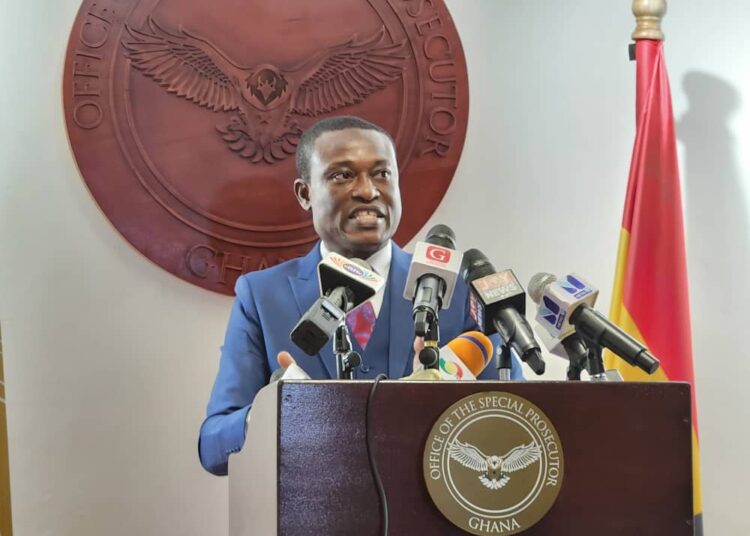
Special Prosecutor Kissi Agyebeng has renewed his call for constitutional and legislative reforms that would grant anti-corruption agencies expanded lifestyle audit powers and the ability to recover unexplained wealth through civil proceedings rather than criminal conviction, repeating a proposal he has pressed consistently since 2025.
Agyebeng framed the push as a response to the persistent resistance corrupt actors mount against existing enforcement tools, arguing that the Office of the Special Prosecutor and the Economic and Organised Crime Office both need broader legal authority to address wealth that cannot be explained by an individual’s declared income.
Kissi Agyebeng grounded his proposal in what he described as global anti-corruption best practice. “Global anti-corruption best practices indicate that broad-based lifestyle audit, non-convention-based asset recovery represent the fairest and optimal method of frontally addressing corruption and unexplained wealth,” he said.
He argued that OSP and EOCO should be invested with express and effective powers requiring individuals to demonstrate legitimate sources of income sufficient to justify property they own.
Under his proposal, where a person’s assets significantly exceed what their declared income could support, the unexplained portion would become liable to confiscation. He said this mechanism would also help detect fraud and undeclared income for tax purposes, extending its usefulness beyond corruption investigations alone.
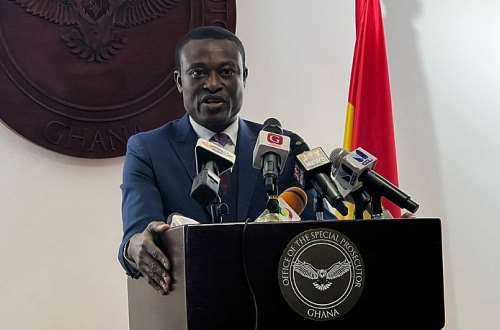
Critically, he argued that a criminal conviction should not be a precondition for asset recovery. “Civil proceedings should suffice,” he said.
A Reverse Onus Clause
Mr Agyebeng’s second and more far-reaching proposal is a constitutional reverse onus clause built around the same lifestyle audit principle. Under this framework, a person found in possession of property disproportionate to their known legitimate income would be presumed to have obtained it through corrupt means, unless they could prove otherwise.
The burden of proof would shift from the state, which currently must establish wrongdoing, to the individual, who would need to account for the source of their wealth.
Mr Agyebeng was careful to frame the proposal as a controlled legal mechanism rather than an invitation to arbitrary state seizure. “This proposed unexplained wealth mechanism is not a shortcut around justice or a license for arbitrary confiscation,” he said.
He said the safeguard lies in requiring the state to first establish the appropriate legal threshold before a civil court, after which only assets that remain unreconciled with legitimate sources of income would be liable to confiscation.

Mr Agyebeng’s remarks extend a campaign he has run publicly since at least mid-2025, when he first raised the reverse onus proposal at the West Africa Regional Anti-Corruption Policy Dialogue in Accra, describing Ghana’s existing legal framework as outdated and unable to keep pace with the sophistication of modern corruption schemes.
“The law always appears to be a step behind criminal innovation,” he said at the time, arguing that investigations and prosecutions under the current system are slow, expensive and often unproductive because of entrenched secrecy and wealth layering.
Speaker of Parliament Alban Bagbin has separately signalled support for the proposal, revealing plans for Parliament to draft legislation implementing lifestyle audits for individuals suspected of unexplained wealth.
Not every lawmaker agrees with the approach. Opposition MP Nana Agyei Baffour Awuah has argued that Ghana already possesses sufficient legal instruments to pursue corruption, telling reporters that duplicating powers through new legislation would be redundant and counterproductive rather than genuinely additive to existing enforcement capacity.
A Renewed OSP Pressing Its Case
Kissi Agyebeng’s latest remarks arrive at a moment of institutional confidence for his office. The Supreme Court ruled on July 29, 2026, in a case brought by private legal practitioner Noah Ephraem Tetteh Adamtey, unanimously upholding the constitutionality of the OSP’s independent prosecutorial powers after months of legal uncertainty had stalled the office’s activities.
Kissi Agyebeng has since described the ruling as marking a “rebirth” of the OSP, pledging that the office will rigorously investigate corruption cases, vigorously prosecute where evidence supports it, and intensify efforts to recover illicit assets and prevent corruption going forward.
That renewed mandate has coincided with active OSP investigation into the Ghanaian dimension of the Asante Kwaku Berko bribery case, in which the former Tema Oil Refinery Managing Director was convicted in the United States this month over payments linked to a Ghana-Turkey power plant deal, a case Mr Agyebeng has cited as precisely the kind of scheme his proposed lifestyle audit and reverse onus powers are designed to reach domestically.
READ ALSO: Tim Cook Steps Down as Apple CEO After Fifteen Years