European Union Enlargement Commissioner Marta Kos has cancelled a planned visit to Serbia in protest against what she described as the “glorification” surrounding the death of former Bosnian Serb Military Commander Ratko Mladić, who was convicted of genocide, war crimes and crimes against humanity during the 1992–1995 Bosnian war.
Kos, a Slovenian diplomat and politician, said the public events planned following Mladić’s death were incompatible with the values Serbia is expected to uphold as it seeks membership of the European Union. Mladić died last week while serving a life sentence after being convicted by a United Nations tribunal for his role in some of the worst atrocities of the Bosnian war.
His remains were flown to Belgrade from The Hague, Netherlands, on a Serbian government plane on Thursday. Upon arrival in Belgrade, Mladić’s coffin was wrapped in the Serbian national flag, while Serbian army soldiers carried his body from the aircraft to a vehicle that transported it to a military hospital.
His son, Darko Mladić, said that the coffin would be placed in a church in Belgrade on Monday morning, allowing members of the public to pay their respects. A public commemoration is also expected to take place in the Serbian capital on Saturday afternoon, before his burial on Monday.
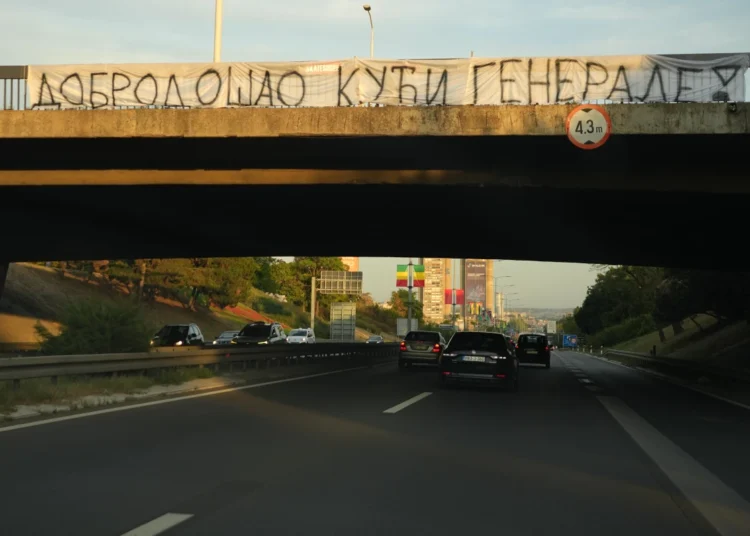
The planned ceremonies have drawn criticism from European officials, who are closely watching how Serbia handles the funeral of a figure who remains a hero to some Serbs despite his conviction by an international tribunal.
In announcing the cancellation of her visit, Kos said that Mladić’s return to Belgrade had revived memories of some of the darkest episodes in Europe’s recent history. “Ratko Mladić was convicted of genocide, crimes against humanity and war crimes,” Kos said. “The return of his remains to Belgrade reminds Europe of the darkest pages in our recent history,” Kos added.
She criticised the public celebrations surrounding his death, arguing that they conflicted with the principles expected of countries seeking closer integration with the European bloc. “The glorification surrounding his death is incompatible with the values on which the EU path is built,” she said, adding that Serbia’s European path required it to confront its past, pursue genuine reconciliation and respect victims of war crimes.
“The values that underpin our common future are not negotiable. In this context, I have decided not to proceed with my planned visit to Serbia at this time.”
Marta Kos
The decision comes as the EU assesses Serbia’s progress towards membership, with relations between Belgrade and Brussels closely tied to issues including democratic standards, the rule of law and reconciliation over the conflicts that accompanied the breakup of Yugoslavia.
Kos described the period surrounding Mladić’s funeral as an important test for Serbia. She said that the coming days would be a “very important test” as authorities deal with public reactions to the return of his remains.
Mladić was sentenced to life imprisonment in 2017 after being found responsible for crimes including the massacre of more than 8,000 Bosnian Muslims at Srebrenica in 1995 and the prolonged siege of Sarajevo during the Bosnian war. He was also convicted over other crimes committed during the conflict, including the establishment of detention camps where non-Serb civilians and captured enemy soldiers were held.
Other Officials Iterate Kos’ Stance Over Mladić “Glorification”
The controversy has extended beyond EU officials. Council of Europe Commissioner for Human Rights Michael O’Flaherty on Friday called on authorities in Serbia and Bosnia and Herzegovina’s Serb-run Republika Srpska entity to oppose the public glorification of convicted war criminals. “I abhor the public glorification of Ratko Mladic, a deceased war criminal convicted for the Srebrenica genocide and crimes against humanity,” O’Flaherty said, criticising statements from officials in both Serbia and Republika Srpska.
He said that the glorification of convicted war criminals was illegal in Bosnia and Herzegovina and was not protected speech under the European Convention on Human Rights.
Belgian Foreign Minister, Maxime Prevot also condemned the prospect of funeral honours for Mladić, saying such recognition would be “shameful and disrespectful for the victims.” “I condemn that act in the strongest terms,” Prevot said, adding that he had conveyed his position to Serbia’s Minister responsible for European affairs.
The reactions have placed renewed attention on Serbia’s handling of its wartime past as it continues its bid for EU membership. While Mladić remains revered by some Serbian nationalists, his conviction and responsibility for atrocities during the Bosnian war have made his legacy a highly sensitive issue across the region.
Kos’s decision to cancel her visit signals the seriousness with which Brussels is treating the public response to Mladić’s death, particularly as the EU expects candidate countries to demonstrate a commitment to reconciliation and respect for victims of war crimes.
READ ALSO: Spain Reports 70,000 Ceuta Migrants Back in Morocco