The Chief Executive Officer of the Business Outsourcing Services Association of Ghana (BOSAG), Mr. David Gowu, has outlined an ambitious five-year strategy aimed at transforming Ghana into Africa’s leading outsourcing hub and creating 100,000 sustainable jobs for Ghanaian youth.
Speaking in a video highlight on the Association’s vision and progress, Mr. Gowu said the strategy is designed to tackle Ghana’s growing graduate unemployment challenge by leveraging the global Business Process Outsourcing (BPO) market, which is valued at over $300 billion.
He noted that Ghana’s labour market is under severe pressure, with more than 138,000 tertiary graduates entering the job market each year, while the traditional economy absorbs only a small fraction.
“We have over 138,000 young people graduating every year with degrees, diplomas and professional qualifications. The economy as it is structured today cannot absorb even 30 percent of them into meaningful, full-time work. We need a new engine for mass employment, and outsourcing provides that engine.”
Mr. Gowu
According to him, outsourcing remains one of the most practical, scalable and globally tested avenues for converting Ghana’s growing digital and professional talent base into productive, well-paying employment without requiring beneficiaries to leave the country.
A Home-Grown Solution to a National Crisis
BOSAG’s five-year job creation strategy, launched in 2024, is built on four pillars: industry expansion, talent development, policy advocacy and international market access.
Under the strategy, the Association is working to attract global outsourcing companies to set up delivery centres in Ghana, while simultaneously supporting indigenous Business Process Outsourcing (BPO), Information Technology Outsourcing (ITO) and Knowledge Process Outsourcing (KPO) companies to scale.
Mr. Gowu explained that the model is deliberately inclusive. It covers customer service, technical support, back-office operations, finance and accounting, data annotation for artificial intelligence, software development, and creative process outsourcing all areas where Ghanaian youth have shown strong capacity.
“What makes outsourcing powerful is that it does not discriminate. Whether you studied business, IT, languages, or social sciences, there is a role for you in the outsourcing value chain if you are trained and work ready.”
Mr.Gowu
20,000 Jobs and Counting
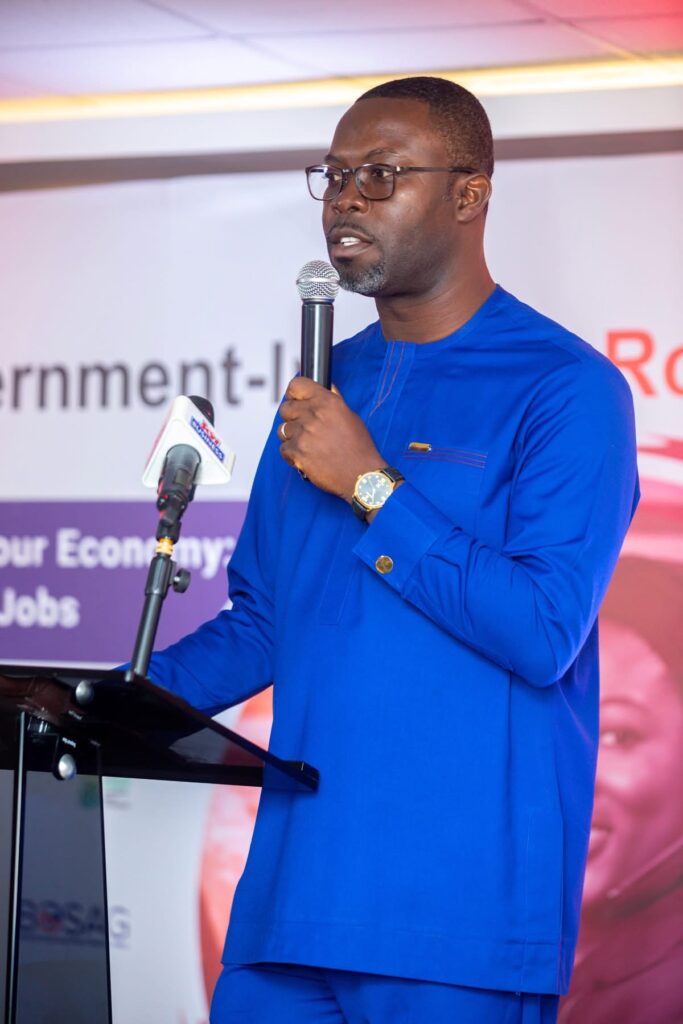
Reflecting on progress since the launch of the strategy, the BOSAG CEO said the sector has recorded significant growth, with over 20,000 young Ghanaians now employed across member companies operating in Accra, Kumasi, Takoradi and remote work locations.
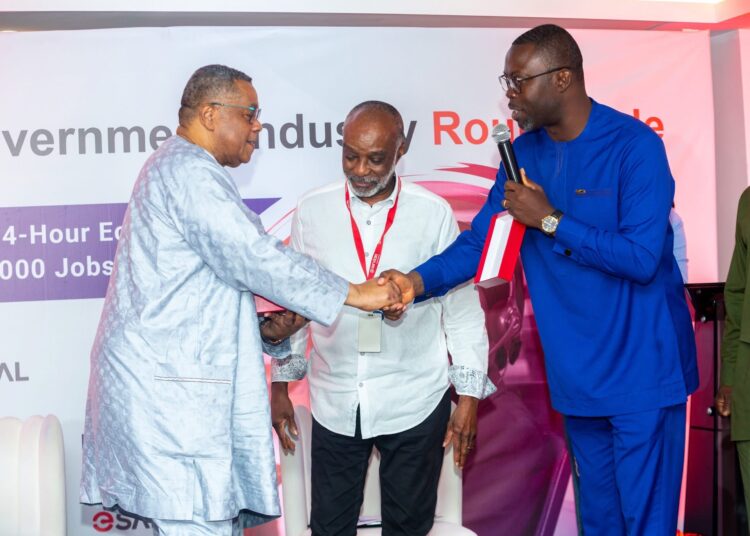
He cited stronger collaboration with government agencies, including the Ministry of Communication, Digital Technology and Innovations, the Ministry of Labour, Jobs and Employment, and more recently, the 24-Hour Economy Secretariat at the Presidency, as a major boost.
He disclosed that the 24-Hour Economy Authority has formally endorsed BOSAG’s vision, recognizing outsourcing as a natural fit for the government’s 24-hour economy policy because global outsourcing work runs round-the-clock across time zones.
“The endorsement by the 24-Hour Economy Authority is a game-changer. It validates what we have been saying – that Ghana can work while the rest of the world sleeps, and earn foreign exchange doing so. A customer service agent in Accra can serve a client in the US overnight and that is a 24-hour economy job.”
Mr. Gowu
The Association is also working with development partners including GIZ, the World Bank and the International Labour Organization to fund work-readiness training, digital skills certification and establishment of outsourcing-ready workspaces.
Ghana’s Competitive Advantage Mr. Gowu outlined Ghana’s unique competitive advantages that position the country ahead of many regional peers in the race for outsourcing investments.
He listed political stability, Ghana’s status as the second most peaceful country in Africa, a large pool of English-speaking graduates with a neutral accent, strong fibre optic connectivity through multiple undersea cables, a rapidly maturing fintech and digital ecosystem, and a time zone that allows same-day service to both Europe and North America.
“Investors look for stability, language, connectivity and talent. Ghana has all four. What we need now is coordinated action to package and sell Ghana to the world as an outsourcing destination of choice.”
Mr. Gowu
He added that Ghana’s cost competitiveness is also attractive, with operating costs 30 to 40 percent lower than South Africa and significantly lower than Eastern Europe and the Philippines for comparable quality.
A Call for Coordinated Action
In the highlight video, which is now available on BOSAG’s website, Mr. Gowu called for coordinated national action to achieve the 100,000 jobs target. He urged government to provide targeted incentives including tax waivers on outsourcing equipment, dedicated outsourcing zones with reliable power and internet, and inclusion of BPO in the Ghana Investment Promotion Centre’s priority sectors.
He also appealed to the private sector and academia to align curricula with industry needs, particularly in communication, critical thinking, digital literacy and customer experience management.
For young people, his message was one of hope and preparation: “The jobs are coming, but they require readiness. We are working with our members to provide free and subsidized training, but the youth must also take initiative to upskill and become globally competitive.”
BOSAG, which serves as the umbrella body for over 45 outsourcing companies in Ghana, says its next phase will involve regional roadshows, an international investor summit, and the launch of a national outsourcing skills database to connect trained youth to employers.
If fully implemented, the Association projects that the outsourcing sector could contribute over $500 million annually in export revenue while providing sustainable career paths for tens of thousands of young Ghanaians who would otherwise remain underemployed.
READ ALSO:Ablakwa Unveils Economic Empowerment Plan for South Africa Returnees