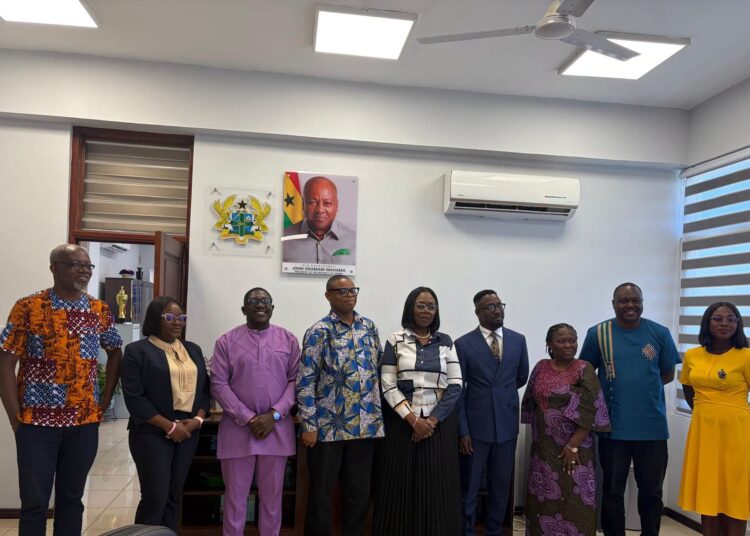
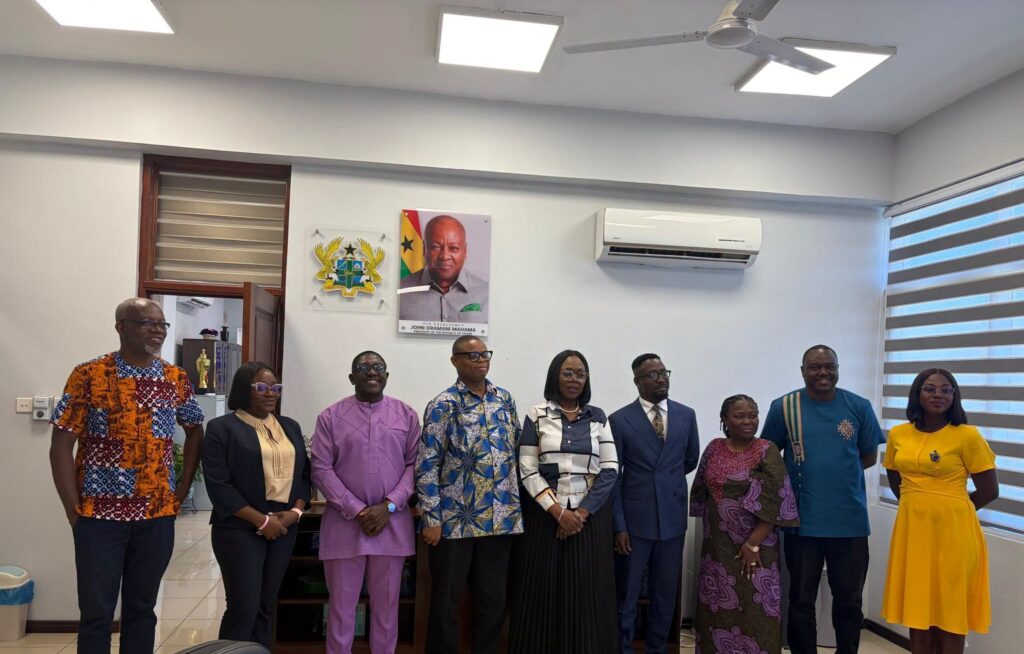
Policy think tank IMANI Africa met the leadership of the Ministry of Gender, Children and Social Protection in Accra on Wednesday as part of a structured series of high-level engagements with ministers of state and their technical teams.
The engagement produced a diagnosis of seven structural problems that, taken together, leave Ghana’s social protection system carrying a national mandate it lacks the resources to discharge.
The visit belongs to a wider IMANI programme built on the argument that standard public reporting rarely captures the nuance of governance, the friction of implementation, or the quiet structural reforms ministries undertake away from public view.
Each engagement therefore works through four questions: the baseline state of the ministry as inherited, the strategic vision now being implemented and how progress is measured, the operational hurdles the ministry is actively navigating, and the milestones recorded over the past year and a half.
A national mandate scattered across ministries
The first problem IMANI identified is mandate fragmentation. Responsibility for social protection sits not with one institution but across several ministries and local government structures, which leaves the sector ministry coordinating outcomes rather than delivering them.
That fragmentation feeds directly into the second problem, a gap between authority and accountability. MoGCSP answers nationally for results it does not fully control at the district level, where the assemblies and decentralised departments that execute welfare services report through a different chain of command.
When delivery falters in a district, the ministry absorbs the criticism without holding the levers that would fix it.
Frontline social welfare running on half a workforce
The engagement pointed to severe weakness at the point of contact with citizens. Social Welfare reportedly carries a staffing deficit of 51.3 per cent, alongside major operational shortages, meaning the officers expected to investigate abuse cases, place children, inspect facilities and follow up on vulnerable households are missing in roughly half the numbers the establishment requires.
Compounding this is a professionalisation deficit. District social work has suffered from the deployment of personnel who arrive without specialised social work training, so even where posts are filled, the technical capacity to handle complex protection casework does not always come with them.
A budget locked into two programmes
The budget picture may be the sharpest of the seven findings. LEAP and the Ghana School Feeding Programme absorb approximately 94.7 per cent of the ministry’s budget, which leaves the wider welfare machinery operating on the fraction that remains.
Both programmes are politically visible and socially important, but their dominance crowds out everything else the ministry is mandated to do.
The consequence shows up starkly in one figure. In the last budget, only GHS 1.7 million was allocated to domestic abuse matters for the entire country, a sum that must stretch across investigations, victim support, shelter referrals and public education in all sixteen regions.
Shelters, rehabilitation centres and the infrastructure gap
IMANI also flagged an infrastructure deficit running through the sector. Shelters, rehabilitation centres, disability services, elderly care facilities and other welfare institutions remain insufficient for demand, which limits what frontline officers can do even when they correctly identify a person at risk.
A social welfare officer who removes a child or a survivor of abuse from a dangerous household still needs somewhere to place them.
Measuring what the country finds hard to count
The final problem is measurement. Ghana counts kilometres of road, numbers of classrooms and hospital beds with relative ease, but protection, rehabilitation, dignity and human welfare resist that kind of arithmetic.
The ministry therefore needs a different performance architecture, one capable of registering outcomes that do not present as physical infrastructure.
IMANI distilled the meeting into a single conclusion. “The Ministry has national responsibility for human vulnerability, but neither the money, authority, frontline personnel nor institutional architecture presently matches the scale of that responsibility,” the brief states.

The think tank describes this as the foundation for a deeper policy diagnosis still to come, with further findings to be published. Founding President and Chief Executive Franklin Cudjoe led the IMANI delegation, joined by Vice President Selorm Branttie, Senior Research Associate Dennis Asare and writer and associate Kay Codjoe.
Chief Director Dr. Marian W. A. Kpakpah led the ministry’s technical team on behalf of Dr. Agnes Naa Momo Lartey. Cudjoe and Codjoe compiled the resulting brief, which now sets the terms for how the sector’s constraints are likely to be debated in the months ahead.
READ ALSO: US Strikes Five Iranian Oil Tankers