The Democratic Republic of Congo (DRC) has detected an Ebola case in its northwestern Sud-Ubangi province, far from the epicentre of the country’s ongoing outbreak, raising concerns over the potential spread of the deadly disease across provinces and neighbouring countries.
The case concerns a man who travelled from South Kivu in eastern Congo to Gwaka, a town in Sud-Ubangi, via Rwanda and Uganda before arriving in the province. His infection with the Bundibugyo strain of Ebola was confirmed by laboratory testing carried out by Congo’s National Institute for Biomedical Research (INRB).
Following the test results, Jean-Rene Galekwa Vundawe, the Acting Governor of Sud-Ubangi, announced that Ebola is present in the province. Local authorities have taken steps to improve surveillance and response protocols.
Sud-Ubangi does not border any of the six provinces that were previously impacted by the pandemic, which makes the development noteworthy. These provinces include Haut-Uele, Tshopo, Ituri, North Kivu, South Kivu, and Bas-Uele.
Authorities are particularly concerned about the number of people who may have been exposed to the virus during the patient’s journey.
The man travelled a long distance from eastern Congo to the northwest, passing through Rwanda and Uganda before arriving in Sud-Ubangi. His means of transport could have brought him into contact with people across several locations, making the identification and monitoring of contacts more difficult.
Former Congolese Health Minister and lawmaker Jean-Jacques Mbungani has warned that the patient’s movements could have created a significant number of contacts requiring investigation.
The case therefore presents a new challenge for health authorities already managing an outbreak that has spread rapidly across eastern Congo.
While the confirmation of the virus in Sud-Ubangi establishes the presence of Ebola in the province, authorities must determine whether further transmission has occurred locally and identify the source and epidemiological links surrounding the case.
The World Health Organization has previously highlighted population movement as a major challenge in controlling the current outbreak. The epidemic has developed amid insecurity, displacement and substantial movement of people across affected areas, making surveillance and contact tracing more difficult.
Meanwhile, the emergence of Ebola in Sud-Ubangi comes as Congo continues to battle its largest Ebola outbreak on record.
The outbreak declared in May after the detection of the Bundibugyo virus, a relatively rare Ebola species. The World Health Organization subsequently declared the outbreak a public health emergency of international concern, citing its rapid expansion and the risk it posed beyond the affected areas.
According to government figures cited in a current report, Congo has recorded more than 6,942 cases and 3,349 deaths. The outbreak has now become the second-largest Ebola outbreak ever recorded globally, behind the 2014–2016 West African epidemic, which killed more than 11,000 people.
The scale of the outbreak has expanded considerably since the first cases were reported in Ituri province.
According to recent reports, the outbreak has continued to spread in regions of Haut-Uele and North Kivu, but incidence have decreased in Ituri. Insecurity, relocation, and a lack of health workers have also hindered the response.
Ebola Response Faces Vaccine and Health-System Challenges
An already overburdened response mechanism is further strained by the Sud-Ubangi case.
The Bundibugyo virus, which is the cause of the current outbreak, has no known vaccine or specialised treatment. According to WHO, efforts are being made to improve clinical patient care and test potential vaccines.
In afflicted areas, however, authorities have started administering the Ervebo Ebola vaccine to frontline personnel. However, the vaccine’s usefulness in the response is limited because it was created to combat the Zaire variety of Ebola rather than the Bundibugyo virus that is causing the present outbreak. A vaccine that targets the Bundibugyo virus is also in clinical development.
WHO has warned that shortages of trained health workers, operational partners and funding are hampering efforts to contain the epidemic. The organisation has called for additional resources as the response expands to areas farther from the original epicentre.
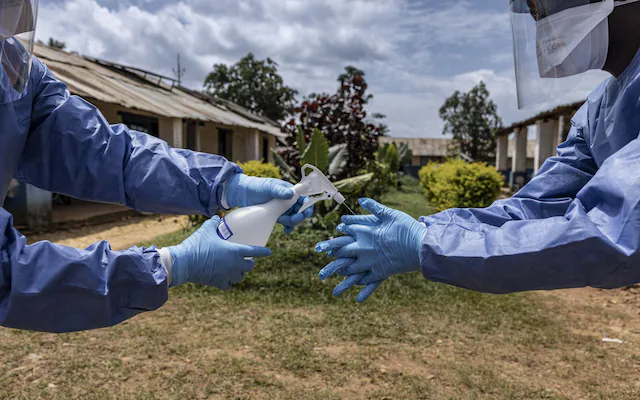
Sud-Ubangi’s immediate goal is to identify people who may have been exposed to the confirmed case, monitor them for symptoms, and prevent further spread.
Provincial officials have urged households to improve preventive measures and collaborate with medical professionals as surveillance and response efforts increase.
READ ALSO: IMF Flags Concentrated Fiscal Risks Across Ghana’s Largest SOEs