
Public Relations Officer of the Ghana Education Service (GES), Daniel Fenyi, has pushed back against what he described as an exaggerated narrative surrounding this year’s school placement exercise, insisting that challenges observed at only two of the country’s 17 resolution centres, Accra and Ashanti Region, do not amount to a nationwide placement crisis.
Speaking in an interview, Fenyi walked through the year-on-year trend in automatic placement figures, noting that this year recorded the highest number of automatic placements to date, significantly outstripping previous years.
According to him, 527,000 students were automatically placed this year, compared to 483,000 in 2025 and 447,000 in 2024, representing a substantial improvement in the system’s performance.
Beyond automatic placement figures, Fenyi highlighted a corresponding drop in self-placement numbers, noting that self-placement stood at 107,000 in 2025 but had fallen to 53,000 this year as of September 10, with registration still ongoing.
He described this near-halving of self-placement numbers as an exceptional improvement year-on-year.
“You halved it from last year to this year, which is quite exceptional,”
Daniel Fenyi
Combined Placement Rate Reaches 93-95%
According to Fenyi, when automatic placement and self-placement figures are combined, approximately 87 percent of students were captured through automatic placement, with the remaining 13 percent directed toward self-placement.

He noted that more than half of this remaining 13 percent, roughly 7 percent of the total, had already successfully completed self-placement as of the interview.
Taken together, Fenyi said this brings the overall placement rate to between 93 and 95% of students successfully placed. “You cannot, by any stretch of imagination, call such a 95% efficiency a crisis, it cannot happen,” he said, arguing that the scale of successful placement fundamentally undermines claims of systemic failure.
Fenyi further stressed that the core challenge facing the placement exercise is not a shortage of available spaces, noting that approximately 800,000 vacancies exist against a little over 600,000 students who sat for the BECE and wish to pursue secondary education.
He argued that this data confirms sufficient overall capacity within the system to accommodate all qualified candidates.
Resolution Centres Designed to Handle Exceptions
Addressing the purpose of the country’s 17 resolution centres, Fenyi explained that their existence reflects a built-in acknowledgment that human error, technical challenges and isolated cases would inevitably arise during a national exercise of this scale.

He noted that resolution centres operate in nearly every region, typically housed within regional education directorates, alongside a dedicated national centre in Accra.
He pointed out that over the two weeks since results were released, no reports of significant chaos had emerged from resolution centres in the Central, Western, Western North, Savannah, Ahafo or Volta regions, arguing that this regional consistency undermines the narrative of a nationwide crisis.
“Accra is not Ghana,” he said, cautioning against generalising challenges observed at overwhelmed centres in the capital and Ashanti Region as representative of the entire country’s placement process.
According to Fenyi, 15 of the 17 resolution centres nationwide are functioning efficiently, resolving cases quietly and smoothly, with only the Accra and Ashanti Region centres experiencing overwhelming numbers, a situation he attributed partly to their visibility and proximity to media coverage.
He argued that a system operating at 89 percent efficiency across its resolution centres, combined with a 93 to 95 percent overall placement rate, represents the best performance recorded in the past eight years, rather than evidence of a failing system.
Distinguishing Manageable Challenges From Systemic Failure
Fenyi maintained that every large-scale national exercise inevitably produces exceptions and individual cases requiring additional attention, arguing that the existence of such cases does not by itself indicate that the entire system has failed.
He said the responsible approach involves identifying and addressing these challenges directly, rather than amplifying isolated difficulties into a broader narrative of nationwide dysfunction.
“There is a fundamental difference between having a manageable number of unresolved cases and having a national crisis, the data clearly points to the former,”
Daniel Fenyi
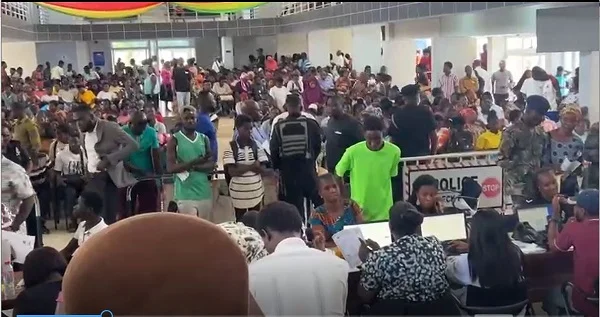
Concluding his remarks, Fenyi maintained that the outstanding cases still being processed at resolution centres would continue to be addressed, while insisting that isolated challenges at two centres should not be permitted to define the performance of the placement system as a whole.
He reiterated that GES remains committed to transparently sharing verified data with the public as the remaining cases are resolved in the days ahead.
READ MORE: Accra-Kumasi Expressway Design Leaves Space for Future Railway Line, Says Mahama