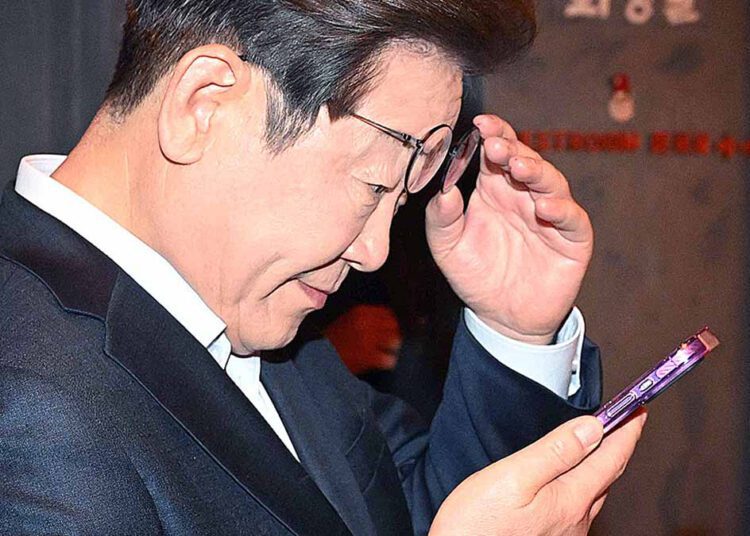
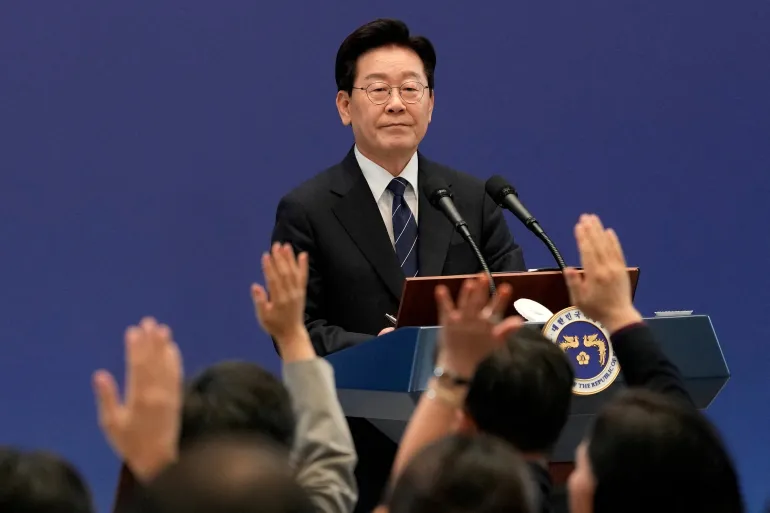
South Korean President, Lee Jae Myung has ruled out any deployment of South Korean troops to the Strait of Hormuz, making clear that Seoul will not become militarily involved in the ongoing Iran war.
Lee reiterated the position three times, stressing that South Korea would not send troops or undertake activities that could draw the country into the conflict.
“Let it be clear. There will be no dispatch of troops that will lead to involvement in a conflict. There will be no engagement or involvement in war.”
Lee Jae Myung
The statement comes amid growing domestic opposition to any potential deployment of South Korean military assets to the strategic waterway. Protests have broken out in recent weeks as concerns mounted that Seoul could become involved in the conflict through efforts to protect its commercial shipping interests.
Lee, however, indicated that South Korea would continue to take limited measures to protect its economic and maritime interests in the region. He stated that the government would “carry out the minimum necessary activities” to safeguard South Korean merchant vessels and oil shipping routes.
The Strait of Hormuz is a critical passage for global energy supplies, and disruptions in the waterway can have significant consequences for countries heavily dependent on imported oil. South Korea, as a major energy importer and trading nation, has a direct interest in keeping its commercial shipping routes secure.
Lee’s comments therefore draw a distinction between protecting South Korean vessels and becoming a participant in the wider military conflict. His administration has faced pressure to ensure the safety of South Korean nationals, ships and energy supplies while avoiding steps that could expand Seoul’s military involvement.
South Korea Says Trump Seeks Dialogue With Pyongyang
Lee also said that United States President Donald Trump wants to reopen dialogue with North Korea, although he acknowledged that the prospects for renewed talks remain uncertain. “Trump clearly wants dialogue with North Korea,” Lee said, adding that while such talks were uncertain, they were not impossible.
According to Lee, South Korea was continuing “preliminary coordination efforts” aimed at creating conditions for dialogue between Washington and Pyongyang. He also suggested that a resumption of US-North Korea talks could come before meaningful progress in relations between the two Koreas.
He asserted that the resumption of North Korea-US dialogue “would be far easier than resuming inter-Korean dialogue.”
Trump has previously expressed an interest in reviving the relationship he says he established with North Korean leader Kim Jong Un during his first term in office. The US President has said that he plans to meet Kim later this year and has stressed the importance of maintaining a relationship with the North Korean leader.

Trump also said it was important to “get along” with Kim, while referring to North Korea’s growing nuclear capabilities. He said that Pyongyang now possessed 57 “very powerful” nuclear weapons.
South Korea, moreover, has assessed that North Korea possesses approximately 80 to 120 nuclear warheads, highlighting the continuing uncertainty surrounding the size of Pyongyang’s nuclear arsenal.
North Korea has not issued a clear response to Trump’s latest comments. Pyongyang has, in recent years, strengthened its strategic relationship with Russia, while its relations with Seoul have continued to deteriorate.
Relations between the two Koreas reached a period of heightened engagement in 2018, when diplomatic contacts and inter-Korean initiatives expanded. However, the broader diplomatic process lost momentum after negotiations between Kim and Trump broke down in February 2019.
The deterioration was followed by a series of developments that further strained relations between Seoul and Pyongyang. In 2020, North Korea destroyed the Inter-Korean Liaison Office, a facility established to support communication and improve relations between the two sides.
On Thursday, a Seoul court ordered North Korea to pay roughly $32.5 million in compensation for the destruction of the building. The ruling added another layer to already strained inter-Korean relations.
Amid these incidents, Lee’s government is seeking to balance security concerns on the Korean Peninsula with broader diplomatic and economic engagement across the region. South Korea is also working to deepen ties with other regional partners as it seeks to expand its diplomatic and economic relationships.
On Wednesday, Seoul hosted the first-ever presidential summit involving South Korea and the leaders of five Central Asian states. The meeting focused on strengthening economic cooperation and building deeper relations with the Central Asian countries, including states that maintain close relations with Russia.
The developments reflect a broader effort by South Korea to protect its national and economic interests while managing security challenges on multiple fronts. Lee’s decision to rule out military deployment to the Strait of Hormuz signals that South Korea intends to maintain a clear separation between safeguarding its commercial interests and direct participation in the Iran war.
READ ALSO: 24-Hour Economy Unveils Six Strategic Industrial Projects for Private Investors in Ghana