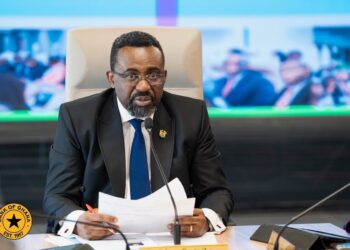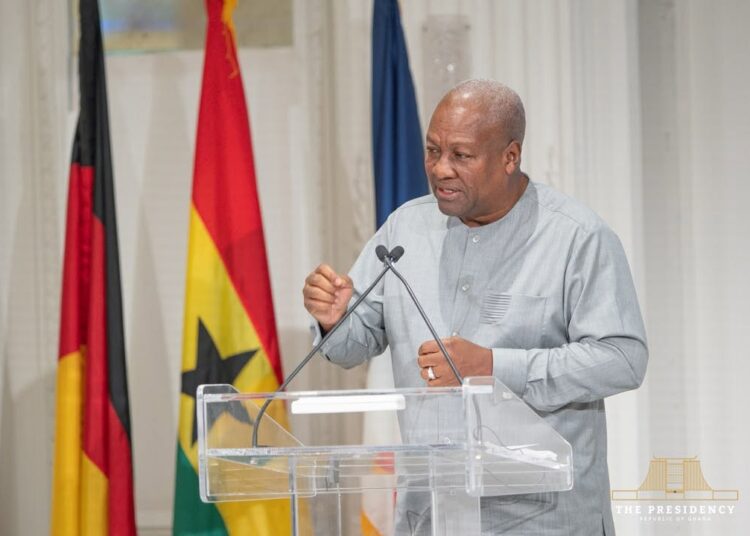
President John Dramani Mahama has credited fiscal discipline, corrective reforms and difficult policy choices for Ghana’s recent economic recovery, telling Ghanaians in New York that his administration had to restore an IMF-supported programme that had suffered major slippages before pursuing reforms beyond the Fund arrangement.
Speaking at a town hall meeting with the Ghanaian diaspora, President Mahama said the government inherited a programme that was “off track” and had to take austere measures before the next IMF mission.
The IMF’s fourth review later described programme performance as having “deteriorated markedly” at end-2024, citing pre-election fiscal slippages, inflation above programme targets and delays in structural reforms.
President Mahama said the corrective measures required sacrifice from citizens but argued that they helped return the programme to a stronger footing. He added that the government then chose to deepen fiscal discipline through domestic reforms, rather than treating the IMF programme as the only reason for tighter public financial management.
IMF Programme Returned to Track
The IMF’s fourth review of Ghana’s programme confirmed that the new administration adopted corrective measures after the 2024 slippages. These included a 2025 Budget aligned with programme objectives, tighter expenditure controls, public financial management reforms and measures aimed at preventing another accumulation of unapproved commitments.
President Mahama told the gathering that some of the decisions were difficult but had produced results. “I’m happy to say that those decisions paid off,” he said, pointing to the decline in public debt, lower inflation and a more stable currency as evidence of the turnaround.
Ghana subsequently completed the sixth and final review of the US$3 billion Extended Credit Facility in July 2026. The IMF said performance under the programme had become broadly satisfactory and that substantial gains had been achieved in macroeconomic stabilisation and debt sustainability.
Ghana has since moved into a non-financing Policy Coordination Instrument intended to anchor reforms beyond the ECF.
Fiscal Rules Extend Beyond the IMF
President Mahama said the government wanted fiscal discipline to continue after the lending programme rather than disappear with the final IMF disbursement. That position has been backed by changes to Ghana’s public financial management framework, including stronger commitment controls and a statutory debt anchor.
The amended fiscal framework sets a debt anchor of 45 percent of GDP by 2034. Recent fiscal spending controls have also focused on ensuring that ministries and agencies do not enter expenditure commitments without the required authorisation, a response to the large payables accumulated during 2024.
The government has also established an Independent Fiscal Council to monitor compliance with the new fiscal rules, adding an institutional layer to the discipline Mahama said should continue after the IMF programme. The council is expected to scrutinise fiscal decisions and support longer-term debt sustainability.
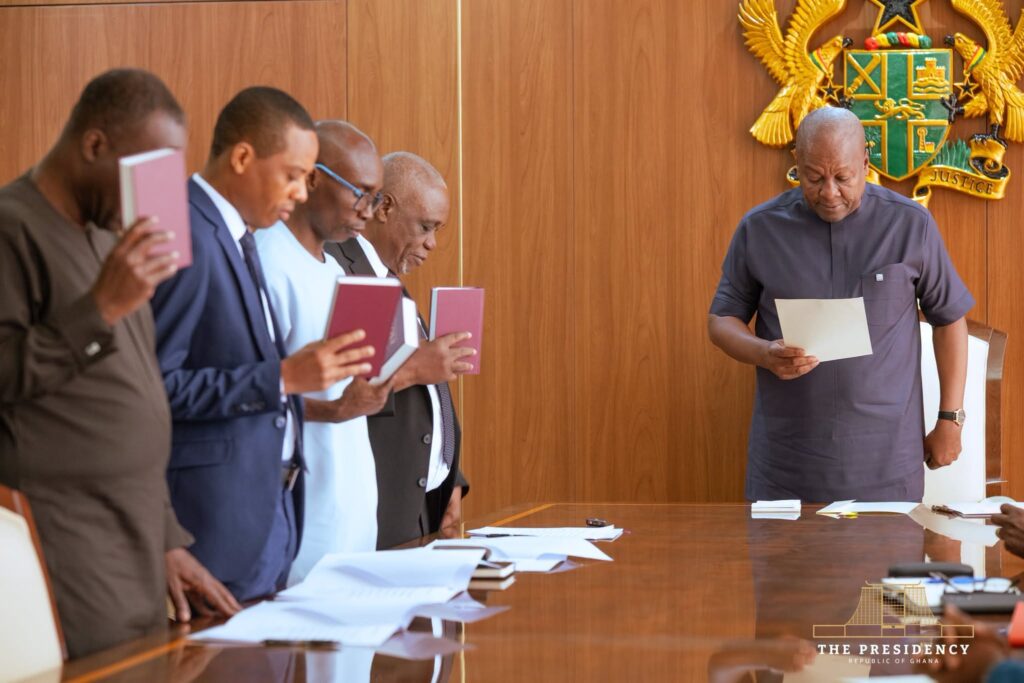
The President said the improvement in the debt position showed the effect of the reforms. Ministry of Finance data put public debt at 45.3 percent of GDP at end-2025, while the IMF’s programme definition placed gross public debt at 48.8 percent. The difference reflects measurement and coverage, but both series show a sharp reduction from 2024 levels.
Inflation Falls as Recovery Gains Hold
President Mahama also highlighted the steep decline in inflation. He told the audience that inflation had fallen from above 23 percent to about 5 percent by the end of 2025. Ghana Statistical Service data put year-on-year inflation at 23.8 percent in December 2024 and 5.4 percent in December 2025.
Inflation subsequently fell further before moving back to 5.0 percent in August 2026. The President has repeatedly presented the reduction in inflation as part of Ghana’s wider economic recovery, alongside improved fiscal balances, stronger reserves and the stabilisation of the cedi.
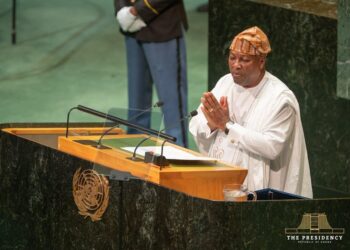
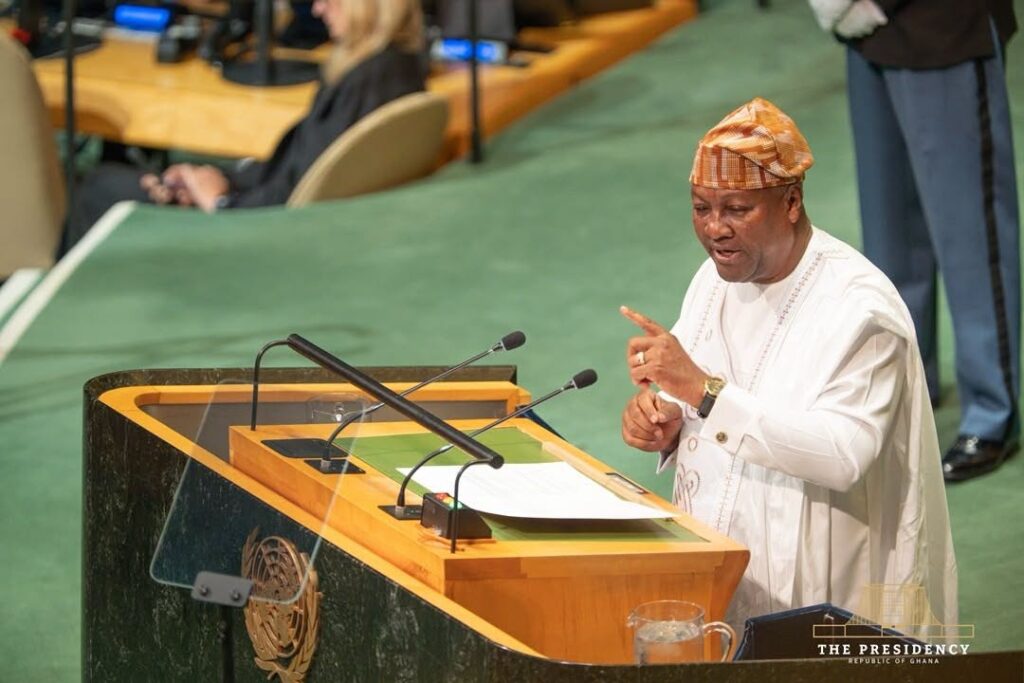
He has carried the same economic recovery message into his wider New York engagements, where he has linked macroeconomic stability to the government’s next phase of infrastructure, industrialisation and job creation.
Cedi Stability Supports Business Planning
On the currency, President Mahama said the cedi had recovered from periods when the dollar traded around GH¢17 and had strengthened to below GH¢10 before settling at a more moderate level. Bank of Ghana data show a weighted median interbank rate of GH¢11.6225 to US$1 on September 25.
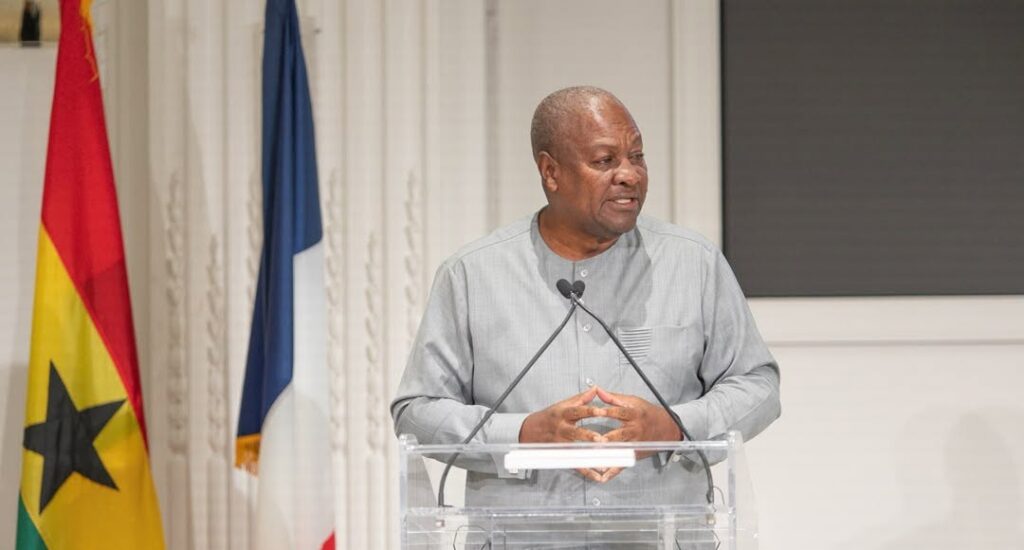
The President said exchange-rate stability was important for business planning because it improves predictability for importers and firms with foreign-currency obligations. He argued that the government did not want an excessively weak cedi, but also did not seek an exchange rate so strong that it created other distortions.
President Mahama said the objective was to preserve a manageable and predictable currency path while sustaining the fiscal discipline that helped stabilise the wider economy. His message to the diaspora was that the gains achieved under the IMF-supported adjustment should now be protected through domestic rules and policy choices rather than treated as temporary programme conditions.
READ ALSO: GCB MSME Caravan Clinic Hits Kumasi as Support for Ghanaian Small Businesses