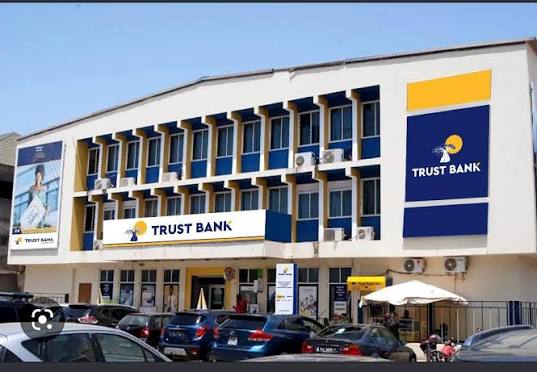
Trust Bank PLC has officially ended its presence on the Ghana Stock Exchange (GSE), completing a major step in its exit from Ghana’s capital market after shareholders tendered more than 3.5 million shares under an exit offer.
The delisting took effect on Friday, September 25, 2026, bringing an end to trading in the ordinary shares of the Gambian banking institution on the GSE.
The development follows an exit offer sponsored by Solo Dabo Company Limited, which gave qualifying shareholders the opportunity to tender their holdings at GH¢1.20 per share. The offer was contained in a tender-offer circular dated August 11, 2026, and closed on September 11.
Trust Bank subsequently confirmed that settlement had been completed for all qualifying shareholders who accepted the offer.
GH¢4.2m Shares Tendered Under Exit Offer
At the close of the offer, shareholders had tendered 3,510,021 shares, representing 47.89% of the 7,328,773 ordinary shares held on the Ghana share register.
“At the close of the Offer, Qualifying Shareholders tendered 3,510,021 shares, representing 47.89% of the 7,328,773 ordinary shares held on the Ghana share register,” the bank said.
Based on the GH¢1.20 offer price, the shares tendered were worth approximately GH¢4.21 million.
The transaction therefore provided a direct exit route for a sizeable portion of Trust Bank shareholders who chose to accept the offer and convert their holdings into cash.
Yet, the numbers also reveal another important side of the transaction.
A majority of the shares on the Ghana register were not tendered before the offer deadline.
3.82m Shares Remain Outside The Offer
Trust Bank disclosed that 3.82 million shares, representing 52.11% of the shares held on its Ghana register, were not tendered.
At the same GH¢1.20 offer price, those shares would have carried an implied value of approximately GH¢4.58 million.
Taken together, the entire 7.33 million shares registered in Ghana would have been valued at almost GH¢8.8 million at the offer price.
The fact that more than half of the shares were not tendered adds an interesting dimension to the delisting.
It does not, on its own, establish why those shareholders chose not to participate. Some investors may have preferred to retain their exposure to Trust Bank, while others may simply not have completed the tender process before the September 11 deadline.
The bank did not provide a detailed breakdown of the reasons behind the untendered shares.
What is certain is that these shareholders remain owners of their shares even though those shares will no longer trade on the Ghanaian exchange.
Trading Ends After September 25
Trust Bank has formally brought its GSE trading chapter to a close. “After 25 September 2026, TBPLC shares will no longer trade on the GSE,” the company said.
The delisting changes the trading environment for investors who continue to hold the bank’s shares. Ownership itself does not disappear, but the platform previously available to shareholders for buying and selling the security in Ghana is no longer available.
This distinction is particularly important for the 3.82 million shares that were not tendered.
Those shareholders now have to consider what happens to their holdings during and after the transition period.
Ghana Register Gets Three-Month Lifeline
Trust Bank has provided a three-month transitional period for shareholders whose holdings remain on the Ghana share register.
During that period, investors will have an opportunity to seek assistance regarding their holdings and determine how they wish to proceed.
At the end of the three-month window, outstanding holdings will be transferred to Trust Bank’s principal share register in The Gambia.
“The Ghana share register will remain open for a three-month transitional period, after which the holdings will be transferred to TBPLC’s principal share register in The Gambia.”
Trust Bank
Shareholders seeking to trade during the transition have been directed to contact Universal Merchant Bank PLC, the registrar, or Databank Brokerage Limited, the sponsoring broker.
The transition therefore becomes an important phase for investors who retained their shares.
Liquidity Becomes A Major Concern
The practical issue facing these shareholders extends beyond continued ownership.
An investor can retain an interest in a company while facing greater difficulty selling that interest, determining a readily observable market price or completing a transaction.
That concern becomes more significant once the shares move from the Ghana register to Trust Bank’s principal register in The Gambia.
Trust Bank did not state in its announcement what trading arrangements would be available after the transition. It also did not provide details on documentation, settlement procedures or potential transaction costs that Ghana-based shareholders could face once their holdings are transferred.
These details could influence how easily minority shareholders manage their investments in the future.
Another Security Leaves Ghana’s Market
Trust Bank’s departure also removes another security from the GSE, narrowing the pool of listed equities available to investors.
The exchange provides companies with access to capital and gives investors a structured platform through which securities can be traded. A delisting therefore changes not only the position of individual shareholders but also the composition of the market.
Trust Bank, however, did not provide specific reasons for pursuing the delisting in its September 25 announcement beyond the tender offer sponsored by Solo Dabo Company Limited and the related circular.
Maintaining a secondary listing can involve regulatory, administrative and reporting obligations. Companies with limited trading activity or a relatively small shareholder base may therefore reassess the value of maintaining a listing.
Trust Bank’s Ghana Chapter Closes
Established in 1997 after acquiring the assets and liabilities of the defunct Meridian Biao (Gambia) Bank, Trust Bank has grown into one of The Gambia’s major commercial banks.
The delisting from Ghana does not affect the bank’s operating status in The Gambia. Instead, it changes the market through which its shares can be traded.
Shareholders who accepted the offer will receive GH¢1.20 for each tendered share, bringing their participation in the Ghana exit process to a close.
Those who retained their holdings now face a different decision. They can explore their options during the three-month transition or allow their shares to be transferred to Trust Bank’s principal register in The Gambia.
The GSE exit may now be complete from the exchange’s perspective, but the story is not entirely over for the holders of the remaining 3.82 million shares. Their next step will determine how easily they can manage and potentially trade their investment after Trust Bank’s Ghana listing has come to an end.
READ ALSO: A Rocha Ghana Disputes Mahama’s Position On Galamsey Measures, Calls For Review