
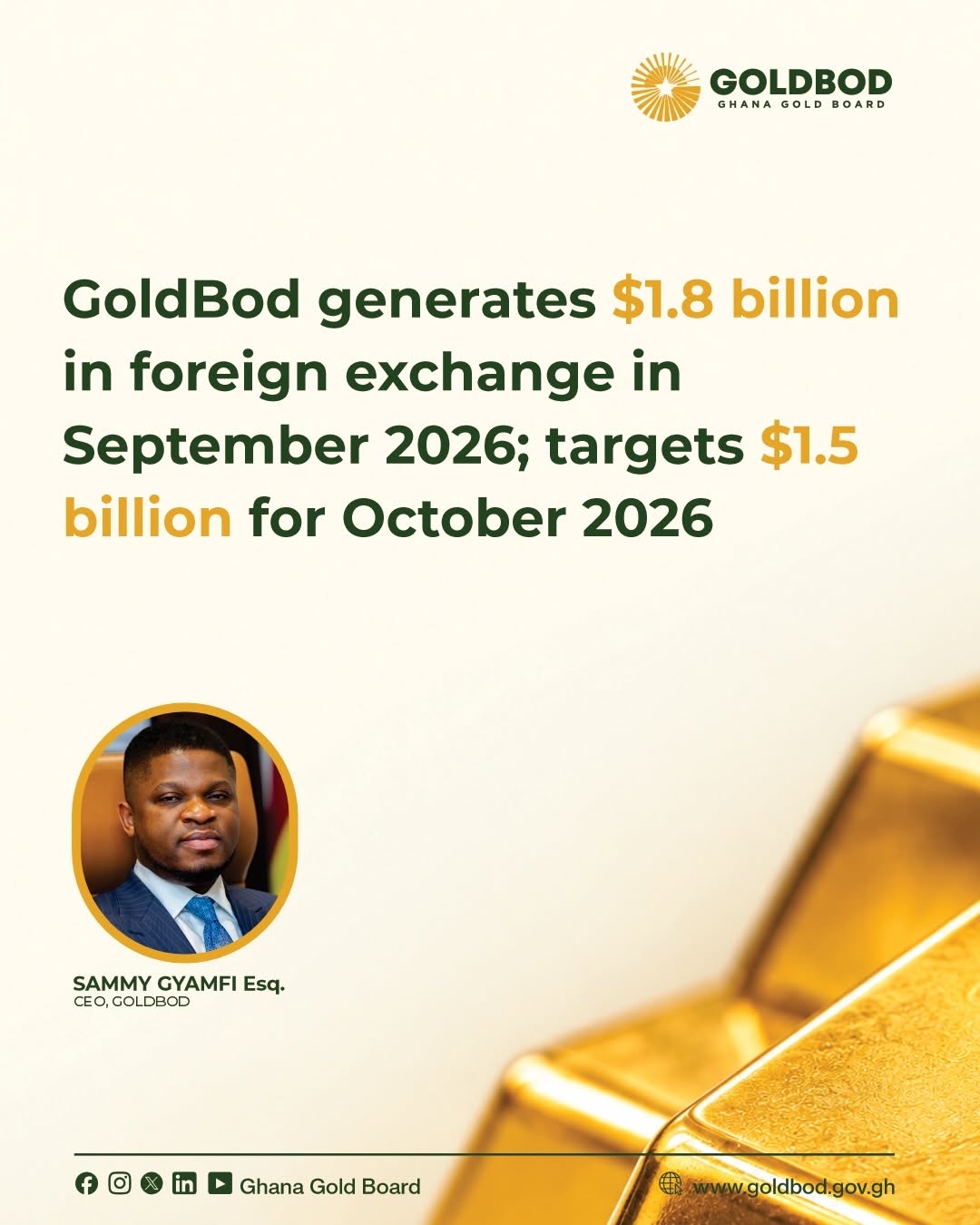
Ghana Gold Board generated US$1.871 billion in foreign exchange from its artisanal and small-scale mining gold operations in September, beating its US$1.4bn target by about 33.6 percent and reinforcing gold’s growing role in Ghana’s external-sector adjustment.
GoldBod sold US$701.3 million to authorised commercial banks against a US$700 million target to support foreign-exchange market stability, while US$1.170 billion was provided to the Bank of Ghana for reserve accumulation against a US$700 million target. The central-bank allocation therefore exceeded target by roughly 67 percent.
The September result also marks a sharp acceleration from August FX flows, when GoldBod generated US$1.315 billion under the new financing model. Total monthly foreign-exchange generation increased by about 42.3 percent, while the amount made available to the Bank of Ghana rose by roughly 81 percent. The numbers strengthen the link between Ghana’s gold trade, formal foreign-exchange liquidity and the rebuilding of external buffers.
FX Supply Shifts External Picture
The latest outturn changes the immediate external-sector picture after September began with concern about the pace of gold shipments and reserve accumulation. Earlier in the month, the Bank of Ghana had drawn attention to reserve pressure and temporary disruption to GoldBod exports, making the flow of gold-generated foreign exchange an important variable for the cedi and the country’s external position.

GoldBod’s September performance suggests that the supply channel has strengthened materially. The US$701.3 million directed to commercial banks provides foreign currency to the formal market, where importers and other legitimate users compete for dollars. Greater and more predictable supply can reduce pressure created by temporary demand imbalances, although it does not determine the exchange rate on its own.
Ghana’s currency still responds to import demand, external debt payments, capital flows, market expectations, commodity prices and global financial conditions. GoldBod can strengthen the supply side of the market, but lasting exchange-rate stability requires those wider external accounts to remain consistent with the available foreign-exchange envelope.
Reserve Allocation Deepens Buffer
The larger September allocation to the Bank of Ghana is particularly important because Ghana’s reserve position had softened from its mid-year level. The central bank reported September reserves of about US$12.0 billion, equivalent to 4.5 months of import cover, as at September 22. That compared with about US$12.9 billion and five months of import cover at end-June.

The US$1.170 billion provided by GoldBod should not be read as a one-for-one increase in the stock of gross reserves. Reserve levels also move with external payments, foreign-exchange interventions, debt service, valuation effects and other inflows and outflows. What the GoldBod figure establishes is the scale of an important inflow channel available to support reserve accumulation.
This distinction is central to interpreting Ghana’s recent external performance. Strong export earnings and a large trade surplus create foreign exchange for the economy, but they do not automatically become central-bank reserves. GoldBod’s model is economically significant because part of the gold-generated foreign exchange is deliberately channelled to the Bank of Ghana while another part is released to commercial banks.
October Split Changes Emphasis
GoldBod expects to generate another US$1.5 billion in October, but the planned distribution signals a change in emphasis. Of that amount, US$1 billion is expected to go to commercial banks to support foreign-exchange market stability, while up to US$500 million will be provided to the Bank of Ghana for reserve accumulation.
Compared with September’s actual allocations, the October plan would substantially increase the share going directly to commercial banks while reducing the amount earmarked for the central bank. That suggests a stronger near-term focus on market liquidity as Ghana enters the final quarter, when seasonal foreign-exchange demand can become more important.
The October transactions are also expected to operate under GoldBod’s newly developed Spot FX Sales/Intermediation Framework, which the institution says is intended to strengthen transparency, fairness and regulatory compliance. The framework will matter because the macroeconomic benefit depends not only on the volume of dollars generated but also on how efficiently and predictably they reach the market.
Gold Flows Face Bigger Test
September’s US$1.871 billion performance is therefore significant, but the stronger policy test is whether the mechanism can remain durable. Ghana has benefited from high gold receipts and stronger formalisation of artisanal and small-scale gold exports, yet external stability cannot rest indefinitely on one commodity or favourable international prices.
For now, GoldBod’s latest figures provide a stronger bridge between Ghana’s mineral exports and two immediate macroeconomic objectives: supplying foreign exchange to the domestic market and supporting the accumulation of international reserves. If that flow remains transparent, commercially sustainable and consistent with broader monetary policy, it can strengthen the economy’s capacity to absorb external shocks.
The September result consequently matters beyond GoldBod’s target. It shows how Ghana is attempting to convert a major export resource into usable foreign-exchange liquidity and reserve support. The next question is whether the October shift toward commercial-bank supply can reinforce cedi stability without slowing the rebuilding of the reserve buffer.
READ ALSO: GoldBod Announces $1.872bn from ASM Gold Operations in September