The Director of the Presidential Initiatives in Agriculture and Agribusiness (PIAA), Dr. Peter Boamah Otokunor, has commended Afaani Royal Enterprise for investing in large-scale rice production and supporting smallholder farmers under the government’s DOBIDI Initiative.
He said the company’s cultivation of more than 1,000 acres of rice at Wungu in the West Mamprusi area demonstrated the important role private agribusinesses could play in expanding domestic food production, creating market opportunities for farmers and reducing Ghana’s reliance on imported food.
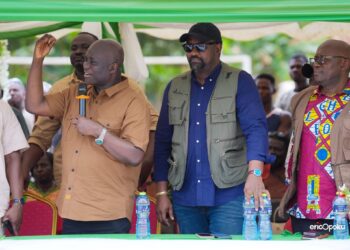
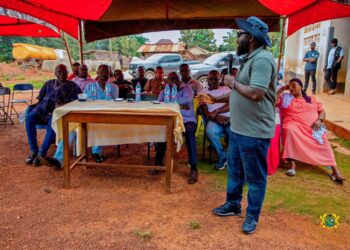
Dr. Otokunor made the remarks during a working visit to the company’s farming operations to assess the progress of rice production and implementation of the DOBIDI Initiative, an integrated outgrower programme aimed at addressing some of the major challenges confronting smallholder farmers.
The initiative provides participating farmers with support covering land preparation, production inputs, technical assistance, harvesting and market linkages, with the objective of reducing production risks and improving the profitability of farming.
Dr. Otokunor said the progress recorded at Afaani Royal Enterprise reflected the kind of private-sector participation required to accelerate Ghana’s agricultural transformation.
“We commend Afaani Royal Enterprise for the work they are doing. This is exactly the kind of partnership and investment we need to expand production, improve the incomes of farmers and strengthen Ghana’s agricultural sector.”
PIAA, Dr. Peter Boamah Otokunor
He noted that commercial agricultural investments, when properly linked with smallholder farmers, could create opportunities for farmers to increase production while ensuring that agribusinesses had reliable supplies of agricultural commodities.
According to him, the scale of rice cultivation at Wungu was particularly significant at a time when Ghana continued to face a gap between domestic rice production and consumption.
“We have a huge opportunity in rice production. The demand is there, the market is there, and what we need to do is to increase our production capacity.”
PIAA, Dr. Peter Boamah Otokunor
He explained that Ghana currently consumed approximately 1.4 million metric tonnes of rice annually, while domestic production stood at about 750,000 metric tonnes, leaving a substantial supply deficit.
“The figures clearly tell us that we cannot continue producing at the current level and expect to meet the demand of our people. We must increase production, support farmers with the right technology and inputs, and create a system where what is produced can be sold profitably.”
Director of PIAA, Dr. Peter Boamah Otokunor
The PIAA Director said the government’s approach under the DOBIDI Initiative was therefore focused on addressing constraints along the agricultural value chain rather than providing support at only the production stage.
He said farmers often faced difficulties with land preparation, access to quality inputs, technical knowledge, harvesting and marketing, adding that such challenges could undermine the profitability of farming even when farmers achieved good yields.
He mentioned that DOBIDI is about making farming a business and the initiative is to reduce the burden on the smallholder farmer and make sure that the farmer has the support needed from the beginning of production through to harvesting and marketing.
Dr. Otokunor said the initiative was designed to help farmers maximise their returns by reducing some of the costs associated with production and providing stronger linkages with agribusiness operators.
“Our objective is to maximise the profit margin of our farmers.When farmers have access to the right inputs, proper land preparation, technical support and harvesting services, they are in a much better position to make agriculture profitable.”
Director of PIAA, Dr. Peter Bomah Otokunor
He added that market access remained a critical component of the programme because farmers needed assurance that their produce would have buyers after investing time and resources into product.
He expressed that a farmer can produce, but if there is no market, the farmer will still suffer, PIAA is not only interested in production but also interested in what happens to the produce after it leaves the farm.
He disclosed that the current rice production cycle at Wungu was progressing towards harvest, with harvesting expected to begin in October.
He said arrangements were being made to ensure that the rice produced by the farmers and the enterprise would have access to markets when harvesting commenced.
“We are looking at the entire chain. Once the rice is ready, we want to make sure there is a market for it.”
Director of PIAA, Dr. Peter Boamah Otokunor
The PIAA Director also stressed the need for greater private-sector participation in Ghana’s agricultural sector, arguing that government alone could not provide all the investment and infrastructure required to transform agriculture.
He said companies such as Afaani Royal Enterprise could serve as important partners in building stronger agricultural value chains by combining commercial production with support for smallholder farmers.
“This is the partnership we need to see more of across the country. Government has a role to play, but the private sector must also come in with investment, technology, management and markets.”
PIAA, Dr. Peter Boamah Otokunor
Dr. Otokunor further linked increased domestic rice production to Ghana’s broader food security objectives. Ghana Must Be Food Secure,” he said.
He said expanding rice production would not only reduce the country’s dependence on imports but could also create employment and income opportunities for farmers, processors, transporters, input suppliers and other actors within the agricultural value chain.
The DOBIDI Initiative is being implemented as a government-led, private-sector-driven programme with emphasis on supporting smallholder farmers, improving access to production inputs and finance, strengthening technical services and establishing effective market and post-harvest linkages.
The initiative forms part of efforts to make agriculture more productive and commercially viable while encouraging stronger collaboration between government institutions, private agribusinesses and smallholder farmers.
The working visit to Wungu formed part of continued field-level engagements by PIAA to monitor the implementation of government’s agricultural initiatives, assess production progress and strengthen collaboration with private-sector partners.
Dr. Otokunor said such field engagements were important because they enabled government to identify challenges confronting farmers and agribusinesses and respond to them based on conditions on the ground.
He said the government remained committed to creating an enabling environment for farmers and agribusinesses to expand production, improve incomes and contribute to Ghana’s food security.
The developments at Wungu, he added, demonstrated the potential for integrated agricultural models to connect smallholder farmers to commercial production systems and markets, while strengthening Ghana’s capacity to produce more of the food consumed locally.
READ ALSO:Blood and Water Star , Ama Qamata to Debut on UK Stage