
Ghana’s push to substitute imported food with domestic production is showing programme-reported supply gains, but the economic payoff will depend on whether higher output translates into durable reductions in the import bill, stronger value chains and lower exposure to foreign exchange and global food-price shocks.
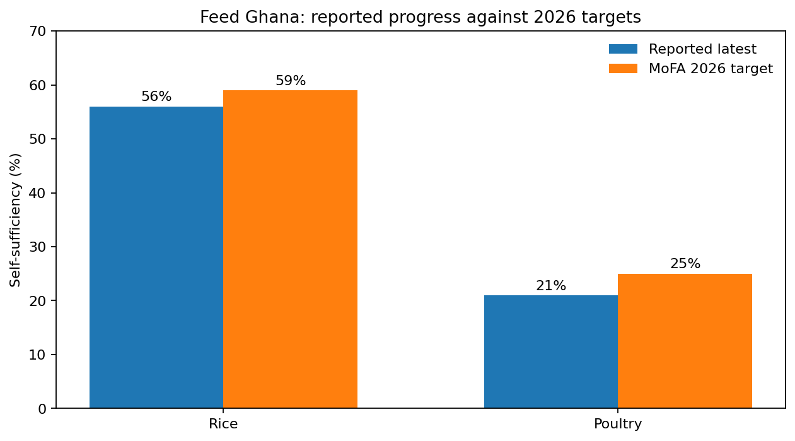
Feed Ghana National Coordinator Bright Kwadzo Demordzi says maize production has exceeded 100 percent of national consumption, while rice self-sufficiency has risen from 42 percent to 56 percent and poultry self-sufficiency from 5 percent to 21 percent over the past 17 months.
The programme was formally launched on 12 April 2025 as the flagship initiative of the government’s Agriculture for Economic Transformation Agenda. Its official Feed Ghana framework targets higher domestic output, lower import dependence, greater value addition and stronger agricultural exports.
The latest figures are programme-reported performance estimates rather than a new Ghana Statistical Service production series. MoFA’s published results framework lists 2024 self-sufficiency baselines of 29 percent for rice, 5 percent for poultry and 91 percent for maize, with 2026 targets of 59 percent, 25 percent and 119 percent respectively. That distinction matters when assessing the pace of progress.
Supply Gains Meet FX Test
For the broader economy, the central issue is import substitution. Ghana has historically spent substantial foreign exchange on rice, poultry, vegetable oils and other food products that can be produced locally. Raising domestic supply can reduce part of that demand for foreign currency, improve resilience to external price shocks and narrow the pass-through from exchange-rate movements to food costs.
That objective also sits behind Ghana’s rice quota policy, which links import access to domestic production commitments. The policy logic is to create a predictable market for local producers while avoiding an abrupt supply shortage that could raise prices for households.
The maize result is particularly important because excess supply creates a different policy problem. Once production moves beyond immediate consumption needs, storage, processing, transport and market access become as important as farm output. Without those links, a supply gain can depress farm-gate prices and weaken incentives for the next planting season.
Budget Backs Domestic Output
The import-substitution drive is being supported by sizeable public spending. The 2025 Budget allocated GH¢1.5 billion to the broader Agriculture for Economic Transformation Agenda, of which Feed Ghana, the Ghana Grains Development Project, the Vegetable Development Project and Nkoko Nkitinkiti were key components.
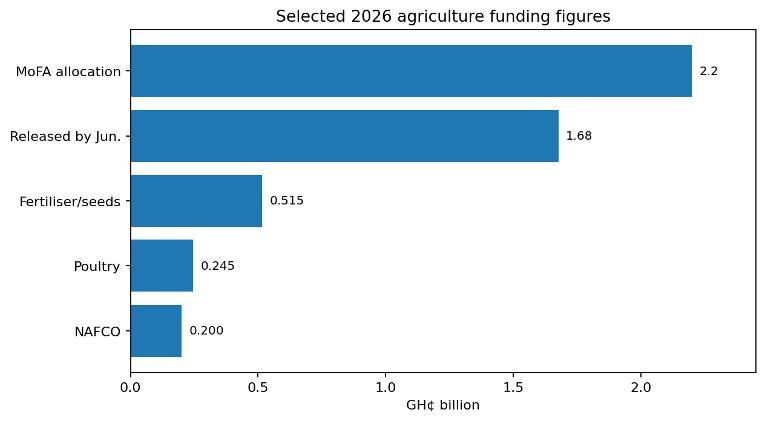
For 2026, government allocated GH¢2.2 billion to the Ministry of Food and Agriculture. On 4 June, the Ministry of Finance said GH¢1.677 billion, representing 85 percent of the ministry’s approved 2026 Goods and Services and CAPEX budget, had been released.
The amounts disclosed for key interventions included GH¢515.3 million for fertiliser and certified seeds, GH¢244.9 million for the Poultry Farm-to-Table Project and GH¢200 million through the National Food Buffer Stock Company.
Import Dependence Still Matters
The reported improvement does not mean Ghana has eliminated its food-import exposure. International partners continue to treat rice and poultry as major import-substitution value chains, while domestic demand is growing. Higher production can therefore coexist with substantial imports if consumption expands faster or if local processing, distribution and quality requirements remain constrained.
Poultry illustrates the scale of the challenge. President John Mahama said Ghana spent over US$350 million importing poultry products in 2023, a foreign-exchange burden also examined in poultry import report. Moving from 5 percent to a reported 21 percent self-sufficiency rate would be significant, but it would still leave a large domestic supply gap.

The inflation effect is also not automatic. More local food can help cushion prices, but energy, transport, storage losses and distribution costs still determine what households ultimately pay. Recent Vaultz analysis of the country’s food price buffers showed that softer staple prices can coexist with renewed cost pressure from fuel, transport and distribution.
That relationship is important for policymakers watching the food price buffer. Import substitution works best when productivity gains are accompanied by efficient domestic supply chains rather than simply replacing imported food with higher-cost local output.
Storage Becomes Next Constraint
Demordzi has acknowledged that the programme’s next phase must strengthen storage, transportation, processing and connections between farmers and buyers. Tomato farmers, for example, have faced off-take difficulties despite strong harvests. This suggests Ghana’s next agricultural constraint may increasingly shift from production itself to market absorption.
Economically, that shift is critical. A sustainable import-substitution strategy must preserve farmer incentives, lower unit production costs and create reliable demand from processors and consumers.
If those conditions hold, higher domestic output can reduce foreign-exchange demand and strengthen food security without creating persistent surpluses that cannot be marketed.
Feed Ghana’s latest figures therefore point to progress, but they also set a higher test for policy. The next measure of success will be whether the reported production gains show up in lower import volumes, stronger agro-processing, stable farm incomes and a more resilient food-price environment.
READ ALSO: Successful Poultry Models Hold Key to Ghana’s Future