The ECOWAS Bank for Investment and Development (EBID) has approved US$280 million in two Ghana-specific facilities, combining a major gold-development commitment with new financing for petroleum supply.
Together, the two approvals represent 71.8% of the bank’s latest US$390 million package and put two important external-sector channels, gold earnings and fuel imports, under the same development-finance decision.
EBID said at its 101st Ordinary Board Meeting in Lomé on 28 September it approved US$230 million for Azumah Resources Ghana Limited to develop the Black Volta Gold Project and US$50 million for MOSL Limited to support petroleum-product supply. The EBID announcement was issued on 30 September and covered four operations across West Africa.
The distinction is important for Ghana’s public-finance debate. EBID identifies the recipients as private companies, so the US$280 million should not be described as new sovereign borrowing by the Government of Ghana. Its macroeconomic significance instead runs through investment, productive capacity, exports, foreign-exchange flows and energy supply.
Gold Financing Targets Export Capacity
The US$230 million Black Volta facility is the larger of the two and follows an earlier US$47.4m facility approved by EBID for long-lead process equipment and early development work.

Azumah Resources describes the project in Ghana’s Upper West Region as construction-ready, but the economic gains still depend on construction, commissioning and commercial production.
The export channel is substantial. Ghana’s latest trade data show that gold bullion generated GH¢78.4 billion, or US$6.9 billion, in the second quarter of 2026 and accounted for 72.3% of merchandise exports. If Black Volta adds commercially viable production, it could expand future export receipts and foreign-exchange supply while creating potential channels for taxes, royalties, employment and domestic procurement.
Yet the same investment also highlights Ghana’s concentration risk. A larger gold base can strengthen the external account when production and world prices are favourable, but it can deepen exposure to a single commodity. The quality of the project’s macroeconomic contribution will therefore depend on production efficiency, domestic linkages and how much value and foreign exchange are retained within the economy.
At the domestic level, mine construction can raise demand for engineering, logistics and local services. But mining is capital-intensive, so the financing amount should not be treated as equivalent to employment or fiscal revenue. Those gains depend on local sourcing, wages, production volumes and taxable profitability once operations begin.
Fuel Facility Supports Supply
The second Ghana facility is US$50 million for MOSL, Maranatha Oil Services Limited, a wholly Ghanaian-owned bulk distribution company that imports and distributes refined petroleum products. EBID says the facility will support petroleum-product supply, giving it immediate relevance for transport, logistics, industry and household energy costs.
The financing, however, does not remove Ghana’s fuel import dependence. Petroleum imports require foreign currency, so higher international prices or cedi weakness can raise the import bill and transmit into transport and production costs. A supply facility can ease working-capital constraints and support availability, but the underlying foreign-exchange exposure remains.
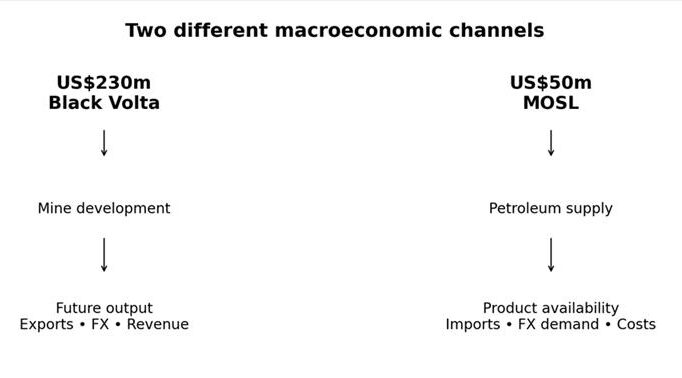
That creates the central macroeconomic contrast in the package. The gold facility is designed to build an asset that could generate future foreign-exchange earnings, while the petroleum facility finances continuity in an import-dependent supply chain that consumes foreign exchange. One strengthens potential dollar-earning capacity over time; the other helps meet a current dollar-intensive requirement.

Supply finance can therefore improve resilience without eliminating price exposure. If international petroleum prices rise or the cedi weakens, the foreign-currency working capital required to maintain the same import volume can still increase. The facility addresses the financing side of product availability; it does not by itself change the global-price and exchange-rate forces that shape Ghana’s fuel bill.
Regional Finance Meets Structural Needs
Ghana’s US$280 million country-specific approvals sit alongside US$100 million for Nigeria’s Kano-Maradi railway and US$10 million for the pilot phase of the West Africa Initiative for Climate-Smart Agriculture covering Ghana, Senegal and Togo. The regional agriculture facility is excluded from the US$280 million figure because EBID did not publish a country-by-country allocation.
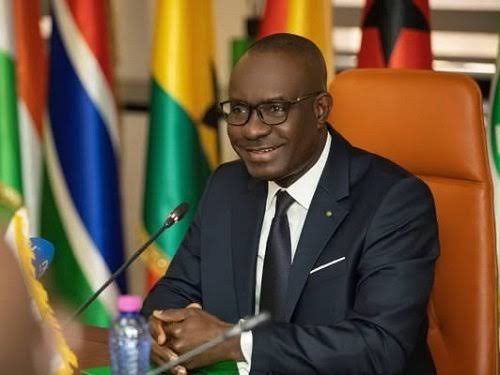
EBID President Dr George Agyekum Donkor said the approvals would “support productive activity, strengthen regional value chains, facilitate trade and create opportunities for private-sector participation and employment.” The bank links the package to its Growth, Resilience and Optimisation Strategy for 2026-2030.

For Ghana, approval is only the starting point. The Black Volta mine must translate financing into construction, production and export receipts before the larger foreign-exchange and fiscal effects materialise. MOSL’s facility can support near-term fuel availability, but it does not substitute for greater domestic refining efficiency or lower structural import dependence.
Taken together, the approvals capture both sides of Ghana’s external-sector challenge: expanding productive capacity that can earn foreign exchange while still financing essential imports that use it. The long-run value of the US$280 million package will therefore be determined less by the headline financing amount than by execution, output, domestic value creation and the durability of the foreign-exchange flows it ultimately produces.
READ ALSO: Ghana’s US$8.8bn Trade Surplus Meets a Reserve Paradox as Energy Payments Drain External Buffers