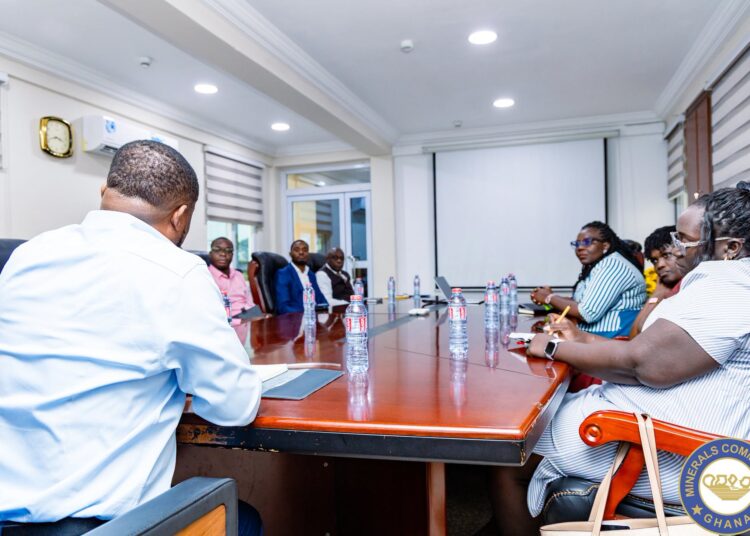
Mr. Isaac Tandoh, Chief Executive Officer of the Minerals Commission, has met with yet another batch of local contract miners to address critical operational concerns raised by the Mine Workers Union over the industry-wide transition from owner mining to contract mining.
The high-level regulatory dialogue forms part of an aggressive step to ensure that structural shifts within the extraction industry do not undermine local workforce stability, standard labor rights, or equity in compensation.
“We need to build a firm but workable baseline for remunerations. Workers cannot be made worse off in their conditions of service when employed by local contractors.”
Mr. Isaac Tando

Expanding on this engagement, Mr. Tandoh clarified that the Minerals Commission empathises with the Union’s firm position regarding unfair wage structures, emphasizing that the regulatory body remains unreservedly committed to ensuring the full participation and defense of Ghanaian workers within the national mining sector.
He urged the attending contract miners to immediately constitute a specialized team to develop a fair, transparent, and balanced framework favorable to contract workers. The Chief Executive Officer maintained that establishing a workable baseline for overall worker welfare is non-negotiable as market dynamics evolve.
Addressing financial discipline among operators, Mr. Tandoh issued a stern warning against price undercutting, cautioning contractors to price their services appropriately or face direct government intervention.
He cautioned that the government will not hesitate to take decisive punitive action to enforce workers’ welfare standards across all mining operations.
This warning follows severe complaints revealing that certain contractors have routinely failed to honor statutory and contractual obligations, including provident fund contributions, annual bonuses, and Social Security and National Insurance Trust (SSNIT) payments.
Shift from Owner to Contract Mining and Labor Risks
The institutional drive behind this intervention stems directly from the rapid systemic migration of major mining concessions in Ghana from traditional owner-operated models toward third-party contract mining.
While mine owners utilize contract mining to trim operational overheads, shift equipment capital costs, and maximize short-term profit margins, this commercial strategy frequently creates an unstable trickle-down effect for the workforce. Subcontracted labor entities, pressured by tight profit margins, regularly cut labor expenses to remain competitive during bidding cycles.

Consequently, mine workers suffer severe remuneration cuts, diminished health coverage, reduced job security, and the deliberate erosion of long-standing collective bargaining agreements previously negotiated under owner-mining arrangements.
Regulatory Imperative to Stop Price Undercutting
A central catalyst for the Commission’s decisive policy stance is the widespread prevalence of destructive price undercutting among local mining sub-contractors.
In desperate attempts to secure lucrative service contracts with multinational mining firms, local contractors submit artificially low bids that leave little financial headroom for operational compliance.

To cover their financial shortfalls, default contractors illegally divert employee provident funds, withhold performance bonuses, and delay mandatory statutory SSNIT remittances.
By directly intervening in contract pricing standards, the Minerals Commission aims to eliminate predatory bidding practices, ensuring that sub-contractors charge sustainable rates that fully budget for complete employee benefits and statutory obligations.
Safeguarding Local Content and Worker Dignity
The initiative further underscores the Minerals Commission’s broader mandate to align local content regulations with genuine socio-economic empowerment.
While national policy mandates increased local enterprise participation across the extractive value chain, local participation becomes counterproductive if indigenous companies achieve growth by exploiting Ghanaian citizens.

Through structured wage baselines, mandatory statutory compliance checks, and regulatory penalties, the Commission is establishing clear boundaries for commercial operations.
Protecting contract miners guarantees that the country’s mineral wealth translates into dignified employment, equitable compensation, robust social security protection, and long-term economic security for Ghanaian mining communities.
READ ALSO: Ghana’s Benchmark Lending Rate Falls Further to 10.04%