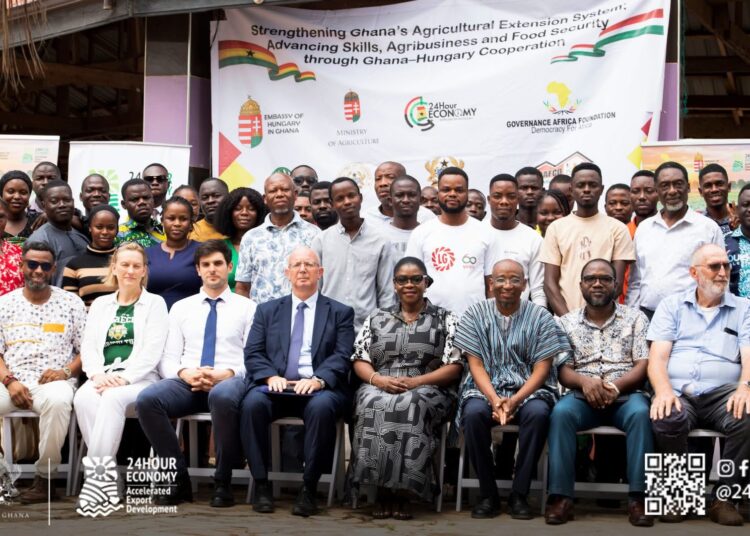
The Ghana-Hungary Agricultural Extension Capacity Building Programme, officially opened at Alexis Hotel near the Afienya Tollbooth, brings together 45 agricultural extension officers drawn from all 16 regions of Ghana for intensive training in modern agricultural technology and advisory services from October.
The programme is being supported by the Governance Africa Foundation (GAfF) and the Embassy of Hungary in Accra, with the 24-Hour Economy and Accelerated Export Development Secretariat participating in the initiative.
Dr. Al-Hassan Adam, Social Policy Advisor at the 24-Hour Economy and Accelerated Export Development Secretariat, who served as Special Guest of Honour at the opening, said the training presented an opportunity to reposition extension officers as critical actors in Ghana’s agricultural transformation.
The programme comes at a time when government is seeking to move agriculture beyond primary production towards integrated value chains involving irrigation, mechanisation, processing, logistics, finance and export markets.
At an earlier Ghana-Hungary Agricultural Cooperation Forum, Presidential Advisor on the 24-Hour Economy and Accelerated Export Development Secretariat, Augustus Goosie Tanoh, emphasised that extension services must evolve alongside the changing requirements of agriculture and agribusiness.
“The question cannot only be how much the farmer can produce. It must also be who will buy it, at what quality, at what price, how will it be processed and how much of that final value will remain with the farm.”
Presidential Advisor, 24-Hour Economy,Augustus Goosie Tanoh
The training therefore seeks to expose participating officers to modern approaches that can enable them to provide farmers with advice extending beyond production techniques to areas such as storage, processing, finance, standards, logistics and market requirements.
24-Hour Economy Strengthening Agricultural Extensions
For the 24-hour economy, strengthening extension services is particularly important because the programme is built around increasing production while ensuring that agricultural output feeds into processing and export-oriented businesses.
Dr Adam outlined several opportunities that extension professionals could help unlock, including the Volta Economic Corridor, where government envisages large-scale irrigation and agro ecological parks; the Palm Plantation Project in the Oti Region; and agricultural production systems designed to operate continuously and supply processors and export markets.
The Volta Economic Corridor is expected to form part of the government’s broader effort to connect productive regions with infrastructure, investment and markets. The 24-Hour Economy Secretariat has identified agriculture, value addition and human-capital development as important components of the transformation agenda.
Its leadership structure also places agricultural value chain development and the mobilisation of farmers into viable cooperatives among its areas of focus.
The Ghana-Hungary partnership builds on growing bilateral cooperation in agriculture and agribusiness.
In August 2026, Hungary’s Ministry of Agriculture and Food signed a cooperation agreement with GAfF aimed at strengthening agricultural development, knowledge transfer and agribusiness cooperation between the two countries.
Providing Agricultural Innovations and Machinery
Under that agreement, Hungarian agricultural experts are expected to provide specialised training in modern agricultural practices, technology transfer, farm management and agribusiness development.
The partnership also envisages stronger farmer organisations and cooperatives, improved market access and greater links between production, processing, value addition, investment and markets.
Hungary’s Ambassador to Ghana, Tamás Endre Fehér, has described the partnership as an avenue for sharing Hungary’s experience in crop production, livestock farming, water management, food processing, agricultural research and vocational education.
“Strengthening extension officers’ professional capacities will help transfer modern agricultural knowledge to farming communities and improve productivity, sustainability and resilience.”
Hungary Ambassador to Ghana,Tamás Endre Fehér
READ ALSO:World Bank Warns of Ghana’s $6.4bn Eurobond Maturities