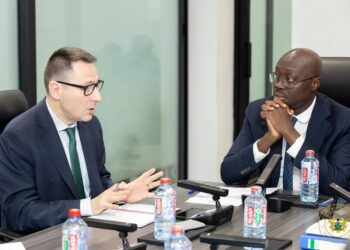
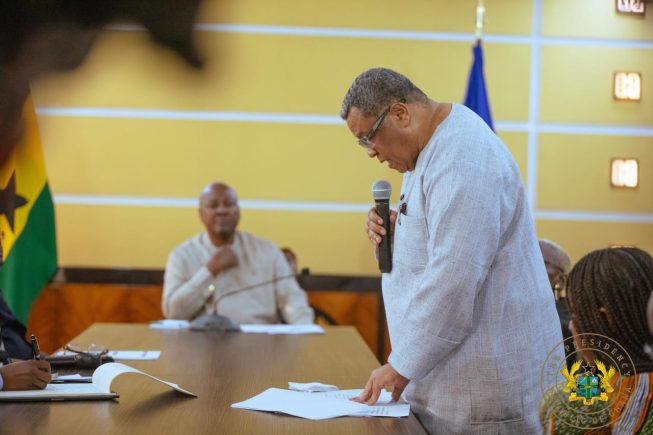
The 24-Hour Economy Secretariat has deepened efforts to operationalise its flagship programme following a high-level engagement with the Bank of Ghana.
The meeting focused on aligning the ambitious 24-hour economy policy with Ghana’s broader macroeconomic framework as the initiative transitions from policy design to implementation.
The engagement forms part of a series of consultations with key state and private institutions aimed at strengthening collaboration, securing institutional feedback, and building strategic partnerships. The central bank is among the latest institutions to be engaged in what officials describe as a critical phase of policy coordination.
Presidential Advisor on the 24-Hour Economy Programme, Goosie Tanoh, expressed appreciation to the Bank for the opportunity to engage its leadership and technical teams. He stressed that the country’s immediate priority remains the consolidation of macroeconomic stability as the foundation for sustainable growth.
According to him, the 24-hour economy initiative is not a departure from ongoing stabilisation efforts but a complementary strategy designed to translate macroeconomic gains into tangible enterprise-level outcomes.
Building on Macroeconomic Stability
Mr Tanoh commended the Bank of Ghana for providing stability that has created platforms for growth, expansion, and increased economic activity. He noted that recent economic indicators show promising signs of recovery and resilience. Sustained treasury bill performance and a decline in inflation were cited as evidence that Ghana’s economic fundamentals are strengthening.
The Secretariat believes that these improvements provide a conducive environment for scaling up production, boosting exports, and supporting job creation. The 24-hour economy concept seeks to maximise productivity by encouraging round-the-clock operations in strategic sectors such as manufacturing, agro-processing, logistics, and services.
Officials argue that while macroeconomic stability is essential, it must be matched with targeted micro-level interventions that unlock enterprise capacity. The alignment with the Bank of Ghana is therefore intended to ensure that regulatory and monetary policy frameworks support rather than constrain the programme’s objectives.
Food Security and Price Stabilisation Fund
A major highlight of the discussions was the proposed establishment of a Food Security and Price Stabilisation Fund. The Fund is expected to moderate commodity price volatility, reduce food inflation, and strengthen national food security.
Rising food prices have historically exerted pressure on inflation and household incomes. By introducing a structured mechanism to stabilise supply and pricing, policymakers aim to complement existing monetary policy tools with practical interventions that address structural bottlenecks in the food value chain.
The Secretariat indicated that the Fund would operate in collaboration with financial institutions and relevant stakeholders to ensure transparency, sustainability, and measurable impact. This initiative aligns with broader efforts to safeguard purchasing power while enhancing domestic agricultural output.
Financing Framework for 24-Hour Enterprises
Beyond macro stability and food security, the meeting explored detailed financing strategies to support businesses participating in the 24-hour economy. Among the proposals discussed was the development of a 24H+ credit policy and enterprise financing framework tailored to the needs of eligible firms.
The framework is expected to include coordinated appraisal processes for credit requests, syndicated and direct lending opportunities, and balance sheet support for enterprises that meet due diligence requirements. These measures are designed to reduce financing bottlenecks that often hinder expansion and productivity.

Recognition of credit insurance schemes was also highlighted as a way to strengthen collateral frameworks and de-risk lending. By improving risk-sharing mechanisms, financial institutions may be better positioned to extend credit to small and medium-sized enterprises operating under extended production schedules.
Regulatory considerations for 24-hour loan portfolios were discussed, ensuring that prudential guidelines remain intact while providing flexibility to support growth-oriented businesses.
Forex Support and Digital Access
Another critical area of engagement involved foreign exchange hedging instruments to support SME lending at reasonable rates. Exchange rate volatility has long posed challenges for import-dependent sectors and exporters alike. The introduction of hedging tools tailored to the 24-hour economy could provide predictability and enhance investor confidence.
The meeting also examined digital platforms to expand access to trade and finance. Leveraging digital infrastructure is expected to improve efficiency, streamline loan applications, enhance credit assessments, and promote financial inclusion.
Officials emphasised that integrating technology into the programme’s financing architecture would help reduce transaction costs and increase transparency. This approach is consistent with Ghana’s broader digital transformation agenda.
Strengthening Financial Infrastructure
The deliberations with the Bank of Ghana are expected to culminate in strategic regulatory policy initiatives aimed at strengthening Ghana’s financial services infrastructure. Policymakers believe that a coordinated framework between the Secretariat, commercial banks, and the central bank will create a stable ecosystem under which Ghanaian enterprises can thrive.
The 24-hour economy initiative represents a structural shift in how productivity and growth are conceptualised. By ensuring that financial regulations, credit policies, and risk management tools align with the programme’s goals, the Secretariat hopes to unlock new levels of domestic production and export competitiveness.
As the programme enters its operational phase, sustained collaboration with the central bank will be crucial. The alignment signals a recognition that transformative economic policies require strong institutional backing and policy coherence.
With macroeconomic indicators showing signs of improvement and strategic financing tools under consideration, stakeholders are optimistic that the 24-hour economy can evolve from policy ambition to measurable impact.
The engagement with the Bank of Ghana marks a significant step in ensuring that Ghana’s growth strategy is both stable and inclusive, providing the regulatory certainty and financial support needed to drive round-the-clock economic activity across key sectors.
READ ALSO: Fidelity Bank Ghana Ltd, IOM Seal Reintegration Deal