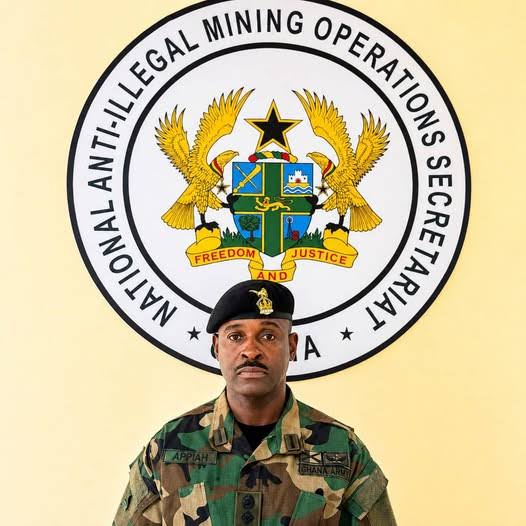
The Director of Operations for the National Anti-Illegal Mining Operations Secretariat (NAIMOS), Colonel K.S. Appiah, has announced plans for operations against illegal mining, promising decisive action against offenders in the coming days.
Speaking at the Progress Series, Col. Appiah revealed that the agency has secured the operational funding required to execute its planned activities, with deployments expected to intensify across affected areas as NAIMOS pursues its enforcement mandate.
“We have a number of operations planned from now till the end of the year, and you’ll see sustained operations in various areas starting from next week.”
Colonel K.S. Appiah

The director of Operations affirmed that the agency’s approach involves carefully sequencing operations to secure lasting results instead of dispersing personnel across numerous locations without maintaining pressure on illegal mining hotspots. He explained that operational planning considers the consequences of inaction, limited intervention and comprehensive enforcement.
Col. Appiah expressed confidence that NAIMOS is making progress in its fight against galamsey, asserting that the agency is working towards victory through deliberate deployments and sustained pressure on illegal mining activities.
Responding to questions about enforcement against influential individuals allegedly supporting illegal mining, he explained that arrests at active mining sites provide a basis for police investigations into the networks behind the operations. He noted that intelligence agencies, including the police, national security and the Bureau of National Intelligence, collaborate to identify those involved.
However, he cautioned that investigators require evidence admissible in court, a process that can take time. He indicated that ongoing intelligence work could yield further developments in the coming months.
The director also addressed concerns that enforcement efforts target low-level operators while influential figures escape scrutiny. He explained that NAIMOS focuses on its operational mandate while relying on partner institutions to investigate and pursue suspected financiers and other individuals linked to illegal mining.

Meanwhile, Col. Appiah indicated that the agency would increase media engagement through selected field operations and community visits, allowing journalists to observe its work while maintaining appropriate safety precautions.
He also affirmed that NAIMOS would continue working with relevant institutions to strengthen enforcement and consolidate progress. The agency’s strategy prioritises sustained interventions designed to prevent illegal miners from returning to areas already targeted by security operations.
NAIMOS Advances Green Shield And Community Mining Cooperation
The National Anti-Illegal Mining Operations Secretariat (NAIMOS) is strengthening cooperation with traditional leaders, community groups and the Blue Water Guards as part of efforts to combat illegal mining and protect forest reserves.
Discussing the planned Operation Green Shield and the agency’s community engagement strategy, Col. Appiah explained that sustained environmental protection requires coordination between security personnel, local leadership and institutions responsible for safeguarding natural resources.
“Operation Green Shield will commence. It will be a sustained operation where troops will remain in the forest reserve until all the illegal miners are cleared.”
Colonel K.S. Appiah
The director explained that the operation would use specially trained personnel, with subsequent monitoring arrangements to support the transition towards longer-term forest protection. He indicated that the Forestry Commission would eventually be expected to provide forest guards, allowing NAIMOS personnel to withdraw and serve as a quick reaction team when required.
In addition to forest protection, the agency is working with Blue Water Guards in the Western, Western North and Ashanti regions. Col. Appiah explained that some guards provide information and guide NAIMOS personnel to locations requiring intervention, although coordinating their contributions has posed challenges.
To improve cooperation, the agency is planning joint training to synchronise field activities and strengthen the exchange of intelligence.
Meanwhile, traditional leaders have become important partners in the campaign. Col. Appiah observed that chiefs have contacted the agency with information and requests for operations in their communities, reflecting growing local awareness of the effects of illegal mining on water supplies, agriculture and public health.
He also emphasised the responsibility of chiefs who control land, explaining that community engagement seeks to persuade traditional authorities to prevent land from being made available for illegal mining.
The director outlined a combined approach involving enforcement and non-enforcement measures, including dialogue with traditional leaders, miners and mining associations. He explained that engaging these groups was intended to encourage communities to recognise the damage caused by illegal mining and support efforts to prevent its continuation.
Col. Appiah further indicated that selected operations and community engagements would include media representatives, allowing journalists to observe the work being undertaken in affected areas while respecting operational and safety requirements.
READ ALSO: NAIMOS Vows To Deal Ruthlessly With Illegal Miners