
Ghana’s proposed US$28 billion Petroleum Hub expansion is facing renewed scrutiny over investor credibility, financing capacity and the government’s ability to convert ambitious infrastructure announcements into completed industrial projects.
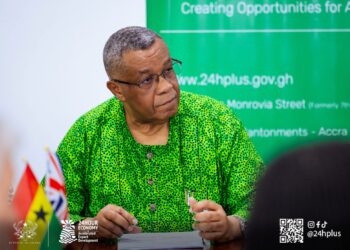
Bright Simons, honorary vice-president of the IMANI Centre for Policy and Education, has challenged the credibility of the consortium selected to develop Phase Two of the Petroleum Hub in Jomoro, Western Region, arguing that Ghana risks committing to another megaproject without sufficient evidence that the investors can deliver.
His intervention raises questions that extend beyond the latest agreement between the Petroleum Hub Development Corporation (PHDC) and a consortium led by Global Sphere: whether Ghana’s investment-screening process adequately tests the financial capacity, execution record and funding structures behind projects presented as transformative national assets.
The concerns are particularly significant because the new agreement comes while key implementation challenges associated with the wider petroleum hub initiative remain unresolved.
In his assessment, Simons warned that Ghana could continue attracting investors whose proposals promise enormous capital commitments but provide insufficient evidence of the capacity required to execute them.
“If Ghana keeps packaging unviable deals, it will keep attracting non-investors.”
The warning directly challenges the assumption that announcing a multibillion-dollar investment is, in itself, evidence of progress towards industrialisation.
$28bn Agreement Raises Questions Beyond Project Size
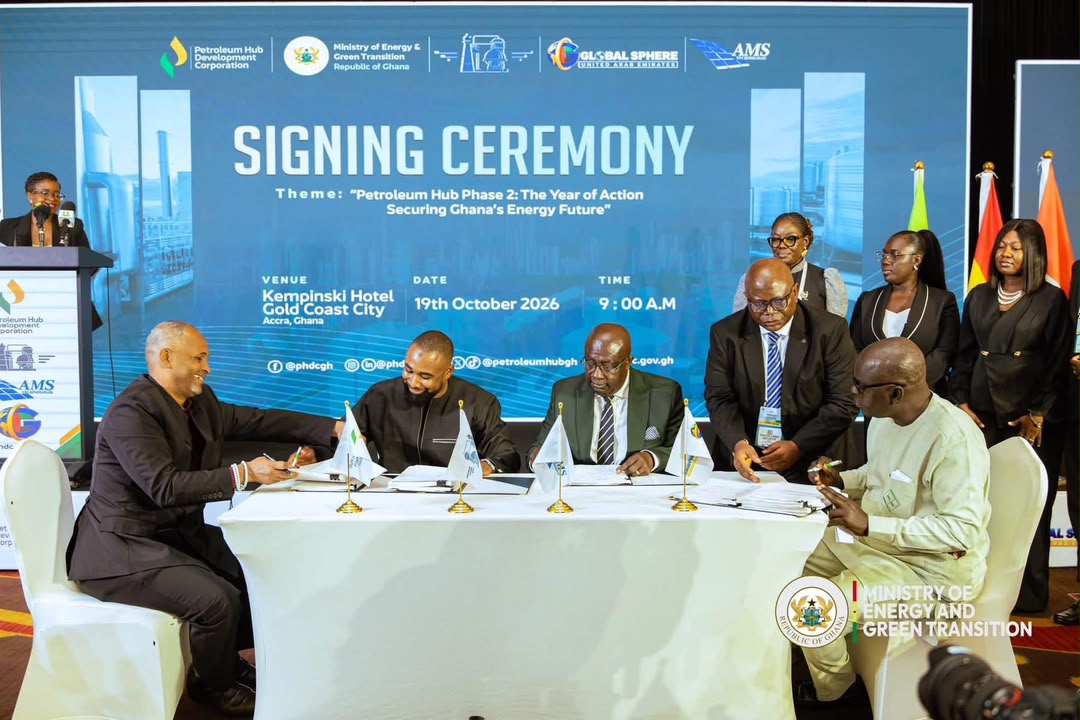
The PHDC signed an agreement with a Global Sphere-led consortium on October 19, 2026, for the second phase of the petroleum hub.
The proposed development includes a refinery with capacity of 300,000 barrels per stream day, two petrochemical plants, storage infrastructure with a combined capacity of four million cubic metres and a multi-berth jetty.
The five-year development is expected to strengthen Ghana’s refining and petrochemical capacity while positioning the country to serve petroleum markets across West Africa.
However, the scale of the proposed investment makes the consortium’s financing arrangements and delivery capabilities central to the project’s credibility.
Simons argues that Global Sphere’s previous megaproject announcements warrant closer examination. He cited the company’s proposed US$30 billion Hanoi Wall Street development in Vietnam and a planned US$300 million solar-panel manufacturing facility in Huế, alongside other large investment announcements that he says failed to translate into completed projects.
Vietnamese reporting provides some support for the concerns surrounding the earlier proposals. Reports on Hanoi Wall Street indicated that the project failed to advance after the investor could not demonstrate the required capacity, while reporting on the Huế solar-panel project said Global Sphere withdrew from the proposed development.
These precedents do not, by themselves, establish that the Ghana project will fail. They do, however, make the consortium’s ability to demonstrate committed capital, credible financing partners and an executable construction plan an important question for Ghanaian authorities.
The issue is not whether Ghana should pursue large-scale petroleum infrastructure, but whether the specific investors selected have demonstrated the capacity to deliver it.
Financing Remains the Critical Test
The financing question is especially important because the consortium’s representative, Boubacar Belco Bah, indicated at the signing ceremony that investment mobilisation and financial structuring were still being advanced.
The proposed financing approach includes strategic equity participation, long-term debt financing, credit enhancement and risk-mitigation arrangements. Bah also acknowledged that the signing did not represent completion of the financing process.

That distinction matters. An agreement establishing the scope of a project is not equivalent to financial close, when the necessary funding commitments and conditions are sufficiently secured to allow implementation to proceed.
Simons has separately raised concerns about Doubletree Capital Bank, which he identifies as the consortium’s financing partner. He questions its credentials as a banking institution and the experience of its principals in financing megaprojects.
Those claims require careful scrutiny by the relevant Ghanaian authorities. The existence of a company under a banking-related name is not proof that it is a licensed bank or that it can mobilise the capital required for a project of this scale.
Equally, questions about its status should be resolved through verifiable regulatory records and documentary evidence rather than assumptions based on its name or address.
For Ghana, the immediate requirement is evidence of the proposed financing structure, including the identity and capacity of capital providers, the proportion of equity committed, debt arrangements and any sovereign guarantees or other public-sector exposure being contemplated.
Without that clarity, the US$28 billion figure remains the stated value of the proposed development, not proof that US$28 billion is available for construction.
Land Compensation Still Clouds Implementation
The new financing questions also intersect with challenges already identified in The Vaultz News’ coverage of the petroleum hub.
Previous reporting by The Vaultz News examined outstanding land acquisition, compensation and financing issues affecting the project, including Energy and Green Transition Minister John Abdulai Jinapor’s pledge to coordinate discussions with the Ministries of Finance and Lands and Natural Resources, alongside the Attorney-General’s Office, to help resolve the bottlenecks.
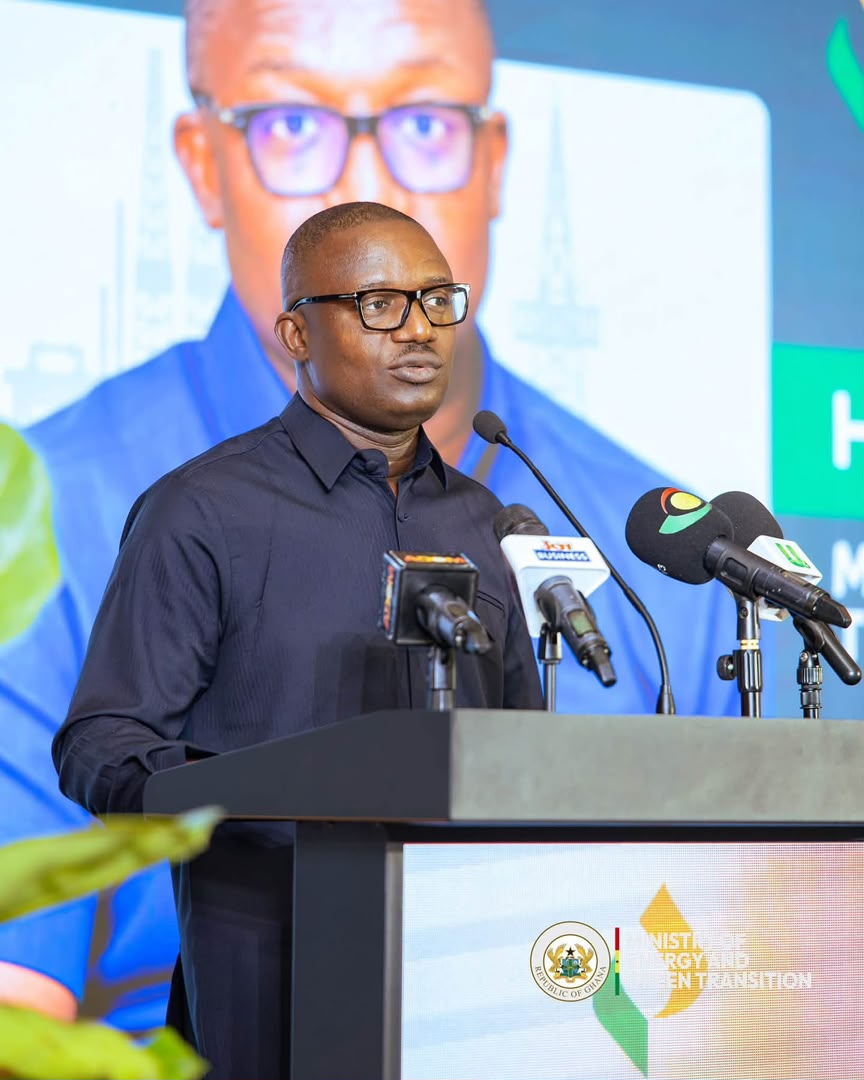
Those commitments highlighted the gap between announcing an investment and creating the conditions needed to begin construction.
Simons says the concerns of some Jomoro residents about possible land grabbing have persisted since the project’s launch in 2019. He further argues that the US$100 million reportedly required for land compensation had not been raised, despite the commencement of the first phase in 2024.
These are claims that require confirmation from PHDC and the relevant government agencies, particularly regarding the amount outstanding, compensation payments made and the status of land acquisition.
Nevertheless, the underlying policy question remains: how can a new phase advance credibly when land and financing issues associated with the wider project remain unresolved?
The planned commencement of site activities in the first quarter of 2027 will depend not only on the agreement signed with investors but also on the resolution of these practical requirements.
Investor Screening Must Go Beyond Announcements
Simons’ criticism places responsibility on more than the prospective investors. It also challenges the public institutions responsible for evaluating proposals, negotiating agreements and protecting the public interest.
The petroleum hub is intended to support domestic value addition, create employment and establish Ghana as a regional centre for refining, storage and petrochemicals.
Achieving those objectives requires more than ambitious capacity targets: it requires reliable capital, access to crude oil, commercially viable markets, infrastructure and transparent governance.
The planned 300,000-barrel-per-stream-day refinery, for example, would need dependable feedstock and a credible route to market for its output. Its commercial prospects would also be shaped by competition from established and expanding refining capacity elsewhere in West Africa.
These questions remain important even if the consortium ultimately proves capable of financing construction.

For the government, the appropriate response to investor interest is therefore rigorous due diligence, clear disclosure of financial commitments and enforceable milestones.
Authorities should be able to demonstrate what funding has been secured, what conditions must be met before construction begins, and what remedies apply if the consortium fails to perform.
The same scrutiny should apply to any arrangement involving sovereign guarantees, public land or other state-backed commitments, since poorly structured obligations can expose the public sector to risks even when private investors are presented as the principal funders.
From Megaproject Promises to Measurable Delivery
Ghana’s petroleum hub ambition is not inherently unviable. A well-financed and commercially sound development could expand domestic processing, support industrial activity and strengthen regional petroleum trade.
But the case for the project must be established through evidence rather than the scale of the headline investment figure.
Simons’ intervention puts the credibility of the proposed investors and the quality of the state’s screening process at the centre of the debate.
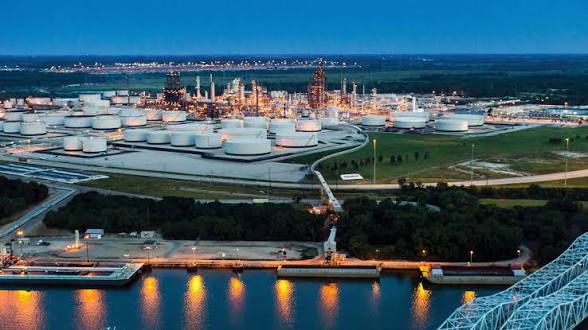
The outstanding questions are concrete: whether the consortium can demonstrate its financial capacity, whether the compensation and land issues can be resolved, and whether the proposed facilities can operate profitably in a competitive regional market.
Until those questions are answered, the US$28 billion agreement should be treated as a proposed investment with significant implementation tests ahead—not as US$28 billion already secured for Ghana’s industrial transformation.
READ ALSO: Healey Vows to Back British Businesses and Entrepreneurs