
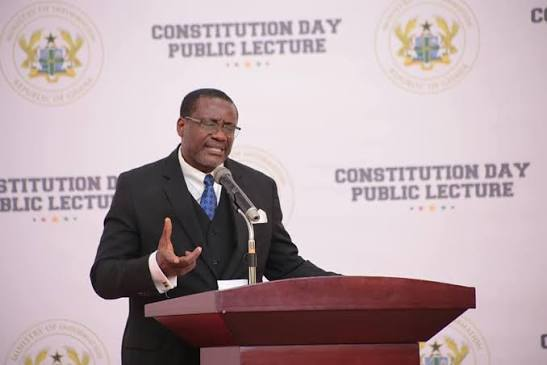
Professor Philip Bondzi-Simpson, Senior Member and Founding Dean of the Faculty of Law at the University of Cape Coast, has urged the Ghana Tertiary Education Commission (GTEC) to priorities its advisory, coordinating and guiding functions, warning that describing it as a regulator has encouraged it to exercise excessive control over universities.
He made the submission at the UTAG Experts’ Forum 2026, where he discussed regulatory authority and academic freedom in Ghana’s tertiary education sector.
Prof. Bondzi-Simpson argued that public discourse has distorted the Commission’s mandate and strengthened its authority in an unbalanced manner. He maintained that greater emphasis on the roles assigned to GTEC by law could redirect its attention to responsibilities he believes are not being adequately fulfilled.
“We refer to GTEC as a regulator, which is true, but only partially true. Because of the descriptions we routinely use, we have empowered it to act as a policeman, but the law describes it as an adviser,”
Professor Philip Bondzi-Simpson
Language and Discourse Shape GTEC’s Role
The legal scholar said the law also identifies GTEC as a coordinator and guide, adding that the language used to describe an institution can influence how it operates.

“If we refer to GTEC as an adviser and drive home that point, perhaps it will do more advising than regulating,”
He added that describing the Commission as a coordinator could encourage it to focus more on coordination, while its role as a guide should be recognised in matters relating to accreditation.
“Our own language and discourse have distorted its mandate and empowered it in an asymmetrical manner. Discourse matters,”
Professor Philip Bondzi-Simpson
“There is a lot more it can do,” he said, urging the Commission to concentrate on its statutory responsibilities, including regulation, rather than extending its activities into areas beyond its remit.
GTEC Should Not Sit on University Councils
Prof. Bondzi-Simpson also argued that GTEC should not have a place on university governing councils under the new legislation, warning that such an arrangement could create a conflict between oversight and decision-making.
He explained that university councils make decisions concerning the institutions they govern. If GTEC participates in those decisions and later acts in an oversight capacity, he said, it could find itself reviewing or undermining decisions in which it had been involved.

Using a sporting analogy, he said a regulator should not be involved in choosing the people or setting the policies it may later have to be assess.
“A referee or regulator cannot employ your staff or determine your policies. A referee cannot choose the coach, the players, the captain or the general captain and then come and referee the game,”.
Professor Philip Bondzi-Simpson
He maintained that both the letter and the spirit of the law did not support GTEC sitting on university councils.
Mandate Must Precede Authority
The professor further drew attention to the statutory responsibilities of the Director-General and the staff of the Commission. He described the Director-General as the organisation’s chief executive, responsible for its day-to-day administration and for implementing decisions taken by its governing body.
He argued that the Director-General’s actions must be grounded in the mandate established by law and in decisions properly made by the Commission’s governing body.
He said chief executive whose mandate is set out by law does not go hovering around all manner of tertiary institutions to see what they are doing right or wrong. Anything he does should be in furtherance of the mandate set for them
Prof. Bondzi-Simpson also stressed the importance of clear official correspondence, suggesting that letters should identify the date of the relevant Commission or board meeting, the matter discussed and the decision taken.
He warned that where the statutory mandate is not established before authority is exercised, actions by the Director-General, Deputy Director-General, directors or other staff acting on their behalf could be called into question.
Call for Regulations and Collaboration
Prof. Bondzi-Simpson said regulations were expected to follow the passage of the law to guide its effective implementation. He cited a provision requiring the Minister, on the advice of the Board, to make regulations by legislative instrument within 12 months after the Act came into force.
The provision, he noted, includes procedures for granting, varying or revoking accreditation for tertiary education institutions, among other matters. He concluded by calling for stronger cooperation among institutions across the tertiary education sector.
READ MORE: Galamsey Now a Health Safety Threat — Pratt