Ghana’s crude oil production has risen above 120,000 barrels per day, President John Dramani Mahama has announced, pointing to renewed investment commitments from existing operators as government seeks to reverse years of declining output in the upstream petroleum sector.
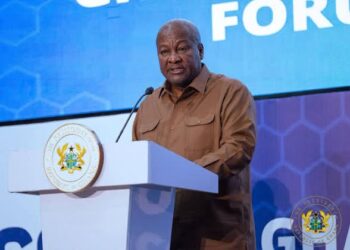
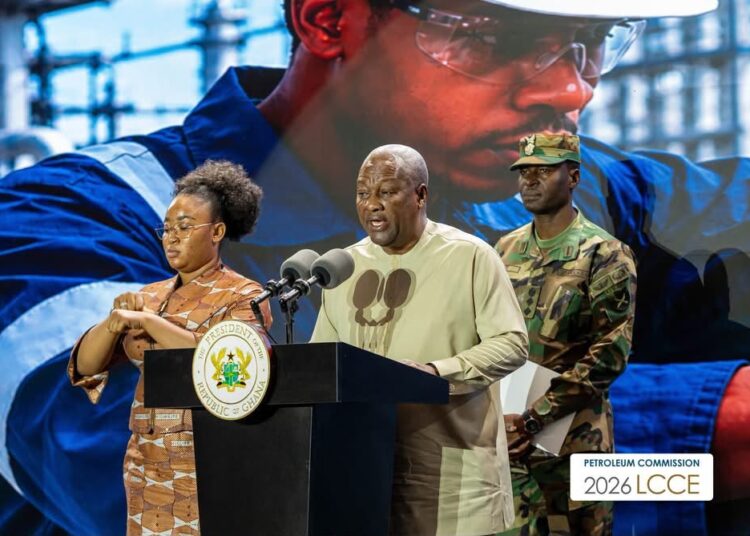
Speaking at the 2026 Local Content Conference and Exhibition in Takoradi on November 10, the President said production had recovered from approximately 88,000 barrels per day, following efforts by his administration to address outstanding disputes, rebuild investor confidence and encourage companies to reinvest in Ghana’s petroleum resources.
The announcement offers an important indication of the government’s efforts to restore activity in the sector, which had experienced a significant decline after production peaked at approximately 195,000 barrels per day in 2019.
Mahama attributed the earlier reduction to a combination of external pressures associated with the global transition towards cleaner energy and domestic weaknesses in governance and regulatory consistency.
He said the lack of new drilling and delays in signing petroleum agreements had contributed to falling production and revenues, while major investors had redirected capital to other jurisdictions.
The President said his administration had prioritised resolving upstream disputes and restoring confidence among operators.
“Crude oil production has risen to more than 120,000 barrels per day, and existing operators are committing capital to new projects.”
The announcement suggests that the government’s engagement with petroleum companies is beginning to produce renewed investment commitments.
However, sustaining the recovery will require more than a temporary improvement in production. Ghana must also replace the reserves it extracts and secure a consistent pipeline of new projects.
New Capital Returns To Existing Fields
Mahama disclosed that the Jubilee partners had committed US$2 billion to new investments, while partners in the offshore Cape Three Points area had committed US$1.5 billion.
Together, the commitments amount to US$3.5 billion and are expected to finance new wells, subsea infrastructure and the expansion of production facilities.
These investments are important because Ghana’s production decline has been linked partly to insufficient drilling and limited development activity.
New wells and infrastructure upgrades could help sustain output from existing fields and improve the country’s ability to recover available resources.
The President said the Jubilee investment was expected to sustain oil production while increasing gas output.
But the commitments should be distinguished from expenditure already completed. The actual effect on production will depend on the timing of the projects, their execution and the results of the additional wells.
For Ghana, the key issue is whether renewed investment can establish a more durable production profile rather than simply slow the decline of mature fields.
The Investment Recovery Must Address Reserve Replacement
The President acknowledged the need to replace the reserves being produced and outlined efforts to open additional exploration areas, including the ultra-deep waters of the Accra-Keta Basin.
Government is also engaging companies including ENI, Vitol, Shell, Chevron and Petrobras over prospective acreage in Ghana’s western and eastern sedimentary basins.
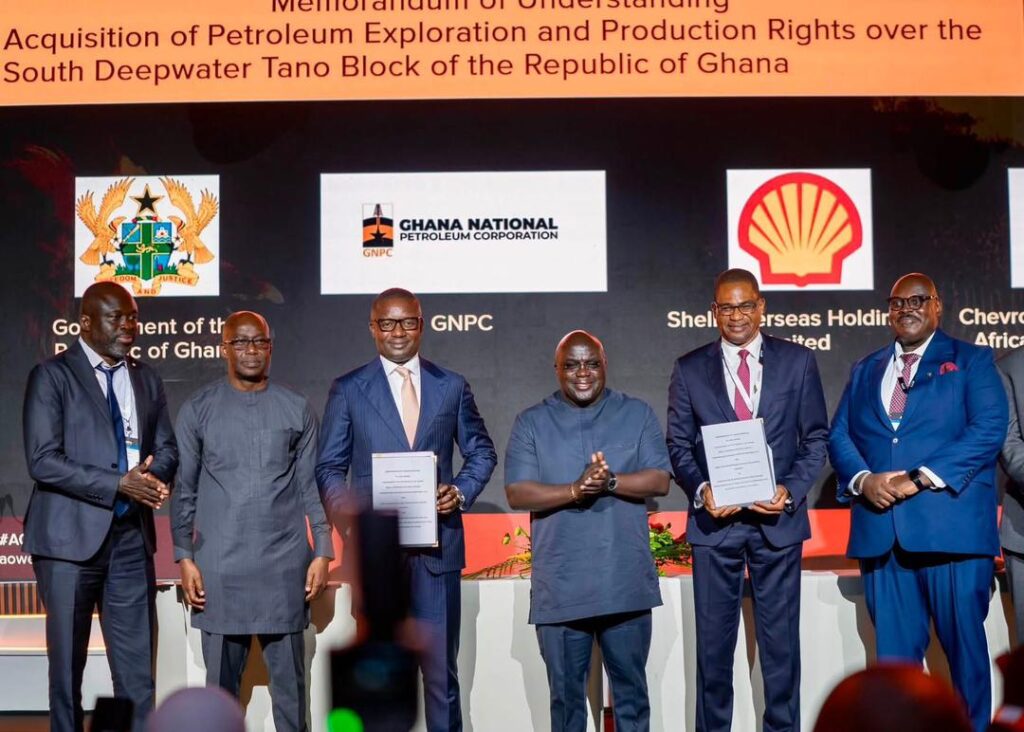
Mahama said three memoranda of understanding had been signed on key terms for three blocks, while discussions on petroleum agreements for other areas were continuing.
These engagements are intended to create new exploration opportunities and reduce the risk of relying too heavily on existing producing fields.
Reserve replacement is particularly important because production from an established field cannot be assumed to remain constant indefinitely.
Without successful exploration and development, a country may continue extracting petroleum while its future production capacity weakens.
The President’s announcement of new acreage discussions therefore forms an important part of the recovery strategy.
However, memoranda of understanding and ongoing negotiations are not equivalent to discoveries or approved development projects.
Their value will depend on whether they result in exploration commitments, drilling and commercially viable resources.
Regulatory Reform And Investor Confidence
Mahama also linked the decline in Ghana’s petroleum activity to governance and regulatory concerns, arguing that the country had lost investor interest as major companies redirected capital elsewhere.
He said the administration had worked to resolve outstanding upstream disputes and restore confidence among industry partners.
The President also disclosed that amendments to the Petroleum Exploration and Production Act, 2016 (Act 919), had been signed by the Ministers of Energy and Finance and submitted to Cabinet.
The proposed changes are intended to provide better incentives for investment.
That reform agenda is significant because petroleum exploration involves considerable financial risk.
Companies assess not only the geological prospects of a country but also the predictability of its legal framework, fiscal terms and dispute-resolution arrangements.
Mahama emphasised the importance of balancing investor confidence with the public interest.
“Both duties are important. Companies need clear, predictable rules and Ghanaians need confidence that those rules will be applied fairly and in the public interest.”
The principle is important for Ghana’s next phase of upstream development. Attracting capital cannot be the only objective; the country must also ensure that agreements deliver fair public returns, employment and opportunities for domestic businesses.
The Pecan Field And Outstanding Disputes
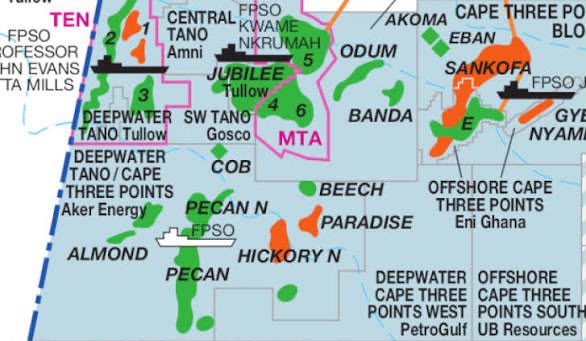
The President further announced that a major obstacle hindering development of the Pecan field had recently been removed, creating the possibility of agreeing on an accelerated development programme.
The development could be relevant to Ghana’s efforts to expand its future production base, particularly as the country seeks to bring new resources into the upstream pipeline.
Mahama also referred to the arbitration between government and Tullow, saying both parties had negotiated a mutually acceptable roadmap following the dispute.
He assured petroleum partners that Ghana would address disagreements and arbitral awards in a manner that benefits all parties.
Resolving such disputes is important because prolonged disagreements can delay investment decisions and create uncertainty around project development.
However, the commercial and production consequences of the Pecan and Tullow developments will need to be assessed through subsequent agreements and implementation.
A Recovery That Must Be Sustained
The increase in production to more than 120,000 barrels per day represents a notable improvement on the approximately 88,000 barrels per day cited by the President.
Yet the figure remains below the peak of approximately 195,000 barrels per day recorded in 2019.
The US$3.5 billion in announced commitments, the proposed legislative reforms and the renewed discussions over exploration acreage provide a basis for further activity. They do not, by themselves, guarantee that production will return to previous levels.
Ghana will need to monitor whether committed investments translate into completed wells, additional production facilities, new discoveries and development approvals.
The country must also ensure that local businesses and workers participate meaningfully in the new projects.
Mahama’s announcement points to an upstream sector beginning to recover from a period of reduced investment and declining output.
The challenge now is to turn that recovery into a sustained programme of exploration and production that strengthens public revenue and domestic capacity.
For Ghana, the real measure of success will be whether renewed investor interest can secure the next generation of producing assets, rather than merely restore activity in existing fields.
READ ALSO: Mahama Cuts Sod for $98.41m Takoradi Port Expansion