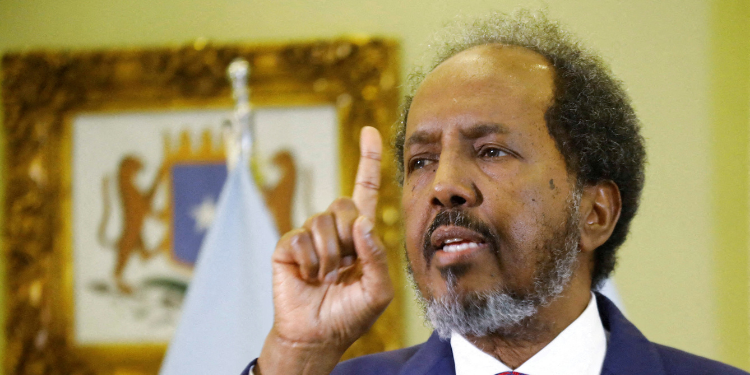
Somalia’s President, Hassan Sheikh Mohamud, has called on wealthy nations to provide more climate finance through grants rather than loans, insisting that support for vulnerable countries should be treated as an obligation rather than an act of charity.
Addressing world leaders at the 31st UN Climate Change Conference (COP31) in Antalya, Türkiye, Hassan Sheikh Mohamud urged the international community to release disaster funds before death tolls emerge, noting that climate finance must enable countries to prepare for and respond to extreme weather events rather than arrive only after communities have suffered devastating losses.
Somalia’s President also drew attention to the unequal burden of climate change, noting that countries with minimal carbon emissions continue to suffer severe weather events.
He stressed that “the move away from fossil fuels must be just, and must leave room for countries like mine to develop as well.”
Vulnerable Nations Demand Fairer Climate Finance
In addition, Tanzania’s President, Samia Suluhu Hassan, highlighted the economic consequences of climate-related disasters, warning that extreme weather shocks are estimated to cost her country between 2 and 3 percent of its gross domestic product annually.
She called for improved access to climate finance and greater transparency in carbon markets, stressing that financial mechanisms deliver meaningful benefits to countries bearing the greatest climate risks.
Cyprus President Nikos Christodoulides also emphasised the need for regional cooperation, pointing to his country’s potential role in supporting climate action across the Mediterranean and the Middle East.
He noted, “climate change transcends politics and does not recognise borders.”
Sudan’s President, Abdelfattah al-Burhan, similarly called for increased investment in climate adaptation, highlighting the need to strengthen countries’ capacity to withstand the effects of climate change.
Finland’s President, Alexander Stubb, placed the climate crisis within the broader context of international security, describing climate change as “chronically underrepresented” on the global agenda.
“No country, regardless of size, power and geography, can shield itself from the consequences of climate change, and no country can do it alone.”
Alexander Stubb
UN Chief Calls for Climate Justice Compact to Support Developing Nations
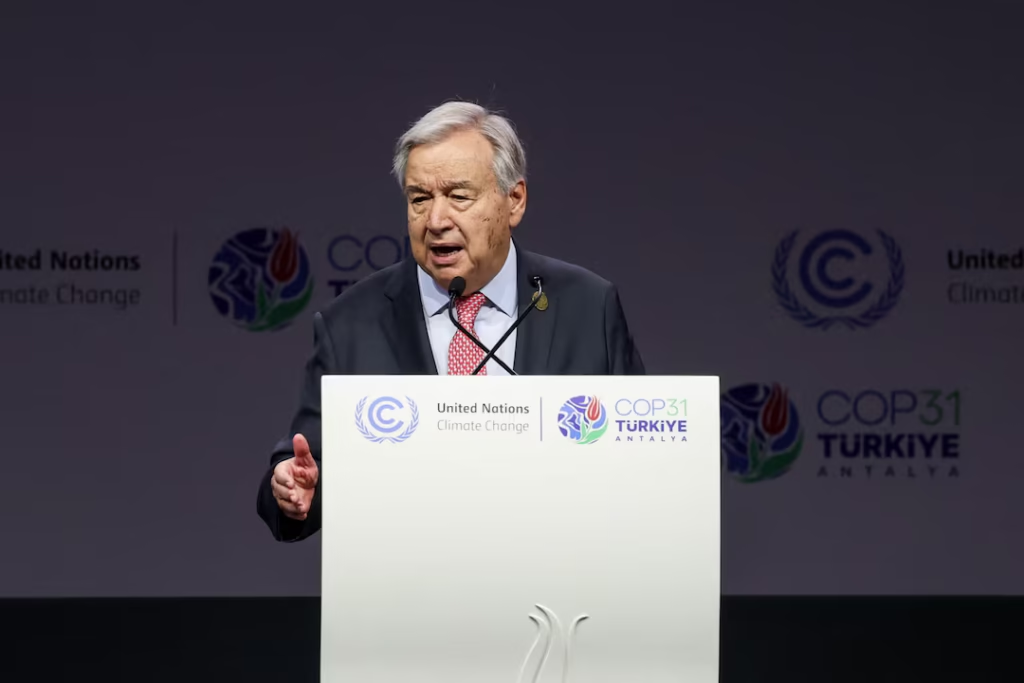
Meanwhile, United Nations Secretary-General António Guterres has called for a new Climate Justice Compact to address widening inequalities in global climate action, urging world leaders to provide developing countries with the financial resources, technology and support needed to transition towards cleaner energy systems.
Addressing the COP31 Leaders’ Summit in Antalya, Türkiye, the UN Chief noted that countries facing the greatest climate vulnerabilities continue to receive an inadequate share of global investment in renewable energy, despite accounting for a significant proportion of the world’s population.
“We cannot demand that countries transform their economies while denying them the means to do so.”
António Guterres
According to the UN chief, emerging and developing economies outside China account for nearly two-thirds of the global population but attract less than one-fifth of worldwide clean-energy investment, exposing a significant funding gap.
He noted that these financial constraints threaten to slow the adoption of renewable energy, particularly in countries where governments and businesses struggle to mobilise the resources required to develop alternative power sources.
He warned that without affordable access to clean energy, developing economies could be forced to rely on fossil fuels to meet their growing energy needs, potentially locking in high emissions for decades.
The consequences, he added, extend beyond energy production, as vulnerable communities lacking adequate resources to adapt to climate change could experience worsening instability, with repercussions across national borders.
Four Pillars Anchor Proposed Climate Justice Compact
The proposed Climate Justice Compact rests on four pillars: accelerating a just transition away from fossil fuels, protecting people from climate impacts, ensuring adequate and affordable climate finance, and strengthening international cooperation.
Under the first pillar, Guterres urged governments to align their national policies, investments and infrastructure plans with the goal of limiting global warming to 1.5°C.
He called for credible national roadmaps to guide the transition, including measures to protect workers and communities affected by changes in energy production.
The UN chief also urged countries to expand renewable energy, electricity grids, energy storage and clean electrification, while reducing methane emissions and safeguarding forests, oceans and biodiversity.
On adaptation, he called for a new generation of national adaptation plans, supported by the international community, to protect vulnerable populations from rising temperatures, floods, droughts and rising sea levels.
He further stressed the need to ensure that every person is covered by an early-warning system, while support for loss and damage must be made accessible to communities facing climate impacts that exceed their capacity to adapt.
Guterres Demands Greater Climate Finance
The UN chief also called for greater financial support from developed countries, urging them to deliver a minimum of $300 billion annually by 2035 and adopt clear plans to at least triple adaptation funding over the same period.
He also called for the $1.3 trillion climate finance goal to translate into actual financial flows to developing countries, insisting that multilateral development banks, private investors and international donors must contribute more substantially.
Among his proposals, Guterres urged multilateral development banks to expand lending, mobilise private investment and deploy innovative financing instruments that respond to the needs of vulnerable economies.
He also called for stronger replenishment of the Green Climate Fund and the Fund for Responding to Loss and Damage, alongside greater South-South cooperation to improve access to climate technology and financing.