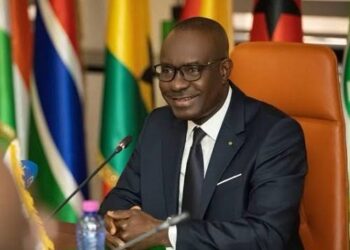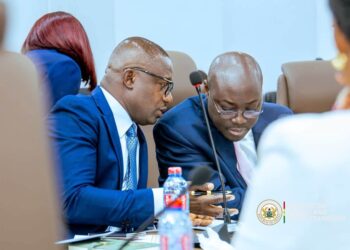
Finance economist Professor Godfred Bokpin at the University of Ghana Business School (UGBS), has weighed in on Ghana’s current economic trajectory, particularly in the context of the IMF-supported program and the nation’s approach to taxation.
He emphasized the need for a balanced and strategic approach to revenue generation that does not stifle businesses or economic growth.
According to Professor Bokpin, Ghana’s economic strategy under the IMF program is largely centered on macroeconomic stability and fiscal consolidation.
“The expectation is very high and of course, one must also be moderate, bearing in mind the reality that we are confronted with. It’s not going to be a major departure because we are under an IMF-supported program.”
Professor Godfred Bokpin University of Ghana Business School (UGBS)
He further explained that fiscal consolidation—through revenue measures and expenditure rationalization—remains the key instrument in stabilizing the economy.
Professor Bokpin cautioned that while increasing revenue is crucial, the strategy employed must be business-friendly. He warned against tax policies that negatively impact businesses, arguing that taxation should not be treated merely as a revenue-raising tool but as a mechanism to enable economic growth.
“The drive is to generate more revenue but of course, the strategy that we deploy in generating that revenue must not impact businesses negatively.”
Professor Godfred Bokpin University of Ghana Business School (UGBS)
He highlighted the significance of the Medium-Term Revenue Strategy (MTRS), which aims to increase Ghana’s revenue-to-GDP ratio to between 18% and 20% by 2027. While acknowledging that Ghana is on course to meet these targets, he pointed out inefficiencies in the current tax mix.
“The first major structural reform under the IMF-supported program is actually about taxes—the medium-term revenue strategy that has been developed [and] it’s supposed to scale up our revenue-to-GDP ratio to about between 18-20% by 2027.”
Professor Godfred Bokpin University of Ghana Business School (UGBS)
Professor Bokpin was critical of the approach taken to taxation in Ghana, arguing that the current tax mix has not resulted in increased tax buoyancy. Instead, there has been a substitution effect where gains in certain tax areas are offset by losses elsewhere.
He stressed that taxation should not be used as a blunt instrument that punishes businesses and households. He said;
“Oftentimes in our part of the world, we think that tax is like a hammer. If you view tax as a hammer, then you treat everything around as a nail. And so, you want to nail them. We are nailing businesses; we are nailing households.”
“Tax is also an enabler. So, you can conceptualize taxation as an enabler to promote businesses, to promote consumption.”
Professor Godfred Bokpin University of Ghana Business School (UGBS)
VAT Inefficiencies, the Need for Administrative Reforms

One major inefficiency Professor Bokpin highlighted was in Ghana’s Value Added Tax (VAT) system. He revealed that VAT inefficiencies are as high as 45%, meaning the government loses significant revenue due to poor administration and compliance.
He argued that improving VAT efficiency by just 15% could significantly boost revenue without introducing new taxes.
Professor Bokpin strongly advocated for the removal of the Electronic Levy (E-Levy) and the COVID-19 levy, describing them as unnecessary burdens on the economy.
“How many serious countries in this world do you find immortalizing COVID with a tax?”
Professor Godfred Bokpin University of Ghana Business School (UGBS)
Exemptions and Revenue Losses
Another area of concern raised by Professor Bokpin was the issue of tax exemptions. He noted that Ghana has been losing about 3.5% of its GDP to tax exemptions over the past 25 years, often without a clear assessment of their benefits.
He emphasized that these exemptions have not been efficiently tracked to ensure they generate jobs or promote foreign direct investment (FDI).
He argued that rationalizing the exemption regime could generate enough revenue to eliminate unpopular taxes like the E-Levy.
“You could actually eliminate these taxes and then find a place by rationalizing your exemption regime.”
Professor Godfred Bokpin University of Ghana Business School (UGBS)
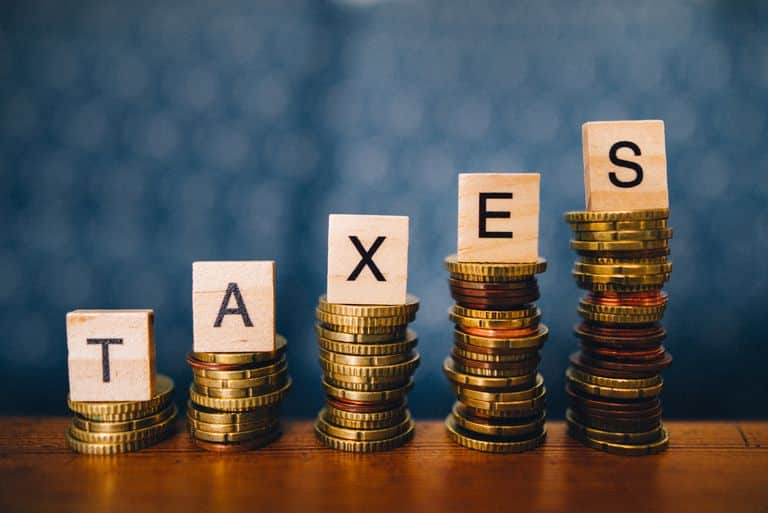
Professor Bokpin stressed that Ghana’s future economic growth will depend more on the digital economy than on traditional sectors.
“The future of our economy is increasingly digital. The future of money, the future of currency, and the future of finance are increasingly digital.”
Professor Godfred Bokpin University of Ghana Business School (UGBS)
Instead of imposing punitive taxes on digital transactions, he urged the government to create an enabling environment for the sector to grow.
He explained that by allowing digital transactions to flourish, the government could generate more tax revenue organically as businesses and financial transactions expand.
“When the pie grows bigger and you even tax a small percentage of that, along the value chain, you’re going to raise more money.”
Professor Godfred Bokpin University of Ghana Business School (UGBS)
Professor Godfred Bokpin’s analysis highlights the need for Ghana to rethink its approach to taxation and economic policy.
He advocates for reforms that prioritize efficiency over rate increases, the removal of regressive taxes like the E-Levy and COVID-19 levy, and a shift toward a more supportive digital economy.
By implementing these changes, he argues, Ghana can generate sustainable revenue without placing undue burdens on businesses and citizens.
READ ALSO; Ghana Needs Economic Shock Absorbers, Not IMF Interventions- Prof. Gatsi