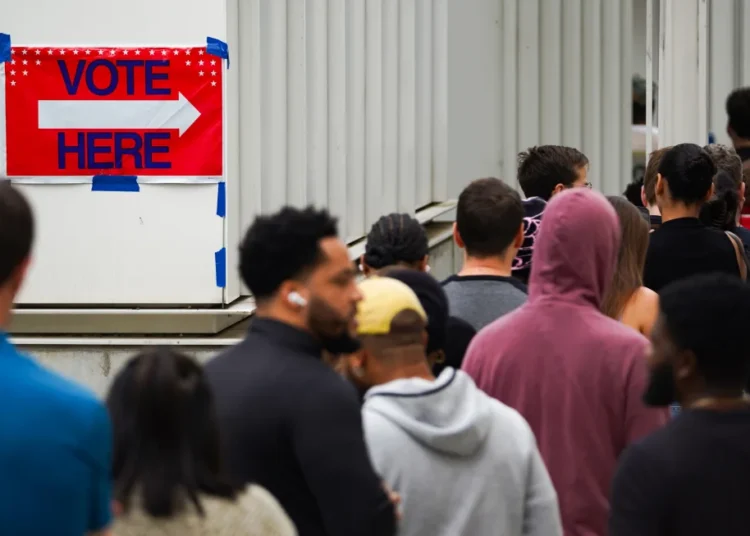
Americans are headed to the polls today, Tuesday, November 5, 2024, to vote for the country’s next President.
Polls open at different times from state to state. It will start as early as 5 a.m. Eastern Standard Time (EST), that is 10:00 GMT.
Across the country, polls will begin to close at 7 p.m. EST (0:00GMT). Nonetheless, polls in some parts of Indiana and Kentucky close earlier.
The first polls will close at 6 p.m. (23:00 GMT) on Tuesday evening and the last polls will close at 01:00 EST (06:00 GMT) early on Wednesday, November 6, 2024.
This race is expected to come down to results from the seven swing states – Arizona, Georgia, Michigan, Nevada, North Carolina, Pennsylvania and Wisconsin.
At 7 p.m. EST (0:00 GMT Wednesday), polls will close in Georgia and five other states and partially in two more states.
At 7:30 p.m. EST (0:30 GMT), polls will close across three states, including North Carolina.
At 8 p.m. EST (01:00 GMT), polls will close in Pennsylvania, 15 other states and the District of Columbia, as well as partially in Michigan and four other states.
At 9 p.m. EST (02:00 GMT), all remaining polls will close in Michigan. Voting will also end in Arizona, Wisconsin and 12 other states.
At 10 p.m. EST (03:00 GMT), polls will close across Nevada and two other states, and partially in two others.
The final polls close in the blue state of Hawaii at 12 a.m. EST (5:00 GMT) and in the red state of Alaska at 1 a.m. EST (6:00 GMT).
The results could take days or weeks to sort through.
The initial results in the hours after polls close might not be determinative.
States decide their own election procedures, and the order in which states count early, mail-in and Election Day votes varies across the map as does how quickly certain cities, counties and regions report their results.
Alongside Trump and Harris, a handful of other presidential candidates will appear on the ballots. While none have enough support to capture electoral votes, their presence could tip the scales in tightly contested swing states.
Notable among them are Jill Stein (representing the Green Party, Stein is on the ballot in every swing state except Nevada), Chase Oliver (With the Libertarian Party, Oliver is on the ballot in all seven swing states) and Cornel West (an independent, progressive candidate, West is on the ballot in Michigan, Wisconsin and North Carolina).
The nephew of John F Kennedy, Robert Kennedy, Jr began his campaign as an independent. He suspended his campaign in August and endorsed Trump, but his name remains on the ballot in Wisconsin and Michigan.
At Least 270 Electoral Votes Needed
Harris and Trump each need at least 270 electoral votes to win the presidency.
In a nutshell, to win the US presidency, a candidate has to win support in enough key states to reach the Electoral College number of 270.
A candidate who wins the popular vote; the most votes in total across the US, may not actually win the White House, as was the case for instance in 2017 when Hillary Clinton lost to Trump.
Before the election, the political parties in each state choose a slate of electors: real people who ultimately cast a vote for the President. Very often, the electors are party officials or supporters.
Each state gets the same number of electors as it has representatives in the US House of Representatives and the US Senate.
For example, Michigan gets 15 Electoral College votes. That corresponds to the two Senators and 13 House members who represent the state in Congress.
In nearly all states across the US, the presidential candidate who gets the most votes wins all that state’s electors: It’s a winner-takes-all system. Even if a candidate wins a state narrowly, they still get all the electors.
The outliers are Maine and Nebraska, which allocate their electors based on a more complicated system that reflects the popular vote on the state and congressional district levels.
The District of Columbia — which is not a state but encompasses the country’s capital — also gets three Electoral College votes.
To win the White House, a presidential candidate must win the support of a majority of the electors.
So out of a total of 538 Electoral College votes, they need at least 270 to win.
The electors ultimately cast their votes in December, about a month after the election. Their votes are then certified by Congress in early January, when the president is confirmed and takes office.