
• About
  • Advertise
  • Privacy Policy
  • Contact
Friday, September 25, 2026
  • Login
The Vaultz News
  • Top Stories
  • News
    • General News
    • Education
    • Health
    • Opinions
  • Economics
    • Economy
    • Finance
      • Banking
      • Insurance
      • Pension
    • Securities/Markets
  • Business
    • Agribusiness
    • Vaultz Business
    • Extractives/Energy
    • Real Estate
  • World
    • Africa
    • America
    • Europe
    • UK
    • USA
    • Asia
    • Around the Globe
  • Innovation
    • Technology
    • Wheels
  • Entertainment
  • 20MOBPL2DNew
  • Jobs & Scholarships
    • Job Vacancies
    • Scholarships
No Result
View All Result
The Vaultz News
  • Top Stories
  • News
    • General News
    • Education
    • Health
    • Opinions
  • Economics
    • Economy
    • Finance
      • Banking
      • Insurance
      • Pension
    • Securities/Markets
  • Business
    • Agribusiness
    • Vaultz Business
    • Extractives/Energy
    • Real Estate
  • World
    • Africa
    • America
    • Europe
    • UK
    • USA
    • Asia
    • Around the Globe
  • Innovation
    • Technology
    • Wheels
  • Entertainment
  • 20MOBPL2DNew
  • Jobs & Scholarships
    • Job Vacancies
    • Scholarships
No Result
View All Result
The Vaultz News
No Result
View All Result
in Banking, One Top Story, Top Stories

Marginal fall in Inflation Rate: What is the Implication on Interest rates?

thevaultzby thevaultz
February 12, 2021
Reading Time: 4 mins read
Add as Preferred on Google
Several factors account for discrepancy between Policy Rate and Lending rate – John Awuah

Mr. John Awuah, Chief Executive Officer of the Ghana Association of Bankers

Ghana’s Inflation rates has marginally dropped from 10.4% in December 2020 to 9.9% in January 2021, according to latest data released by the Ghana Statistical Service.

This implies that the average change in the general price level of goods and services was relatively low in January 2021 as compared to December 2020.

Inflation rates has over the years proven to have a strong correlation between interest rates and basically, the transmission mechanism through which inflation affect interest rate is through the nominal interest rate.

Nominal interest rate is the composition of real interest rate plus inflation. In other words, real interest rate is the interest adjusted for inflation. Banks however, use nominal interest rate which encompasses inflation. This is simply because, high inflation may erode the real interest rate charged on loans. Hence, all things being equal, high inflation will result in high interest charged on loans and vice versa.

ADVERTISEMENT

Additionally, high inflation also reduces the purchasing power of money as the value of goods and services surges, thus, more money is needed to maintain the same level of goods and services demanded. The opposite is also true. Therefore, there will be more demand for credit as a result of high inflation will cause interest rate to increase and vice versa

Government Statistician Professor Samuel Kobina Annim
Government Statistician, Professor Kobina Annim

Impact of inflation on interest rates

Speaking in an interview with the Vaultz News, the Chief Executive Officer of the Ghana Association of Bankers, Mr. John Awuah, confirmed that inflation does have an impact on interest rates.

He said just like any other price, interest is also a price on loans hence, changes in the general price level will also cause a change in the interest rate.

“Yes of course. Inflation does affect interest rates. Inflation is basically the persistent increase in the general price level. Lending rate is the price charge on loans, so when there is a change in the general prices, the lending rate is equally adjusted to accommodate the change in the value charge on loans,” he said.

Mr. John Awuah explained further that inflation and interest do move the same direction, however, the magnitude of change may vary from one bank to the other.

ADVERTISEMENT

“So, you can see that lending rate which is also a price move, in the same direction as inflation; as to the magnitude, it varies across banks that’s why when you check the data, you will see average lending rate, not specific lending rate which basically tells you that the specific lending rate varies across banks due to several factors. However, the Ghana reference rate serves as the benchmark on which the lending rate is pecked.”

As expressed by Mr. Awuah, inflation and interest rate move in the same direction, therefore a drop in inflation is expected to a cause marginal decline in interest rate. However, the degree of this decline may vary from bank to bank.

Trends in Inflation in Ghana

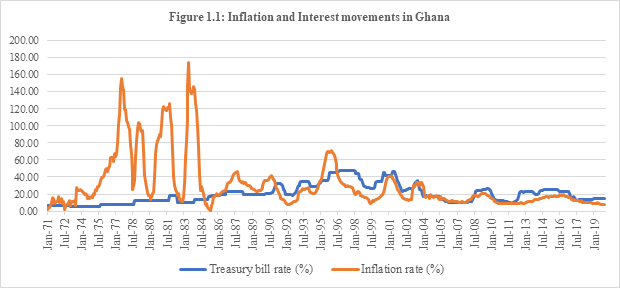
In Ghana, both inflation and interest rate movements have seen considerable volatilities during the regimes of monetary-targeting (MT), inflation-targeting (IT) and the periods prior as shown in Figure 1.1.
ADVERTISEMENT
image

A perusal of the figure above reveals three main patterns on the historical relationship between inflation and interest rate in Ghana. First, there is a wide variation in inflation as compared to interest rate over the period from January 1971 to December, 2019. Evidently, the highest and lowest inflation rates (interest rates) are 174.14% (47.93%) and 1.14% (7.25%) for the respective periods of June 1983 (December 1997) and May 1985 (August 1975).

Second, the variation in inflation during the pre-IT regime is significantly higher as compared to that during the post-IT period. For instance, the maximum and minimum inflation rates recorded in post-IT (pre-IT) period are respectively 20.74% (174.14%) in June 2009 (June 1983) and 7.60% (1.14%) in September 2019 (May 1985). Clearly, inflation rate movements volatilities are lower for post-IT as compared to the pre-IT periods suggesting significant improvement in controlling inflation rate movements volatilities with IT relative to MT and the other monetary policy regimes.

Again, it can be observed that in inflation and interest rate partly move in the same direction since the inception of the inflation-targeting (IT) regime by the Bank of Ghana. Furthermore, the marginal drop in inflation is coming at a time when yield on Treasury bills (which is the short-term interest) has been falling albeit marginally, and which is consistent with the historical data.

Therefore, since inflation rate moves in the same direction with the short-term interest rate, and now that both variables have recorded a dip, is it valid for borrowers to expect lower interest rates from banks? This is one major que.

Read also: Several factors account for discrepancy between Policy Rate and Lending rate – John Awuah


ADVERTISEMENT

Sign Up to Our Newsletter

Fresh updates, Straight to your inbox

Tags: Banking sectorGhana Statistical Serviceinflationinterest rateslending rates
Please login to join discussion
Previous Post

We Will Re-equip The Various Forces- Dominic Nitwul

Next Post

COVID-19 slowing down benefit of AfCFTA for Ghana?

Related Posts

Ecobank Marks 40 Years With $2.6bn African Financing Push
Banking

Ecobank Marks 40 Years With $2.6bn African Financing Push

September 25, 2026
Access Bank Partners ITC to Unlock Africa’s SME Potential
Banking

Access Bank Partners ITC to Unlock Africa’s SME Potential

September 25, 2026
Interest Rate 1
Banking

MPC Keeps 14% Rate, Lending Costs Face Stability

September 24, 2026
President John Dramani Mahama delivers Ghana speech at the 81st UN General Assembly Debate
General News

Mahama Presses UN For Permanent African Seat With Full Veto Rights

September 24, 2026
ADVERTISEMENT

Sign Up to Our Newsletter

Fresh updates, Straight to your inbox

ADVERTISEMENT

Recent News

strike 3

Teacher Unions Strike Nationwide as Collective Agreement Talks Stall With FWSC

September 25, 2026
Finance Minister Dr. Cassiel Ato Forson

Ato Forson Sees Ghana’s Golden Era on the Horizon

September 25, 2026
2025/26: Karela United vs Hearts of Oak in Tamale

Kapor Calls on Tamale Phobians to Back Hearts Against Karela

September 25, 2026
A Galamsey site

Kyebi Galamsey: Abuakwa South MP Declares Himself Helpless In The Fight

September 25, 2026
Dr. Catherine Gegout, Associate Professor in International Relations at the University of Nottingham.

Analyst Says Canada-EU Associate Membership Won’t Create ‘Third Bloc

September 25, 2026
ADVERTISEMENT
Next Post
The global health pandemic may be the very challenge that could stifle Ghana seeing the optimal benefits of the African Continental Free Trade Area (AfCFTA) agreement, especially being a host country.

COVID-19 slowing down benefit of AfCFTA for Ghana?

The Vaultz News

Copyright © 2025 The Vaultz News. All rights reserved.

Navigate Site

  • About
  • Advertise
  • Privacy Policy
  • Contact

Follow Us

Welcome Back!

Login to your account below

Forgotten Password?

Retrieve your password

Please enter your username or email address to reset your password.

Log In
No Result
View All Result
  • Top Stories
  • News
    • General News
    • Education
    • Health
    • Opinions
  • Economics
    • Economy
    • Finance
      • Banking
      • Insurance
      • Pension
    • Securities/Markets
  • Business
    • Agribusiness
    • Vaultz Business
    • Extractives/Energy
    • Real Estate
  • World
    • Africa
    • America
    • Europe
    • UK
    • USA
    • Asia
    • Around the Globe
  • Innovation
    • Technology
    • Wheels
  • Entertainment
  • 20MOBPL2D
  • Jobs & Scholarships
    • Job Vacancies
    • Scholarships

Copyright © 2025 The Vaultz News. All rights reserved.

This website uses cookies. By continuing to use this website you are giving consent to cookies being used. Visit our Privacy and Cookie Policy.