

China is embarking on a significant transformation in its renewable energy sector, transitioning from government-controlled pricing to a market-driven model.
The National Development and Reform Commission (NDRC) and the National Energy Administration (NEA) have jointly announced reforms that will allow the price of on-grid electricity from renewable sources such as wind and solar to be determined by market mechanisms rather than fixed government rates.
Previously, China’s renewable energy prices were subsidy-driven and heavily regulated to encourage rapid growth.
However, with the sector’s maturation and installed renewable capacity exceeding 1,410 gigawatts in 2023—surpassing coal—the government acknowledges that fixed pricing models no longer reflect the realities of market supply and demand.
“With the large-scale development of new energy, the fixed pricing for on-grid electricity cannot accurately reflect market supply and demand and does not share its responsibility for regulating the power system.”
National Energy Administration (NEA)
To mitigate potential price volatility, China will implement a system of “balancing payments,” similar to the UK’s contracts for difference (CfD) mechanism.
This system will compensate power producers when electricity prices fall below an agreed-upon threshold and require repayments from producers if market prices exceed a predetermined ceiling.
This approach aims to maintain a stable revenue stream for energy companies while promoting market efficiency and competition
China’s dominance in the renewable energy sector has not come without controversy. Critics argue that Beijing’s aggressive subsidies have led to overcapacity and market distortions, both domestically and internationally.
In the electric vehicle (EV) sector, China’s production surpassed 10 million units in 2023, with EV sales overtaking conventional petrol cars for the first time in July 2024.
Despite a slowing economy, EV sales grew by 34% year-over-year, fueled by government subsidies of up to $2,800 per vehicle for trading in older cars.
“As EVs outsell conventional petrol cars, more existing production facilities and workers will become redundant.
“Demand for petrol cars will weaken in the coming years.”
Phate Zhang, founder of Shanghai-based CnEVPost
This overcapacity has triggered warnings from international leaders. U.S. Treasury Secretary Janet Yellen expressed concerns about China’s industrial overcapacity.
“Excess capacity poses risks not only to American workers and firms but also to the global economy.
“It floods the market with cheap goods, distorting competition.”
Phate Zhang, founder of Shanghai-based CnEVPost
China’s grip on the global solar supply chain is even more pronounced. The country controls approximately 95% of the world’s polysilicon and wafers and has invested over $50 billion into wafer-to-solar panel production lines—10 times more than Europe.
“The world will almost completely rely on China for the supply of key building blocks for solar panel production through 2025.
“This level of concentration represents a considerable vulnerability in the global supply chain.”
International Energy Agency (IEA)
U.S. Resurgence in Solar Manufacturing
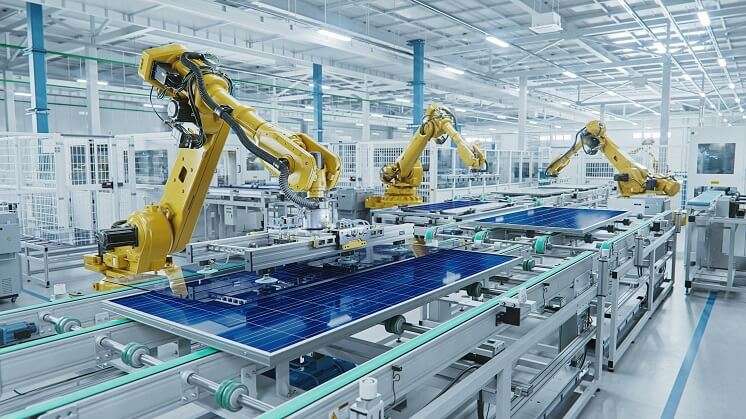
In response to China’s dominance, the U.S. solar industry is experiencing a resurgence. For the first time since 2019, silicon solar cells are being manufactured domestically, with the U.S. adding a record-breaking 9.3 gigawatts (GW) of new solar module manufacturing capacity in Q3 2024.
According to the U.S. Solar Market Insight Q4 2024 report by the Solar Energy Industries Association (SEIA) and Wood Mackenzie: “Five new or expanded factories were launched in three states.”
Abigail Ross Hopper, SEIA President and CEO stated, “Federal solar policies and increased private investments are strengthening our nation’s energy security and creating thousands of new job opportunities for American workers.”
Despite the growth, the U.S. renewable sector faces significant challenges under the second Trump administration.
President Donald Trump has frozen federal grants, including those under the Inflation Reduction Act (IRA), jeopardizing billions in clean energy investments. “To further defeat inflation, my plan will terminate the Green New Deal, which I call the Green New Scam,” Trump declared during a speech at the Economic Club of New York.
China’s reforms, coupled with U.S. policy shifts, highlight the fragile balance in the global renewable energy market. While China is transitioning to a market-oriented model, its dominance raises concerns about supply chain vulnerabilities and market fairness.
Meanwhile, the U.S. strives to regain ground, but political uncertainty threatens to undermine progress. The freezing of IRA funds could stall the clean energy momentum, leaving the U.S. vulnerable to foreign competition.
As the world races toward net-zero emissions, the geopolitical tug-of-war over renewable energy will shape not just economies but also the future of global climate action.
READ ALSO: Dr. Ato Forson to Present 2025 Budget to Parliament on March 10