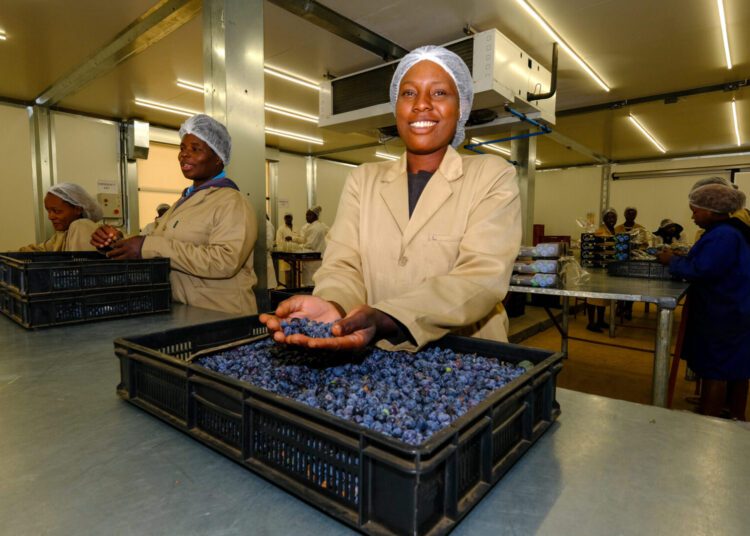
Zimbabwe has secured access to the lucrative Chinese fruit market after concluding a protocol on phytosanitary standards, paving the way for local farmers to begin exporting blueberries to one of the world’s fastest-growing consumer bases.
The agreement was finalized during President Emmerson Mnangagwa’s visit to Beijing this week, where he held talks with President Xi Jinping. Their meeting coincided with commemorations marking 80 years since the end of World War Two.
Zimbabwe’s Horticultural Development Council (HDC) welcomed the breakthrough, saying it represented a milestone for local growers. In a statement, the council noted the protocol “opens the door for local growers to expand into one of the world’s fastest-growing blueberry markets.”
Under the new arrangements, the scale of Zimbabwe’s exports will depend on strict sanitary and phytosanitary requirements as well as compliance costs. With global blueberry demand climbing sharply due to the fruit’s health reputation, Zimbabwe hopes to carve a bigger share of the expanding international market.
Industry projections show Zimbabwe could produce 8,000 metric tons of blueberries in 2024, with output expected to rise to 12,000 metric tons in 2025. The country is already recognized as one of the fastest-growing blueberry producers worldwide. Favorable climatic conditions give Zimbabwean farmers the advantage of high yields and the ability to reach export markets early in the season.

HDC Warns Of Local Constraints
Despite optimism, the HDC cautioned that production growth remains constrained by domestic economic challenges. Farmers face steep interest rates, limited access to long-term financing, and an export retention policy requiring them to convert 25% of their foreign currency earnings into local currency.
Growers are also lobbying for incentives such as income tax holidays, duty exemptions on critical inputs, and reductions in land levies to ease the cost burden on the emerging industry. Without such reforms, stakeholders warn, Zimbabwe may struggle to realize its full export potential despite booming demand.
The new blueberry deal reflects the broader strengthening of ties between Zimbabwe and China, whose bilateral trade relationship has deepened over the past two decades. China remains one of Zimbabwe’s top trading partners, with cooperation spanning agriculture, mining, manufacturing, and infrastructure development.
Zimbabwe exports commodities such as platinum, gold, diamonds, and chrome to China in exchange for machinery, manufactured goods, and technology. For Harare, these exchanges have been vital in addressing persistent development finance gaps and advancing infrastructure upgrades.
China-Zimbabwe Economic Ties Strengthen Further
Infrastructure development has become a cornerstone of the partnership. Chinese firms have played a central role in constructing roads, power plants, bridges, and housing projects across Zimbabwe. Officials argue these efforts support the country’s economic recovery agenda by strengthening energy supply and improving transportation networks critical for attracting fresh investment.
Trade volumes between the two nations have steadily risen in recent years, highlighting China’s appetite for Zimbabwean raw materials. Meanwhile, Zimbabwe has benefited from affordable Chinese goods, ranging from textiles and electronics to vehicles. However, as with many African countries, the trade balance tilts in China’s favor. Harare continues to negotiate terms to extract greater benefits from the relationship.
China has also extended loans and credit facilities to Zimbabwe, financing large-scale projects. While these funds have helped address infrastructure needs, they have also raised concerns about long-term debt sustainability. However, Zimbabwean officials often describe the relationship as mutually beneficial, stressing that China operates as a development partner without the political conditionalities associated with Western engagement.
For both countries, the new agricultural deal fits within a larger strategic alliance. Zimbabwe seeks to diversify its export base and attract investment, while China secures access to key resources and food supplies. The blueberry protocol is thus more than a simple trade agreement; it symbolizes the deepening of South-South cooperation and the shifting global economic landscape.