Author: Kay Codjoe, Market Research Consultant and Volunteer Associate at the IMANI Centre for Policy and Education
There is something deeply fascinating about watching a political argument abandon its own crime scene. The accusation was simple. Mahama’s Presidency was bloated.
The number 808 was paraded across television studios, radio stations and social media timelines as though it were evidence recovered from a financial crime investigation. The implication was clear: too many people, too many appointees, too much government. Felix Ofosu Kwakye was accused of hypocrisy. Case closed.
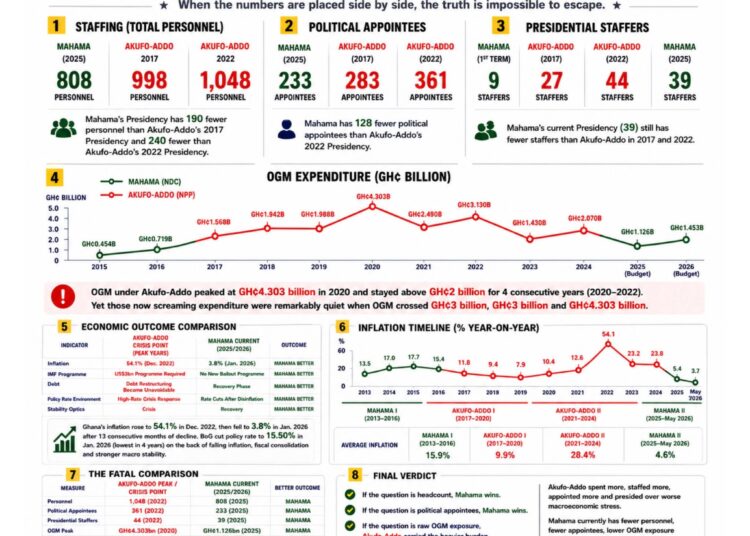
Then the official records arrived. And suddenly, the case developed complications. Mahama’s Presidency reported 808 personnel. Akufo-Addo’s Presidency reported 998 personnel in 2017 and 1,048 personnel in 2022.
The difference was not marginal. Mahama’s Presidency had 190 fewer personnel than Akufo-Addo’s 2017 Presidency and 240 fewer than Akufo-Addo’s 2022 Presidency.
Then things became even more uncomfortable. Political appointees were isolated. Mahama: 233. Akufo-Addo: 283 in 2017 and 361 in 2022. A difference of 128 fewer political appointees than Akufo-Addo’s 2022 Presidency.
Then came Presidential Staffers. Mahama’s first Presidency had 9. Akufo-Addo’s had 27 in 2017 and 44 in 2022. Mahama’s current Presidency has 39. The staffing argument was collapsing under the weight of its own arithmetic. So the critics did what desperate prosecutors often do when a witness turns hostile.
They changed the charge sheet. Suddenly, staffing no longer mattered. Now the argument was expenditure. But expenditure turned out to be an even more dangerous neighborhood.
Under Mahama, the Office of Government Machinery (OGM) stood at GH¢453.9 million in 2015 and GH¢718.9 million in 2016. Under Akufo-Addo, it jumped to GH¢1.56 billion in 2017, GH¢1.942 billion in 2018, GH¢1.98 billion in 2019 and GH¢4.303 billion in 2020.
The spending continued at GH¢2.49 billion in 2021, GH¢3.13 billion in 2022, GH¢1.43 billion in 2023 and GH¢2.07 billion in 2024. Mahama’s current figures stand at GH¢1.126 billion in 2025 and GH¢1.453 billion in 2026.
Yet those now screaming expenditures were remarkably quiet when OGM crossed GH¢2 billion, GH¢3 billion and eventually GH¢4.303 billion. The critics abandoned headcount because the comparison favored Mahama. They then ran into expenditure, where the numbers were no kinder.
But there is an even bigger problem. The same people screaming expenditure today spent years explaining why OGM figures could not be viewed in isolation. And they were right.
OGM is not Jubilee House. In 2018 alone, approximately GH¢1.137 billion of the GH¢1.942 billion allocation was Free SHS. Ministries, agencies, initiatives and secretariats have moved in and out of OGM over the years.
So, which argument are we using? The old one or the new one? Because they cannot both be true. If context mattered yesterday, it matters today. And this is where the expenditure argument becomes truly dangerous.
Governments are not judged by what they spend. They are judged by what citizens endure while they are spending it. During the years OGM allocations climbed into the billions, Ghana entered the worst economic crisis of the Fourth Republic. Inflation reached 54.1 percent in December 2022, the highest level recorded in more than two decades.
The cedi suffered one of its worst depreciations in modern history. Debt restructuring became unavoidable. An IMF programme became necessary. Businesses struggled. Households watched purchasing power evaporate.
Today, the very people who once argued that OGM figures required context now insist that context should be suspended for this discussion alone. Interesting. Because when the numbers are placed side by side, the contrast becomes difficult to ignore.
One administration is being criticized over 808 personnel and an OGM allocation of GH¢1.126 billion while operating in an environment where inflation has fallen from 23.8 percent in December 2024 to 5.4 percent in December 2025 and further to approximately 3.7–3.8 percent in 2026, alongside improving fiscal balances and strengthening macroeconomic stability.
The other presided over 998 personnel in 2017, 1,048 personnel in 2022, OGM allocations that climbed from GH¢1.56 billion to a peak of GH¢4.303 billion, while inflation moved from 11.8 percent in 2017 to 9.4 percent in 2018, 7.9 percent in 2019 and 10.4 percent in 2020 before accelerating to 12.6 percent in 2021, 54.1 percent in 2022, 23.2 percent in 2023 and 23.8 percent in 2024, culminating in debt restructuring and an IMF rescue programme.
Those are not political talking points. They are the recorded staffing figures, budget allocations and macroeconomic outcomes. Those are fingerprints. And fingerprints have an annoying habit. They remain at the scene long after the shouting has stopped.