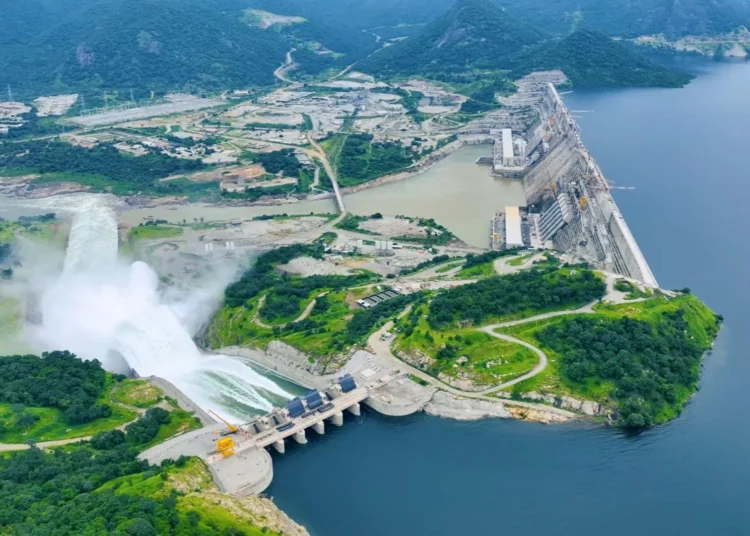
Ethiopia is preparing to unveil one of the most ambitious projects in its history, as the Grand Ethiopian Renaissance Dam (GERD) is officially inaugurated this week. The $multi-billion project, which has been 14 years in the making, is expected to double the country’s electricity capacity and redefine its role in the region.
Stretching an impressive 1,800 meters wide and 175 meters high, the GERD towers above the Blue Nile, a main tributary of the Nile. Its vast reservoir is capable of holding back up to 74 billion cubic meters of water, covering an area larger than the city of London. Since early 2022, the dam has already been producing renewable hydroelectric power, providing Ethiopia with a cleaner energy alternative and positioning it as a potential regional power hub.
Currently, nearly half of Ethiopia’s population lacks reliable access to electricity, forcing millions to depend on polluting fuels such as wood, coal, and gas. With GERD’s full capacity, the government hopes to transform that reality, giving households, industries, and communities more sustainable access to energy.
However, as Ethiopia celebrates its achievement, the project continues to stir unease downstream. For Egypt and Sudan, both heavily dependent on the Nile’s waters, GERD represents both opportunity and uncertainty. A 2019 study published in Earth’s Future warned that water demand in the Nile Basin could exceed supply by 2030, raising concerns over scarcity in the years ahead.
Downstream Nations Fear Water Scarcity Risks
Egypt and Sudan have repeatedly criticized what they describe as Ethiopia’s “unilateral measures” to control the river’s flow, pushing instead for joint management agreements. Both countries fear that reduced water availability could threaten farming, drinking water, and long-term stability.
However, Ethiopian Prime Minister Abiy Ahmed has insisted GERD is a force for progress rather than a threat. “GERD is not a threat,” Abiy stressed recently, pointing out that the dam would also help regulate devastating floods in eastern Sudan while creating opportunities to export power across the Horn of Africa. Ethiopia has already signed electricity supply contracts with Sudan, Kenya, and Djibouti, with further talks ongoing with additional neighbors.

“Ethiopia remains committed to ensuring that our growth does not come at the expense of our Egyptian and Sudanese brothers and sisters,” Abiy told parliament in July. “We believe in shared progress, shared energy, and shared water.”
Despite these reassurances, Sudan’s geographical position makes it the first country to experience the dam’s direct impacts. Located only 15 kilometers from GERD, millions of Sudanese rely on the Nile for farming, irrigation, and drinking water. The country is already struggling with civil conflict, drought, and desertification, making its dependence on the river even more acute.
“Sudan faces very real risks because they’re immediately downstream of the dam,” said Kevin Wheeler, a research associate at the University of Oxford’s Environmental Change Institute.
The Blue Nile then flows onward to Egypt, where the stakes are equally high. Cairo relies on the river for nearly 90 percent of its water, a lifeline for a growing population in the face of dwindling supplies. But Wheeler argued that GERD’s design may actually work in Egypt’s favor.
He noted that because the dam is hydroelectric, rather than an irrigation project, the water will continue flowing downstream after passing through its turbines. “It’s actually in Egypt’s best interest,” Wheeler explained, since the water is not diverted for consumption within Ethiopia.
Cairo’s main grievance remains Ethiopia’s decision to push forward with GERD’s construction without first securing agreements with its neighbors. This lack of consensus has been the most contentious point throughout negotiations.
Wheeler, who has worked with institutions in Ethiopia, Sudan, and Egypt on Nile Basin research since 2012, observed that the dam’s politics are as significant as its engineering. The GERD symbolizes Ethiopia’s growing ambition, but it also underscores the urgent need for cooperation among Nile Basin states in an era of increasing water stress.
READ ALSO: Oil Prices Rebound Over $1 as OPEC+ Output Hike Seen as Modest