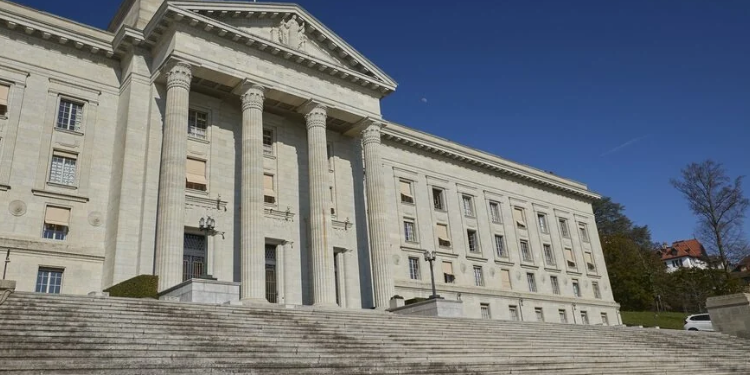
Switzerland’s Federal Supreme Court has upheld a 20-year prison sentence against former Liberian rebel commander Alieu Kosiah for war crimes committed during Liberia’s first civil war, bringing the country’s first-ever war crimes trial in Switzerland to a close.
The ruling, published on Friday, October 30, 2026, dismisses Alieu Kosiah’s second appeal against his June 2021 conviction for rape, murder and cannibalism, while reversing a separate conviction for crimes against humanity because the relevant law, introduced in 2011, cannot be applied retroactively.
Alain Werner, Director of Civitas Maxima, the non-governmental organisation representing victims in the case, stated, “This is a landmark decision, made possible by the courage of these victims, who have written a page of legal history.”
Swiss Court Closes Landmark Liberia War Crimes Case
Alieu Kosiah, a former commander of the United Liberation Movement of Liberia for Democracy (ULIMO), fought against the forces of then-President Charles Taylor during Liberia’s brutal civil war, which lasted from 1989 to 1996.
The Swiss Federal Criminal Court sentenced him to 20 years in prison on June 18, 2021, following a trial that established his responsibility for multiple war crimes committed between 1993 and 1995 in Lofa County, northwestern Liberia.
His conviction followed a nearly five-year investigation after Swiss authorities arrested him on November 10, 2014, in Switzerland, where he had lived since 1999.
The prosecution began after seven Liberian victims filed criminal complaints against him and became formal parties to the proceedings. Swiss Prosecutors subsequently indicted Alieu Kosiah in March 2019 over allegations including ordering the murder and cruel treatment of civilians, rape and pillage.
His trial, initially scheduled for April 2020, was postponed because COVID-19 restrictions prevented victims and witnesses from travelling from Liberia. Proceedings eventually took place in two phases between December 2020 and March 2021.
Alieu Kosiah challenged his conviction, but the Federal Criminal Court rejected his first appeal in 2023. The Federal Supreme Court’s latest decision dismissing his second appeal leaves the 20-year war crimes sentence intact.
Crimes Against Humanity Conviction Reversed
Although the Swiss Supreme Court upheld Alieu Kosiah’s war crimes conviction, it overturned a parallel conviction for crimes against humanity on legal grounds.
The court determined that the legislation criminalising crimes against humanity, introduced in Switzerland in 2011, cannot apply retrospectively to conduct that occurred before its enactment.
The distinction means Alieu Kosiah remains convicted of war crimes and must serve the 20-year sentence, but the separate crimes-against-humanity conviction no longer stands.
His prosecution was made possible by Switzerland’s recognition of universal jurisdiction, a legal principle that allows national courts to prosecute certain serious international crimes regardless of where they occurred or the nationality of the accused and victims.
Human Rights Watch previously described the 2021 conviction as a breakthrough for Liberian victims and Switzerland’s efforts to address impunity for serious international crimes.
“More than 20 years after the violations were committed, victims played a vital role in securing the first conviction for war crimes during Liberia’s civil war,” Balkees Jarrah, associate international justice director at Human Rights Watch, stated following the original verdict.
The organisation also highlighted the importance of victims’ participation in the proceedings, particularly as Liberia has yet to prosecute anyone for the grave crimes committed during its two civil wars.
Liberia Still Faces Accountability Gap
The ruling renews attention on Liberia’s failure to establish a domestic mechanism to prosecute those responsible for widespread atrocities during its armed conflicts.
Liberia experienced two civil wars between 1989 and 1996 and again from 1999 to 2003, during which civilians suffered mass killings, rape and other forms of sexual violence, summary executions, torture, mutilation and the recruitment of child soldiers.
The country’s Truth and Reconciliation Commission recommended the establishment of a war crimes court in 2009, but successive authorities have yet to establish the institution or prosecute individuals for the atrocities.
Consequently, foreign jurisdictions have played an important role in pursuing cases linked to Liberia’s conflicts. Authorities in the United States, Belgium, France, Finland and the United Kingdom have pursued criminal proceedings against individuals accused of involvement in serious crimes connected to the country.
Human Rights Watch has argued that universal jurisdiction prosecutions provide an important route to justice for victims who lack effective domestic remedies, while maintaining that Liberia bears the primary responsibility for addressing the accountability gap.
READ ALSO: Africa Urged To Build Defences Against Energy Shocks