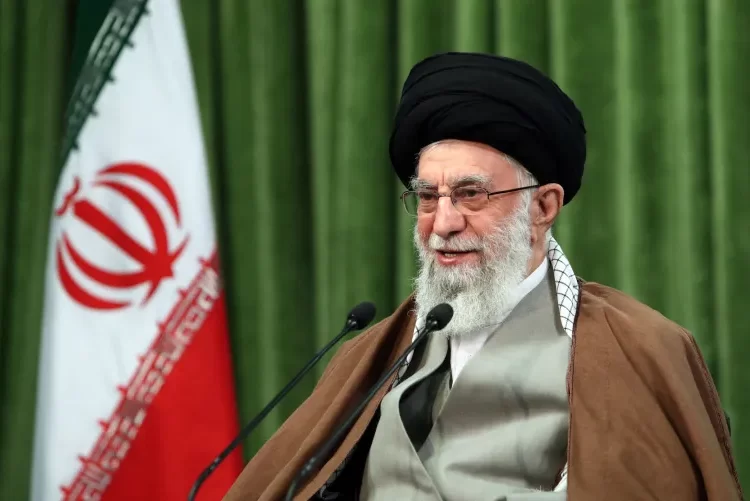
Iran’s Supreme leader, Ayatollah Ali Khamenei has rejected direct negotiations with the United States over his country’s nuclear program, saying that talks with the US represent “a sheer dead end.”
This likely slams the door shut on a last-ditch effort to halt the reimposition of United Nations sanctions on Tehran.
Ayatollah Ali Khamenei’s remarks, aired on Iranian state television, likely constrain any possible outreach to the US by Iranian President Masoud Pezeshkian, who is in New York for the UN General Assembly.
“The US has announced result of the talks in advance. The result is the closure of nuclear activities and enrichment. This is not a negotiation. It is a diktat, an imposition.”
Ayatollah Ali Khamenei
Separately, Iranian Foreign Minister, Abbas Araghchi held meetings with diplomats from France, Germany and the United Kingdom there over the reimposition of the sanctions, set to take effect Sunday.
Germany’s Foreign Minister, Johann Wadephul already described the chance of reaching an agreement with Iran “extremely slim” even before Khamenei’s comments.
Wadephul was reported as saying, “Iran has been disregarding its obligations under the Vienna Nuclear Agreement for years,” referring to the nuclear deal that was concluded between Iran and world powers in Vienna in 2015 and aimed at preventing Iran from developing nuclear weapons.
“We have drawn the necessary consequences from this and triggered the so-called snapback mechanism, which will reinstate international sanctions against Iran at the end of this week.”
Johann Wadephul
Wadephul added, however, that the three European countries — known as the E3 — will continue to negotiate with Iran even after the sanctions are back.
The countries triggered the reinstatement after deciding Iran had failed to comply with conditions including the monitoring of its nuclear sites by the IAEA.
European nations have said they would be willing to extend the deadline if Iran resumes direct negotiations with the US over its nuclear program, allows UN nuclear inspectors access to its nuclear sites, and accounts for the more than 400 kilograms (880 pounds) of highly enriched uranium the UN watchdog says it has.
Iran is the only nation in the world that enriches uranium up to 60%, a short, technical step from weapons-grade levels, that does not have a weapons program.
If no diplomatic deal is found this week, the sanctions will automatically “snapback” on Sunday. That would again freeze Iranian assets abroad, halt arms deals with Tehran and penalize any development of Iran’s ballistic missile program, among other measures, further squeezing the country’s reeling economy.
Khamenei made a point in his roughly half-hour speech to say his comments focused only on America, not on Europe.
Iran has long insisted its program is peaceful, though Western nations and the IAEA assess that Tehran had an active nuclear weapons program until 2003. Khamenei again pledged that Iran does not seek atomic bombs. “We do not have a nuclear bomb and we will not have one, and we do not plan to use nuclear weapon,” he said.
Trump Reference Iran In UNGA
US President Donald Trump, who unilaterally withdrew America from the Iran nuclear deal in 2018, made a point to reference Tehran in his speech before the UN.
He recounted writing a letter to Khamenei seeking talks. US and Iranian negotiators met five times before the 12-day war in June.
“There is no more serious danger to our planet today than the most powerful and destructive weapons ever devised by man, of which the United States, as you know, has many.
“I’ve made containing these threats a top priority, starting with (the) nation of Iran.”
Donald Trump
However, Khamenei stressed that Israeli and American attacks would not destroy the nuclear knowledge gained by Iran over the decades over the crisis surrounding the program. “Science will not be demolished by threats and bombing,” he vowed.
READ ALSO: EC Declares NDC’s Alidu Seidu Winner in Tamale Central By-Election