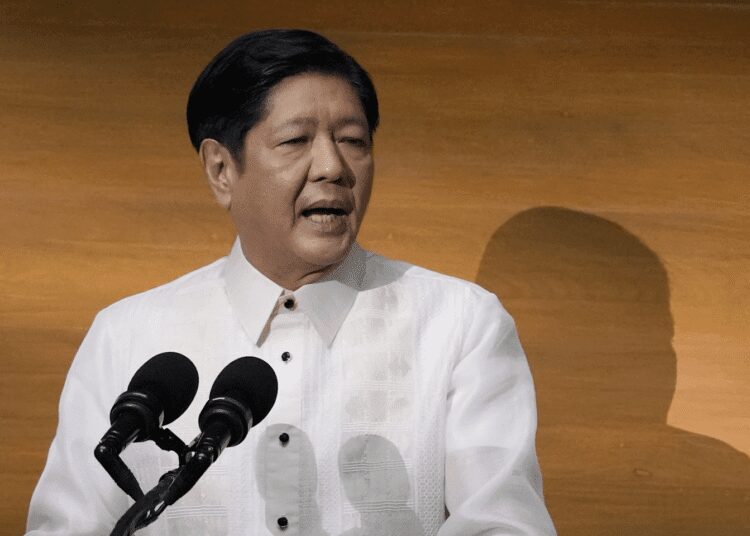
President Ferdinand Marcos Jr. has touted his government’s accomplishments as he delivered his fifth State of the Nation Address (SONA).
His speech lasted one hour and 26 minutes and tackled a wide range of issues, from developments in the investigation into the flood control scandal to the Philippines’ defense of its sovereignty in the West Philippine Sea.

Amongst other things, Marcos Jr. touted zero-balance billing and expanded healthcare benefits. He said that three million Filipinos have received free medical services through the government’s Zero-Balance Billing policy in Department of Health (DOH) hospitals.
He highlighted improvements in the Medical Assistance to Indigent and Financially Incapacitated Patients (MAIFIP) program, including the rollout of e-MAIFIP, which is integrated into the eGovPH app to make medical assistance more accessible without requiring guarantee letters.
Also, Marcos Jr. said that drilling operations at the Malampaya gas field have resumed for the first time in eight years after its service contract was extended until 2039.
He added that the government has awarded 14 petroleum service contracts across Luzon, Visayas and Mindanao, the most ever awarded under a single president, according to him. Four of these contracts are for hydrogen, which Marcos said could serve as backup fuel for power plants, particularly in off-grid areas.
He stated that it may be time for the Philippines to revisit nuclear energy production. “We will ensure it is safe. We will ensure the good benefits of nuclear energy will be explained properly to the public,” Marcos Jr. said.
Additionally, he pointed out an additional fund of almost P58 million released for the local government, “for the speedy and more expansive aid to people” in response to the effects of the Middle East conflict in the Philippines.
He highlighted the almost 100 job fairs that the government organized for Filipino jobseekers on Labor Day amid the rising cost of oil.
Marcos disclosed that a special anti-graft prosecutor would soon file charges against former House of Representatives Speaker Martin Romualdez, who has been implicated in a corruption scandal that the president exposed in his state of the nation speech last year. He did not identify Romualdez, his cousin and key political ally, but was obviously referring to him.
“This is painful to me, but we have to do the right thing. I’m not a President for my family. I’m not a President for my friend.”
Ferdinand Marcos Jr.
Romualdez, along with several House members and Senators, was accused of pocketing huge kickbacks from flood control projects in government and congressional investigations. Romualdez, who resigned as House speaker last year but remains as a congressman, reiterated in a statement that he did not violate the law and he was ready to prove it.
Philippine President Criticises China
Moreover, Philippine President Ferdinand Marcos Jr. denounced China in a veiled rebuke in his state of the nation speech, vowing that his government will defend a 2016 arbitration ruling that invalidated Beijing’s expansive claims in the disputed South China Sea.

Marcos did not mention China by name or elaborate on his criticism of Beijing, which was loudly applauded by many lawmakers. He said that “of late, our very humanity has been called into question” and reminded detractors that “Filipinos are a noble … and a great race. We are not greedy. We are not racists. We are not liars.”
Marcos summoned Chinese Ambassador Jing Quan to his office in Manila last week after the China Daily, a Chinese state-owned media outlet, depicted Filipinos as monkeys in an editorial video and cartoons. The animations centered on Beijing’s rejection of the arbitration ruling that invalidated China’s expansive claims in the South China Sea. The Philippine government strongly condemned the AI-generated images as “racist and dehumanizing” and demanded that they be taken down.
Marcos said the ruling, which he said was final and binding, was a “definitive benchmark for the interpretation and application” of the 1982 U.N. Convention on the Law of the Sea, which was the basis of the decision. The Philippines initiated the arbitration in 2013 after a tense standoff between Chinese and Philippine ships in a disputed shoal, but China refused to participate and rejected the decision as a sham.
“Your government will do all that is necessary to continue upholding this award, utilizing every peaceful and legal means available to the republic against any attempt, foreign or domestic, to undermine this achievement.”
Ferdinand Marcos Jr.
Territorial confrontations in the disputed waters have become more prevalent in recent years, particularly among Chinese, Philippine and Vietnamese forces and fishing fleets. The long-simmering disputes in the strategic waterway, a key global trade route, also involve Malaysia, Brunei and Taiwan.
READ ALSO: France Wildfire Stabilises But Danger Still Looms