

The Board Chairman of the Forestry Commission, Professor Martin Oteng-Ababio, has cautioned that Ghana’s fight against illegal mining, widely known as galamsey, will continue to fail unless fragmented policies are replaced with a unified, well-coordinated national strategy.
He argued that despite the growing national consensus on the need to end the menace, the absence of political will and institutional coordination continues to undermine progress.
Speaking on the country’s long-standing battle against illegal mining, Prof. Oteng-Ababio emphasised that a successful fight requires not just enforcement but collective action and synergy among all state agencies involved.
“Before we can succeed in this fight, we need political will and national consensus. Now, we are talking about it. Every Ghanaian – from pastors to civil society groups – is concerned. So there is consensus that we need to find a solution. But where we are not agreeing is the modus operandi.
“Additionally, we are saying that the policies should be holistic. They should not be siloed. The EPA does its own thing, the Forestry Commission also does its own thing, and the Water Resources Commission does its own thing”
Professor Martin Oteng-Ababio, Board Chairman of the Forestry Commission
He noted that while the national conversation on galamsey has grown louder in recent years, until government interventions stop being fragmented and operated independently, their overall impact will always be weakened.

Prof. Oteng-Ababio warned that such disjointed institutional actions create policy gaps that illegal miners exploit. He stressed the need for a comprehensive framework that is consolidated and harmonises the mandates of key agencies under one coordinated front. “As of now, we don’t have that and the policies are a bit disconnected,” he added.
Licensing Delays Fuel Illegal Mining
According to the Forestry Commission Chairman, the current centralised licensing regime for small-scale mining remains one of the most significant obstacles to effective regulation. He said the system’s bureaucratic delays discourage legitimate applicants while enabling illegal operators to thrive.
“Hitherto, if one wanted a license for small-scale mining, they had to come to Accra, and it could take a year or more before approval. So imagine someone from Awaso applying for a permit and having to travel to Accra repeatedly for two years.
“Meanwhile, the lifespan of an illegal mining site typically ranges from six months to a year. By the time the license comes, the land has already been destroyed”
Professor Martin Oteng-Ababio, Board Chairman of the Forestry Commission
Prof. Oteng-Ababio argued that such inefficiencies fuel the very problem authorities claim to be fighting and proposed that the government decentralise the mining licensing process to make it more efficient, transparent, and accessible to local applicants.
He explained that when the licensing regime is decentralised to enable local-level regulation, agencies like the EPA and Water Resources Commission can collaborate directly with district assemblies and traditional authorities. Such an approach, he said, would improve oversight, speed up approvals, and promote accountability.
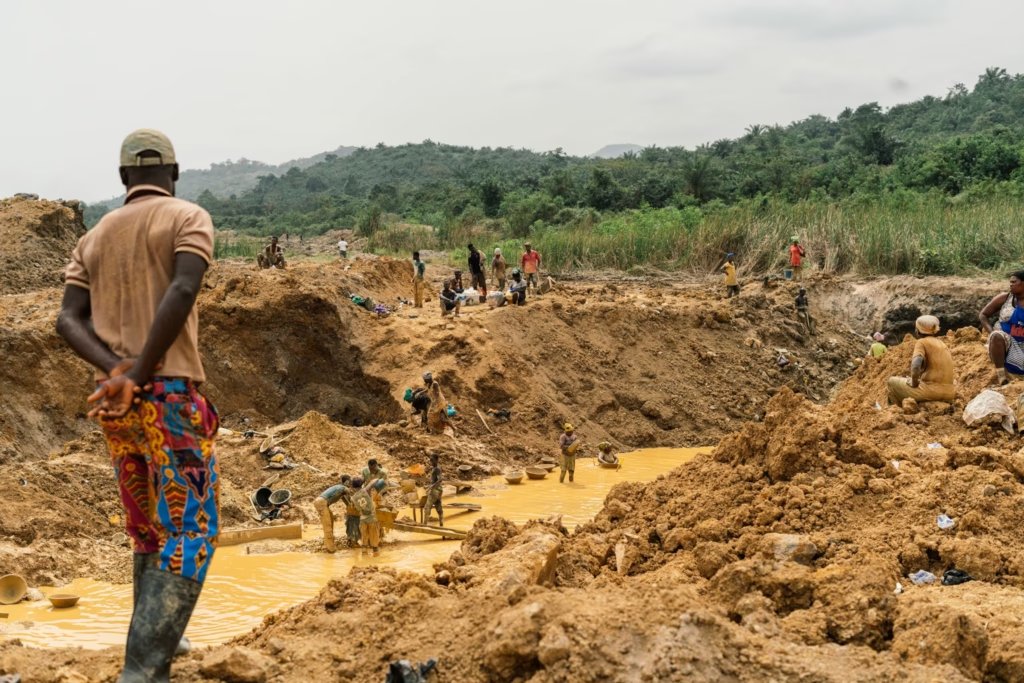
He also underscored the need to involve local communities, traditional leaders, district assemblies, and small-scale miners in decision-making processes to ensure that mining governance reflects the realities of affected areas. Without this, he cautioned, Ghana risks perpetuating a cycle of bureaucratic failure and environmental loss.
Gold Prices Intensifying Galamsey
Prof. Oteng-Ababio further linked the resurgence of illegal mining to worsening rural poverty and the rising value of gold on the global market. He said the high profitability of gold continues to lure both impoverished communities and powerful financiers into the trade, often at the expense of human safety and the environment.
He observed that limited livelihood opportunities in mining-prone regions have made the practice an economic fallback for thousands of youth. For many, he said, “the immediate gains outweigh the long-term dangers,” creating a vicious cycle of poverty, risk, and environmental degradation.
He also revealed that galamsey is no longer limited to artisanal diggers, as increasingly sophisticated operators with financial backing and modern equipment have taken over the business.
This, he warned, has intensified deforestation, water pollution, and land degradation across multiple regions as many of those involved now operate with significant financial and technological capacity.

The Forestry Commission has, over the years, expressed alarm at the pace of forest destruction and the contamination of major water bodies linked to galamsey. Prof. Oteng-Ababio maintained that unless Ghana adopts a “unified policy direction,” supported by political will and institutional synergy, the country risks losing critical ecological assets that sustain its economy.
He urged government and all stakeholders to work toward a coordinated, transparent, and decentralised regulatory framework that not only enforces compliance but also addresses the socio-economic drivers sustaining the galamsey economy.
READ ALSO: Oil Prices Dip as Israel-Hamas Ceasefire Calms Tensions