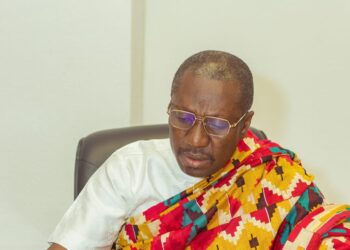

The Trades Union Congress (TUC) has criticised the government for failing to honour commitments made in 2024 to address illegal mining and protect Ghana’s water bodies.
Deputy General Secretary of the TUC, Dr. Kwabena Nyarko Otoo, accused the administration of breaking promises reached after the union’s aborted strike last year, saying the inaction has deepened the galamsey crisis.
Speaking on the state of environmental governance and labour’s broader social concerns, Dr. Otoo expressed disappointment at what he described as the government’s lack of seriousness in dealing with illegal mining despite repeated assurances.
“In 2025, you will agree that even with that aborted strike action in 2024, we agreed on a number of things with the government. But it is now clear to everybody that government did not keep its part of the bargain on those things agreed”
Dr. Kwabena Nyarko Otoo, Deputy General Secretary of the TUC
Dr. Otoo called out the government for failing to act swiftly on several issues since then, including environmental degradation and illegal mining. According to him, the illegal mining menace has worsened, threatening water treatment systems and the livelihoods of communities dependent on clean water and agriculture.
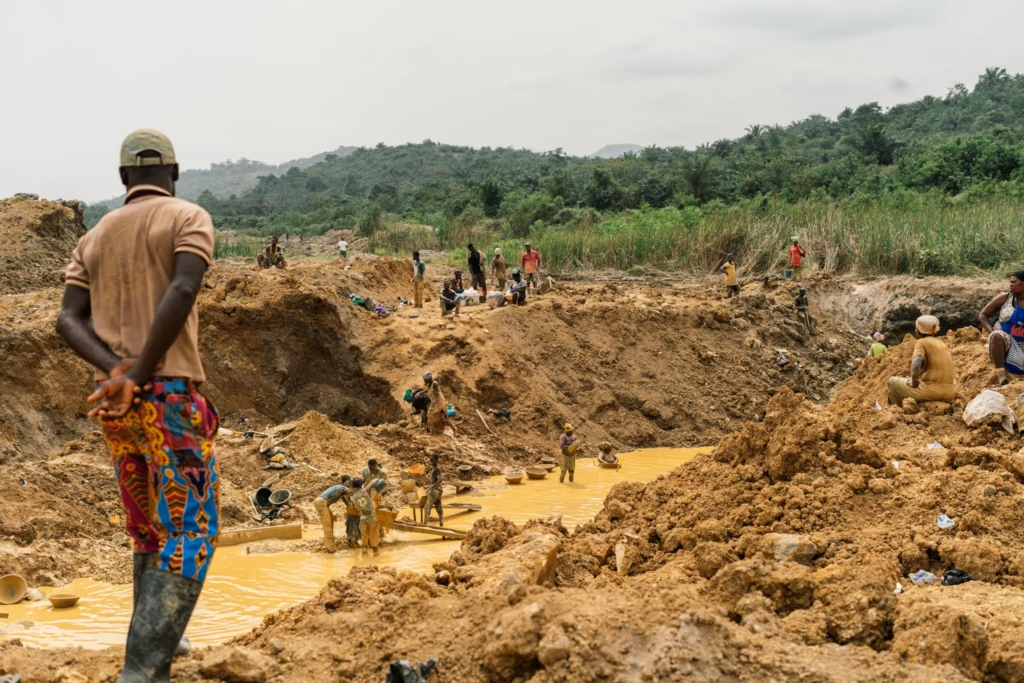
He stressed that the continued devastation caused by galamsey operations has eroded public confidence in the state’s ability to enforce environmental protection laws, noting that despite the urgency of the matter, political rhetoric has outpaced actual enforcement, leaving the nation’s rivers, forests, and farmlands at risk.
“And with galamsey, there are some people who may think that it is far removed from them, even though that might be a myopic view,” he added, noting the inclusiveness of the risk posed by illegal mining.
Dr. Otoo explained that while workers’ unions are traditionally oriented towards economic concerns such as wages, conditions of service, and job security, the environmental threat posed by galamsey cannot be ignored.
He maintained that the crisis undermines both social welfare and economic productivity, since polluted water sources and damaged lands have “direct implications for workers’ health, agricultural productivity, and industrial efficiency.”
The Deputy General Secretary emphasised that issues like illegal mining must not be seen as detached from labour concerns. He admitted, however, that rallying sustained mass mobilisation around environmental issues remains a challenge within the labour movement.
“The point I’m making is that if it is not a core issue, like wages and salaries for which unions are trained and for whose unions actually were established to address, it is always difficult to maintain unity around those issues”
Dr. Kwabena Nyarko Otoo, Deputy General Secretary of the TUC
Dr. Otoo added that while unions have historically focused on bread-and-butter issues, the current scale of environmental destruction demands that organised labour take a more active stance. The TUC, he said, will continue to engage the government to ensure that commitments made in the past are fulfilled and that illegal mining operations are brought under control.
Looming Water Crisis, A Call for Accountability
The TUC’s renewed call for government action follows weeks of warnings from environmentalists and civil society groups that Ghana faces an impending water crisis if urgent steps are not taken to halt galamsey.
The union recently conducted a fact-finding mission to assess the state of water treatment facilities in Kwanyako, Brim, and Akyem within the Central and Eastern Regions. Findings from the mission revealed alarming levels of siltation, chemical pollution, and reduced water flow due to illegal mining activities.
The situation, according to the union, poses a significant threat to urban water supply systems, particularly those serving densely populated areas.
Dr. Otoo’s remarks reflect mounting frustration within the labour front over the government’s perceived complacency in the face of environmental destruction. For him, the government’s inability to deliver on its promises undermines not only ecological protection but also the “social contract between leadership and citizens.”

He reiterated that effective leadership requires more than rhetoric – it demands visible action that safeguards both the environment and the welfare of workers. The TUC insisted hat Ghana’s reset towards responsible governance and national discipline must include decisive steps to end galamsey and restore the country’s natural assets.
The union, through its advocacy and partnerships, says it will intensify pressure on the government to match its words with concrete results, as the future of Ghana’s water security and sustainable development depends on the choices made today.
READ ALSO: Decline In Global Cocoa Demand Puts Ghana’s Fiscal Position At Risk