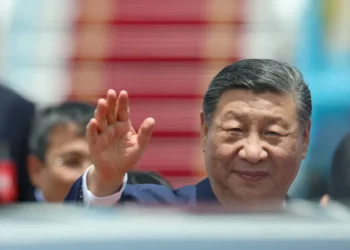
Chinese President Xi Jinping has arrived in North Korea for his first visit to Pyongyang in seven years, opening a closely watched round of talks with leader Kim Jong Un at a time of rising regional tensions, expanding military alliances and renewed concerns over North Korea’s rapidly growing nuclear programme.
The visit comes only days after Kim publicly pledged to accelerate the expansion of North Korea’s nuclear arsenal, describing plans for an “exponential” increase in the country’s strategic military capabilities.
It also follows years of growing military and political cooperation between Pyongyang and Moscow, a development that analysts say has prompted Beijing to move more aggressively to reinforce its influence over its isolated neighbour.
President Xi’s visit is one of the most significant diplomatic engagements between the two nations in recent years, demonstrating China’s desire to maintain its position as North Korea’s most important strategic ally, despite Pyongyang’s growing connections with Russia.
The Chinese leader is expected to hold extensive talks with Kim on regional security, economic cooperation and the future direction of North Korea’s foreign relations.
According to Zhu Feng, an International Relations expert at Nanjing University, “from China’s perspective, North Korea should be engaging with neighbouring countries in talks on peace and denuclearisation.” “More importantly, it should be seeking economic and social engagement with its neighbours to ensure it becomes less isolated and more oriented towards peace,”he added.
Despite expectations that Beijing may push for greater diplomatic engagement, North Korea has continued to signal a hardening stance on its nuclear programme.
Last week, Kim visited a nuclear materials facility and dismissed international calls for denuclearisation as outdated and unrealistic.
According to the state-run Korean Central News Agency, the North Korean leader stated the country was pursuing an ambitious strategy designed to strengthen its nuclear forces at an unprecedented pace.
However, Ja Ian Chong, Associate Professor of Political Science at the National University of Singapore indicated that, “North Korea has its own mind. They don’t do things at anybody else’s bidding, including Beijing,”
China Moves to Rebuild Diplomatic Ties With North Korea

Moreover, Xi’s visit comes amid a period of intense diplomatic activity for China and reflects Beijing’s efforts to maintain influence over a neighbour that has increasingly strengthened ties with Moscow.
Earlier this month, Xi hosted both United States President Donald Trump and Russian President Vladimir Putin on separate state visits to Beijing. The meetings showcased China’s growing diplomatic reach and highlighted the importance of North Korea within the broader geopolitical competition among major powers.
For Pyongyang, the United States remains its principal adversary, while Russia has emerged as a vital strategic partner. The deepening relationship between Kim and Putin has significantly altered regional dynamics and complicated China’s traditionally dominant role in North Korean affairs.
A great deal has changed since Xi’s last visit to Pyongyang in 2019, which was the first summit between the two leaders to be held on North Korean soil.
Three years later, Russia launched its full-scale invasion of Ukraine, creating new geopolitical realities that brought Pyongyang and Moscow closer than at any time since the Cold War.
An estimated 11,000 North Korean troops have reportedly been deployed in support of Russia’s war effort, while analysts believe Pyongyang has received food supplies, financial assistance and technical military support in return.
Beyond Russia, Kim has also been reshaping North Korea’s broader foreign policy posture.
Pyongyang recently revised its constitution to remove references to future reunification with South Korea, a move many analysts interpret as a formal abandonment of decades-long aspirations to reunify the Korean Peninsula.
The constitutional change effectively redefines North and South Korea as permanently separate states and signals a more confrontational approach towards Seoul.
Ahead of Xi’s visit, China had already intensified diplomatic engagement with North Korea.
In April, Chinese Foreign Minister Wang Yi travelled to Pyongyang for his first visit since 2019, where he met both Kim Jong Un and North Korean Foreign Minister Choe Son Hui.
According to China’s Foreign Ministry, the discussions included “an in-depth exchange of views on current international and regional issues.”
The visit was widely viewed as part of Beijing’s effort to strengthen communication and repair ties strained by North Korea’s increasingly close cooperation with Russia.
Diplomatic exchanges between the two countries have accelerated significantly over the past year.
After Xi and Kim met on the sidelines of a military parade in Beijing last September, North Korean Foreign Minister Choe visited China in February, followed by Wang’s visit to Pyongyang in April.
READ ALSO: Florentino Pérez Re-Elected as Real Madrid President, Mourinho Returns