Israel’s parliament dissolved early Friday, July 17, 2026, after passing a marathon of bills in the last moments of Prime Minister Benjamin Netanyahu’s governing coalition.
Israel’s parliament, the Knesset, voted 62-0 to approve a party financing bill that also includes a clause dissolving the legislature before the country’s October election. Following the vote, the Knesset entered recess and will not resume regular sittings until the newly elected parliament is sworn in.
Shas Chairman Aryeh Deri threatened not to back the legislation dispersing the Knesset, demanding that opposition parties also support the law, which also hikes public funding for political parties competing in the election. He eventually backed down.
According to Knesset Legal Adviser Sagit Afik, who recommended passing the bill in its entirety, if the law were to have failed, it would have granted the Knesset another week to pass legislation, up until 90 days before the election date.
Addressing the plenum, Knesset Speaker Amir Ohana, of Netanyahu’s Likud party, called the 25th Knesset the “most challenging” in Israeli history.
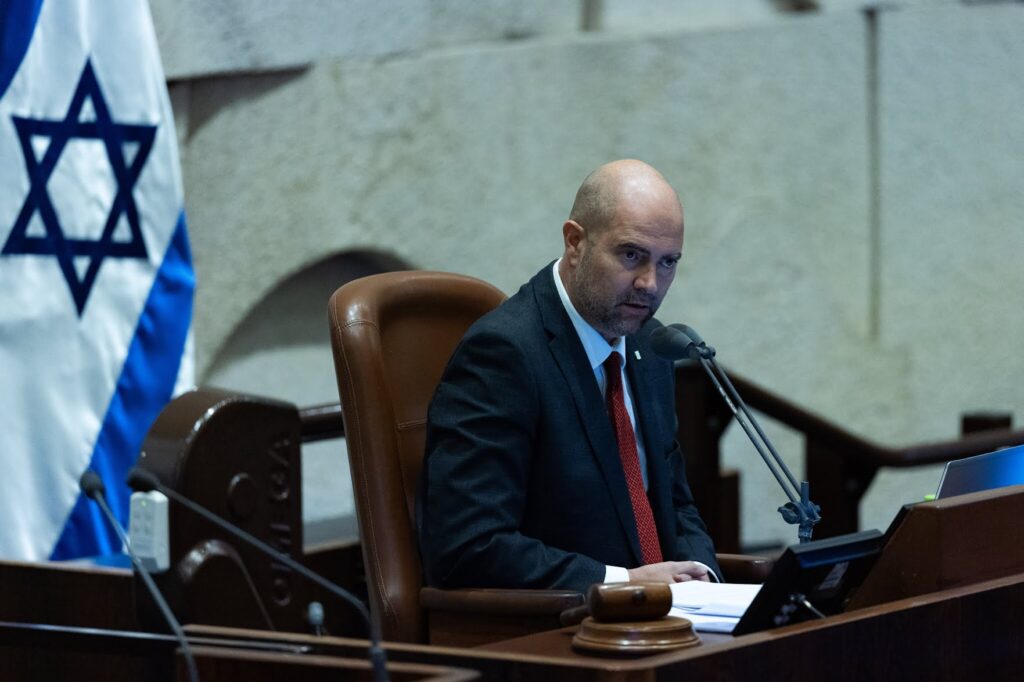
“It included protests of many kinds, accompanied the longest and most difficult war in the country’s history, [as well as] the bereaved families, evacuees from the north and south, the wounded and combat trauma victims and the families of the hostages.”
Amir Ohana
However, he claimed that the Knesset also saw “major moments of broad agreement and legislation that benefited many sectors of the public.” “It is my hope that we will return here soon and remember that, despite all our disagreements, we are not enemies, but partners, even if political rivals, and that we are all part of one people and one country,” he added.
Marathon Of Bills Passage
Over the past week, the Knesset passed several controversial laws in marathon sessions as Israeli Prime Minister Benjamin Netanyahu attempted to ram through several of his pet projects. Earlier this week, the Knesset passed two bills that effectively halt the enlistment of ultra-Orthodox men in the military in an attempt to ensure ultra-Orthodox parties join Netanyahu’s coalition in the next government.

The Knesset also recently passed several bills connected with Netanyahu’s attempts to overhaul the judiciary, including increasing government control over broadcast media and weakening the role of the Attorney General. Attorney General Gali Baharav-Miara has opposed the overhaul, and been a frequent target of Netanyahu and the Israeli right.
Just before voting to dissolve parliament, the Knesset approved a bill extending the mandatory service period for male soldiers to 32 months from the current 30, despite the objection of the Israel Defence Forces, which repeatedly urged the government to lengthen the period to 36 months amid manpower shortages.
Forty-three lawmakers supported the bill, 12 opposed it, and one abstained. Mandatory service for male soldiers was slashed from 36 months to 32 months in 2015. It was shortened again to 30 months in 2020, before being extended back to 32 months a year later, with the planned reduction to 30 months postponed by three years.
In August 2024, amid the multi-front war sparked by the Hamas-led October 7, 2023, attack, the mandatory service period was automatically shortened again to 30 months.The first cohort enlisted under this shorter service period was supposed to be discharged in January 2027, which would have exacerbated the military’s manpower shortages. Under the latest legislation, the mandatory service time will again be shortened to 30 months in June 2029.
Knesset Speaker Amir Ohana said as he announced the dissolution, “We are completing a four-year term, we passed nine budgets and hundreds of bills, I thank you for the trust you placed in me, through which together we succeeded in maintaining a four-year term.”
Completing a full, four-year term is a rare occurrence throughout Israeli history. The last time Israel’s government fulfilled a full term without breaking for early elections was in 1988. Israel has no term limits, and Netanyahu has served more terms than any other Prime Minister in Israel’s history, but it is rare even for him to finish a full, four-year term.
Between 2019 and 2022, Israelis went to the polls five times. Israel holds elections on average every 2.4 years, making it second-lowest ranked country in the OECD for periods between elections, a marker of political instability, according to the Israel Democracy Institute.
READ ALSO: Increased Refining Capacity Doesn’t Automatically Lower Pump Prices Immediately – Energy Chamber