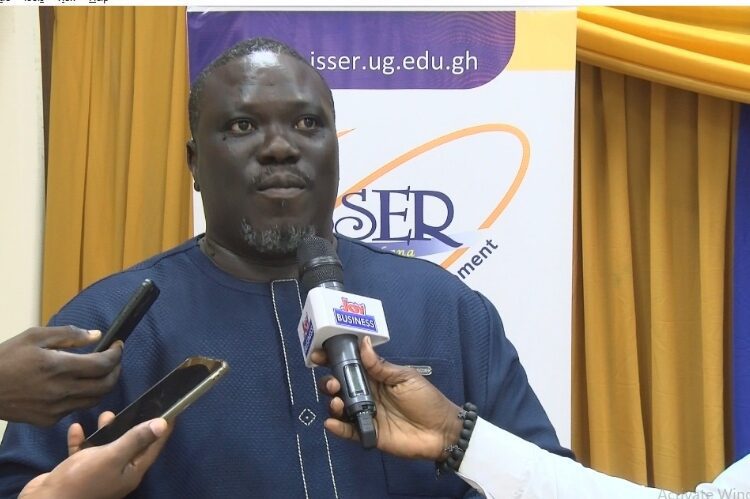
Days to the 2026 Budget statement reading in Parliament, Professor Ebo Turkson cautions the government against depending on commodities like gold to build economic resilience, though they contribute to the macroeconomic stability the country enjoys.
The Professor of Economics at the University of Ghana requested the Minister of Finance and the government to embark on an all-inclusive economic restructuring, while Ghana walks in a sound state of macroeconomic stability.
According to Prof. Turkson, the economic growth and improvement Ghana is witnessing now is derived from the export of gold, cocoa, and other major exports. Though they play a key role in the achievements enjoyed now, they are just commodities. Commodities, he added, cannot get the country to its destination.
A more robust and enduring means is needed beyond the support of the commodities. He advised the government to act now and lay the right foundation for a long-lasting stability and resilience.
“We [Ghana] need to structurally transform our economy. Most of what we [Ghana] are seeing now is also coming from the fact that the balance of payment is good.
“Gold is good, the gold for reserves has helped us [Ghana] a lot but these are based on commodities, and you cannot depend on commodities to build resilience, so we [Ghana] need to change the structure of the economy. This is the time the government should prioritize how we [Ghana] can diversify our production base.”
Prof. Ebo Turkson, Senior Lecturer, UG

Diversification using the 24-Hour Economy Initiative
The current unprecedented surge in the price of gold, the highest seen in recent years, has increased Ghana’s exports. Ghana continues as a leader in terms of gold export in the African continent. Ghana exported GH¢ 17.7 billion in 2024 with a 23.1% production output increase.
The current stability pace of the Ghanaian economy should focus on economic diversification, he said. He added that the surge in the price of gold has strengthened the fiscal and external position of the economy. However, the government should use its current 24-Hour economy initiative to form the basis and foundation to restructure the economy.

The 24-Hour economy initiative, all things being equal, will provide the right structures to serve as pillars that catapult the Ghanaian economy into diversification, from agriculture through manufacturing to export, and all the value chains in between.
The 24-Hour economy and Accelerated Export Development Program, according to President Mahama, is “a national production-led reset of Ghana’s post- colonial, import-dependent, low-value raw material exporting economy into a modern, self- reliant, and globally competitive economy that works around the clock to deliver productivity, sustainable growth, jobs, and food security for all.” The initiative is set to rebuild Ghana’s lost foundation to national development.
“The 24-hour economy is on board so if the right infrastructure is built to support that 24-hour economy, we [Ghanaians] are going to see diversification in the production base of the economy and also our [Ghana’s] export base.”
Prof. Ebo Turkson, Senior Lecturer, UG
Prof. Turkson recounted the gains the economy has made over the past 10 months. He mentioned that, latest data from the Central Bank shows that the Ghana Cedi experienced an appreciation of 37% against the US dollar.
Ghana’s year-on-year headline inflation in September was 9.4%, a remarkable improvement from the 11.5% in August. A single-digit inflation has not been achieved for four years now. The improvement in Ghana’s consumer price inflation to attain a single-digit was accomplished over a 9 months streak of decline.
Prof. Turkson’s Expectations
Prof. Turkson, like many Ghanaians, awaits the 2026 Budget Statement to be read on November 13. He expects that more light will be thrown on the restructuring of the economy and a move away from the sole dependence on commodities to maintain current macroeconomic stability.

The Budget reading will mark the Mahama-led administration’s first full-year budget reading. Since coming into power, the 2025 Budget was prepared by the Akuffo-Addo administration. The Minister of Finance, in his 2025 mid-year budget presentation, covered the second half of 2025.
The 2026 Budget to be read by Dr. Cassiel Ato Forson, the Minister of Finance, will give an account of the past 10 months of running the country, and then present Ghana’s fiscal policy for the coming year.
There are lots of expectations from the populace, experts, and analysts on policy frameworks to sustain the current macroeconomic stability, especially as Ghana exits the IMF program in May 2026.
READ MORE: 82.6% of Banks Expect Greater Financial Stability in 2026- BoG Survey