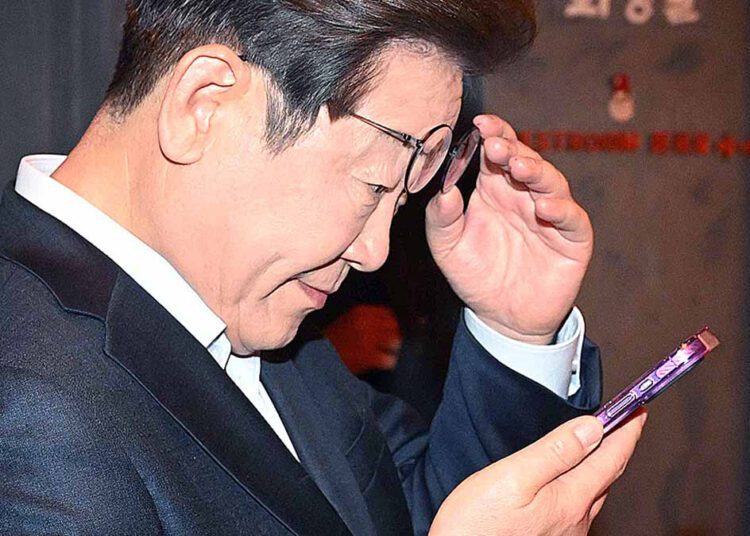
South Korea’s President, Lee Jae Myung has in a budget speech, called for tripling the government spending on projects for expanding artificial intelligence infrastructure and technology.
In his speech at the National Assembly, Lee highlighted his APEC diplomacy and a bilateral meeting with US President Donald Trump, which he said eased uncertainties facing South Korea’s trade-dependent economy by securing lower tariffs on automobiles and computer chips, two of the country’s key exports.
He acknowledged that South Korea was still facing a critical moment for “national survival” amid rapid changes in the global trade order and a “huge, transformative wave of AI.”
Lee said that the proposed budget of 728 trillion won ($506 billion), which would represent an all-time high for government spending, would be the country’s “first budget to open the AI era.”
He called on the liberal-led legislature to approve 10.1 trillion won ($6.9 billion) in AI-related spending; more than triple this year’s level, to advance the country’s AI computing and manufacturing capabilities, with a particular focus on industries such as semiconductors, automobiles, shipbuilding and robotics.
“Just as President Park Chung-hee paved the highway for industrialization and President Kim Dae-jung built the highway for the information age, we must now construct the highway for the AI era to open a future of progress and growth.”
Lee Jae Myung
Lee was referring to major development drives under Park’s dictatorship in the 1960s and ’70s and Kim’s presidency from 1998 to 2003, which focused on expanding South Korea’s internet infrastructure.
Also, Lee stated that South Korean companies would have little difficulty securing the chips for their AI projects, citing a deal for Nvidia, whose GPUs power much of the global AI industry, to supply 260,000 graphics processing units for AI infrastructure projects with major South Korean businesses and the government.
The deal was announced following a meeting during APEC between Lee and Jensen Huang, the Silicon Valley company’s Chief Executive.
It isn’t immediately clear when Nvidia, which agreed to deliver 50,000 GPUs each to the government, chipmakers Samsung and SK, and automaker Hyundai, and another 60,000 to internet company Naver, will deliver those chips.
Huang told reporters in South Korea that AI data centers and power networks must first be established before the company can begin shipping the GPUs.
Concerns have grown over the projects’ future after Trump said aboard Air Force One on Monday that only US customers should have access to Nvidia’s latest Blackwell AI chips, declaring, “We don’t give that chip to other people.”
South Korea’s Lee Urges Increase In Defence Spending

Moreover, Lee called for lawmakers to approve a planned 8.2% increase in defense spending next year, which he said would help reduce its reliance on the United States.
Lee proposed a defense budget of 66.3 trillion won ($46 billion) next year, which he said will be focused on modernizing the military’s weapons systems, including through the adoption of AI technologies, to make the armed forces more self-reliant.
“It’s a matter of national pride that South Korea, which spends 1.4 times North Korea’s annual GDP on defense and is perceived as the world’s fifth most powerful military, continues to depend on others for its security.”
Lee Jae Myung
During his meeting with Trump, Lee reaffirmed South Korea’s commitment to increase defence spending and called for US support for South Korean efforts to acquire nuclear-powered submarines.
Trump later said on social media that the United States will share closely-held technology to allow South Korea to build a nuclear-powered submarine, and that the vessel will be built in the Philly Shipyard in Philadelphia, which was bought last year by South Korea’s Hanwha Group.
Most conservative opposition lawmakers boycotted Lee’s speech amid an ongoing rift over a criminal investigation into former President Yoon Suk Yeol’s brief imposition of martial law in December.