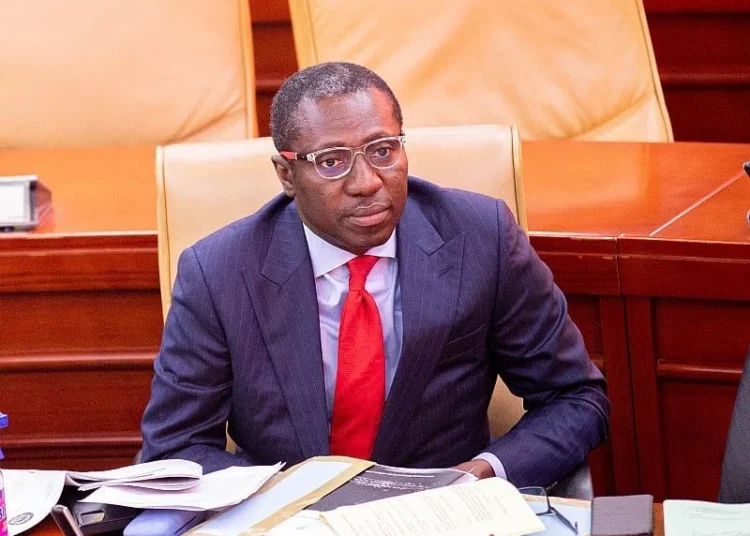
The Minority in Parliament, led by Hon. Alexander Afenyo-Markin, has turned the occasion of National Farmers’ Day 2025 from a celebration into a fierce indictment of the current administration, accusing the government of orchestrating some of the gravest crises in Ghana’s modern agricultural history.
While extending heartfelt appreciation to farmers and fisherfolk for their “extraordinary resilience,” the Minority Leader stressed that the day is one for reflection on the peculiar challenges facing the sector.
The Minority’s statement condemned the systemic policy failures that have devastated key economic drivers, from the grain market collapse in the north to the crippling logistical failures affecting coastal fishing communities and the existential threat of illegal mining to cocoa production.
At the forefront of the critique is the catastrophic failure in the grain market. The Minority stated that over 1 million metric tonnes of paddy rice, valued at an estimated GHS 5 billion, remain unsold and abandoned in warehouses across the Northern, North East, and Upper East Regions.
This crisis, the Minority Leader stated, is a direct consequence of the government’s failure to honour its September 2025 promise that the National Food Buffer Stock Company would purchase all locally produced rice and maize.
“Today is not only a day of celebration. It is a day for deep reflection – a day to honour the strength of our farmers and fishers in spite of frustration, neglect, broken promises, and national policy failures under the current administration”
Alexander Afenyo-Markin, Minority Leader

According to Hon. Afenyo-Markin, this pain was made visible by the unprecedented action of professional farmer associations who endorsed a symbolic boycott of national celebrations, marching through Tamale with placards questioning the government’s broken promise.
Compounding the crisis on land is the destructive encroachment of illegal mining (galamsey), which the Minority warned poses an existential threat to food security. According to COCOBOD, over 30,000 hectares of cocoa farms have been lost to illegal mining. This destruction has forced some farmers to abandon cocoa entirely, switching to rice and palm fruit simply to survive.
Furthermore, the minority noted that the pollution has pushed the turbidity levels of critical water bodies like the Ayensu River to over 30,000 NTU – far exceeding the maximum 2,500 NTU threshold required for treatment – a clear warning from the Ghana Water Company of a looming national water crisis.
The Crisis at Sea
The Minority Leader also expressed profound sympathy for fishing communities, arguing that the government has failed in its most basic duty to sustain the coastal economy.
The crisis is exemplified by the “chronic non-supply of premix fuel,” which has reportedly crippled activities and frozen the livelihoods of countless households in areas like Keta in the Volta Region. Hon. Afenyo-Markins condemned this failure as a “symptom of systemic neglect,” that leaves boats docked and families hungry.

Simultaneously, local producers on both land and sea are battling an influx of cheap, expired, and smuggled imports – often repackaged by “politically connected importers.” The appreciation of the cedi and declining global prices have made these unregulated imports even cheaper, destroying the competitiveness of Ghanaian farmers and fishers in their own markets.
“No local producer can compete with products that enter the country untaxed, unregulated, and unchecked. This is a national failure,” the Minority asserted.
This inability to protect local producers contributes significantly to Ghana’s staggering annual food import bill, which stands at an unsustainable US$3.5 – 4.5 billion, including around US$400 million in poultry and significant volumes of fish.
Investment in AI and Technology
The Minority Leader concluded the statement by outlining a forward-looking prescription, demanding that the government abandon its reliance on outdated manual practices and make bold, strategic investments in modernization.
The path to national competitiveness and job creation, the Minority argued, lies in embracing AI-driven agriculture and aquaculture through tools such as: Artificial Intelligence diagnostics for pest, disease, and stock assessment, drone-based fertilizer and pesticide application, precision agriculture and soil analytics, and smart irrigation and climate/marine forecasting tools.
“Ghana cannot continue relying on outdated tools and manual practices while the world is being transformed by Artificial Intelligence diagnostics for pest, disease, and stock assessment – this is how Ghana becomes competitive. This is how we create jobs. This is how we feed our people”
Alexander Afenyo-Markin, Minority Leader

On this Farmers’ Day, the Minority Leader demanded immediate and decisive government action: the immediate purchase of unsold grain stock, the urgent restoration of reliable premix fuel supply (starting with Keta), strong enforcement against smugglers and illegal mining, and the proper funding and expansion of the Feed Ghana Programme.
The Minority reiterated its full commitment to championing the cause of Ghana’s food producers until the nation invests adequately, protects local producers, and modernizes the sector using technology and innovation.
READ ALSO: Deputy Agric Minister Outlines New Strategy to Feed Industry, Halt Post-Harvest Losses