Ghana’s transition toward cleaner transport demands not just technology, but a stronger national understanding of electric vehicles (EVs) and the risks of continued dependence on fossil-fuel mobility, experts have warned.
Dr. Godwin Kafui Kwesi Ayetor, Group Chair and Special Interest Group (SIG) lead for the Electric Vehicles and Sustainability Group at the Brew-Hammond Energy Centre, stressed that Ghana’s air quality crisis is already causing severe health impacts.
“Some of the diseases we face, like asthma, lung cancer, neurological and cardiovascular diseases are all caused by emissions.”
Dr. Godwin Kafui Kwesi Ayetor
He added that while Africa contributes “less than 1% of global emissions,” local pollution is still directly affecting citizens.
“You are in Accra, and you are breathing it in. You can’t say you produce only 1%; you are still the one inhaling the pollution.”
Dr. Godwin Kafui Kwesi Ayetor

The remarks underscore mounting concern among health and environment experts, who say the dominance of internal combustion engines continues to fuel disease, premature deaths and productivity losses.
The call was made during a two-day electric mobility primer organised by the Climate Compatible Growth (CCG) Programme under the Brew-Hammond Energy Centre, where researchers, trainers and energy specialists outlined the urgency of speeding up EV awareness and readiness.


Dr. Ayetor highlighted that global EV adoption is accelerating, with China leading worldwide electrification, particularly in two- and three-wheel fleets, where 39% of all units are electric. Ghana, he said, is quietly experiencing its own early momentum.
He pointed to a growing presence of electric motorbikes in regional hubs such as Tamale, Bolgatanga and Kumasi, driven largely by start-ups including Solar Taxi, iJANU, Wahoo, and Drive EVGH.
These companies, he said, are laying the foundation for broader EV penetration in both commercial and personal transport.
Clarifying Misconceptions About EV Batteries

As interest in EVs grows, so do questions about battery safety and environmental impact. Dr. Ayetor used the platform to correct common misconceptions, particularly regarding lithium-ion batteries.
Although lithium accounts for only 3.2% of battery composition, their chemistry requires proper recycling and professional handling.
“Even when disposed of in a landfill, they can generate their own fire in about 20 days.
“EV batteries can produce their own oxygen and heat, so extinguishing them requires targeting the oxygen production point, not just the flames.”
Dr. Godwin Kafui Kwesi Ayetor
These insights, he said, demonstrate the need for training, regulation and infrastructure that ensure safe storage, transport and disposal of battery waste.
Dr. Akwasi Adu-Poku, SIG Coordinator of the CCG Ghana Network, emphasized the national importance of the two-day event, describing it as timely and strategic.
“Ghana is in the ‘preparation for take-off’ phase in the implementation of the EV policy, which sets a target of 35% penetration by 2035.”
Dr. Akwasi Adu-Poku, SIG Coordinator of the CCG Ghana Network
He stressed that accelerating the transition requires public understanding of not only EV technology, but also policy, regulation, safety standards and consumer behaviour.
“We need more sensitization and clarity, not only on technology, but also on policy, regulation, safety, and most importantly, consumer readiness.”
Dr. Akwasi Adu-Poku, SIG Coordinator of the CCG Ghana Network
His comments reflect growing recognition that Ghana’s EV transition will succeed only if public awareness grows alongside technical and regulatory capacity.
EVs as the Only Route to Zero Emissions
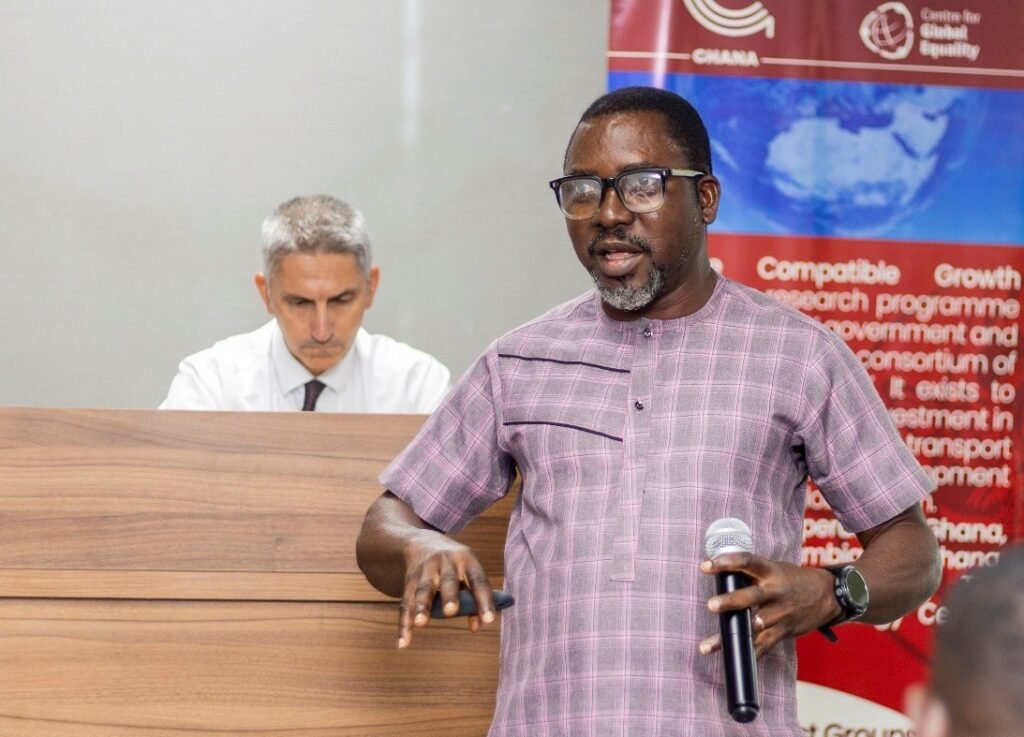
Industry professionals also contributed practical perspectives. Mr. Francis Elikplim Otejo, a training instructor at Toyota Ghana, noted that internal combustion engines will never be able to eliminate carbon emissions entirely.
“We can control the generation of carbon dioxide, but we cannot take it out completely.
“To achieve zero emissions and respond to global warming, the way forward is the introduction of electric vehicles.”
Mr. Francis Elikplim Otejo, a training instructor at Toyota Ghana
He further demonstrated essential EV maintenance and safety procedures, explaining that traditional car-care habits are inadequate for electric models.
“You don’t wash the engine compartment with water at the washing bay. Water is a conductor and will cause trouble for the system. Use vacuum or compressed air instead.
“When working on an EV, you must wear insulated gloves because of the high voltage.”
Mr. Francis Elikplim Otejo, a training instructor at Toyota Ghana
The stakeholder session concluded with a shared message: Ghana must build a stronger knowledge ecosystem around EVs to fully benefit from its clean energy ambitions.
From battery handling to policy alignment, public education to technician training, experts agreed that understanding must grow as fast as technology.
With the government targeting significant EV adoption by 2035 and cities facing worsening air pollution, the readiness of the population and the systems supporting them will determine the success of Ghana’s transition to sustainable mobility.
READ ALSO: Ghana’s Priority Sub-Sectors to Boost Growth in 2026