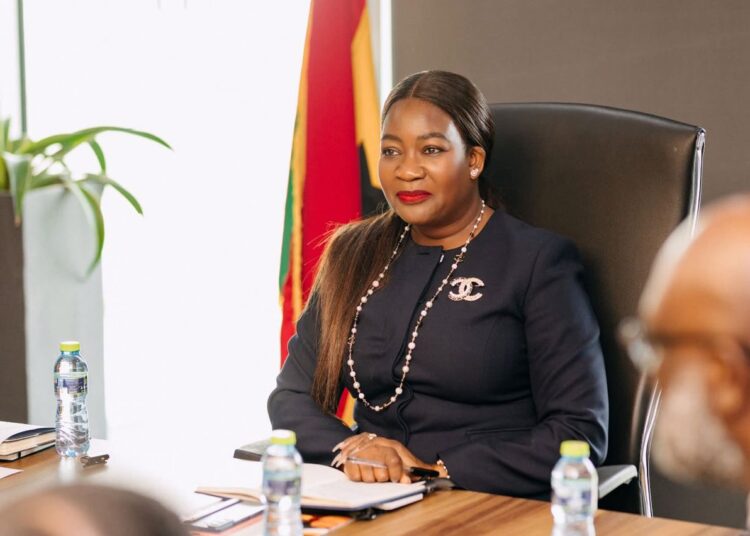
Chief Executive Officer of Minerals Income Investment Fund (MIIF), Mrs. Justina Nelson, has made an unequivocal demand for a significant overhaul of the nation’s mining industry, urging deeper gender inclusion, equity, and empowerment across the entire value chain.
Speaking as the keynote guest at the 10th anniversary celebration of Women in Mining Ghana (WIM Ghana) in Accra, Mrs. Nelson argued that a systemic shift toward a more inclusive sector is not merely a matter of social justice but a critical economic imperative.
Such an approach, she stressed, is essential to strengthening productivity, innovation, and governance within the country’s crucial mining ecosystem, ensuring women are not just present in the industry but fully empowered to lead and thrive.
“As MIIF continues to secure Ghana’s mineral revenues, we stand ready to partner with Women in Mining Ghana to champion a future where gender does not limit potential.”
Mrs. Justina Nelson

Mrs. Nelson’s call for change is a powerful push for structural transformation in an industry historically dominated by men. The CEO’s message of empowerment comes at a pivotal moment, urging stakeholders to ensure that women are “fully empowered to lead, influence, and thrive.”
She lauded the decade of work by WIM Ghana, commending the organisation for its “courage, resilience, and vision” in championing advocacy, leadership development, and opening doors “that were once firmly shut.”
The MIIF chief acknowledged the immense impact of their efforts, stating, “Your work has helped shape national perceptions, amplified women’s voices, challenged stereotypes, and opened doors that were once firmly shut,” MIIF, she declared, “salutes you.”
The Fund’s own commitment was demonstrated through a spotlight on the Women from Mining Communities (WoMCom) Scholarship Scheme, an initiative designed to support brilliant but financially needy female STEM students, with over 90 young women at the University of Mines and Technology (UMaT), Tarkwa, already benefiting from the programme.
The Fund plans to broaden this collaboration with local and international partners, expanding the scheme to universities in the middle belt and northern Ghana in 2026.
Persistent Gender Disparities and Bridging the Gap

Despite the visible efforts of organisations like WIM Ghana, the sector is still grappling with substantial gender disparities.
Drawing on the Ghana Chamber of Mines’ 2023 data, Mrs. Nelson highlighted the persistent gaps in women’s participation. The figures reveal a stark underrepresentation: women account for only 9–10% of the large-scale mining workforce and the contractor workforce.
Representation at the junior level is only 10%, rising marginally to 14% for senior positions and 21% for professional roles. Mrs. Nelson frankly acknowledged, “These are interesting figures, but they are far from where we need to be,” underscoring the long journey ahead.
Beyond the numbers, women in the industry continue to face critical challenges including inequitable earnings, gender bias, and harassment.
The MIIF CEO even referenced her own experience of being “bombarded with false publications and malicious attacks simply for putting things in their right perspective” since assuming office, stressing the reality of resistance faced by women in leadership.
The efforts to bridge this gap, however, are gaining momentum. Organizations like WIM Ghana and the MIIF’s WoMCom Scholarship Scheme are creating tangible pathways for female leadership and technical expertise.
Beyond this, the broader literature on the extractive sector in Ghana shows a rise in women forming solidarity movements to “break barriers” and ensure “gender shape-shifting,” a key part of the move toward inclusive mining.
These efforts are particularly vital, as external research indicates that while women’s participation in the artisanal and small-scale mining (ASM) sector can be as high as 50%, they often occupy the most vulnerable and least remunerative roles, such as the physically taxing task of carrying of the ore, which accounts for over 91% of their activities in some small-scale operations.
Addressing these deep-seated inequalities requires deliberate, inclusive policies that confront unconscious bias and create safer working environments. .
Inclusive Mining and Economic Impact

Inclusive mining, which seeks to integrate gender equity at all levels, is increasingly recognised as a key driver of economic and operational performance in Ghana’s mining industry.
Studies confirm that a greater diversity in the workforce can lead to improved workplace culture, better access to talent, increased innovation and creativity, and less operational risk.
For an economy like Ghana, where the mining sector is a significant contributor to GDP, export earnings, and government revenue, this inclusive approach is not just moral but essential for long-term sustainability and competitiveness.
The MIIF is actively working to ensure women from mining communities are not “left behind in Ghana’s mineral-driven transformation.”
In a clear indication of a strengthened and well-governed sector, MIIF reported significant improvements in Ghana’s mineral royalty inflows for the first three quarters of 2025, reflecting enhanced regulatory compliance and investor confidence.
The results underscore strong momentum in Ghana’s mineral revenue outlook, which is fundamentally tied to a well-governed, stable, and productive industry.
Key highlights of the mineral revenue performance included large-scale gold mining, which saw a royalty inflow of US$291.87 million a 40.18% increase from 2024; mid-tier gold operations reported GH₵59.44 million, a 46.38% rise; manganese saw a US$12.75 million inflow, reflecting a significant 170% surge; the quarry industry registered GH₵13.15 million, achieving 13.12% growth; and sand mining brought in GH₵433,406.41, an increase of 21.48%.
These figures, which the CEO stated “underscore strong momentum,” demonstrate the tangible benefits of a sector operating with strengthened oversight.
The MIIF CEO used the platform to commend Corporate Ghana for their support, expressing hope for continued collaboration, particularly through Corporate Social Responsibility (CSR) initiatives, to uplift more women into the mining space.
Mrs. Nelson concluded her address by urging all stakeholders to actively build a mining sector where women are “respected, safe, visible, and empowered,” congratulating WIM Ghana on its 10-year milestone and expressing hope for even greater transformation in the coming decade.
READ ALSO: Just Say No to A Presidential Third Term!