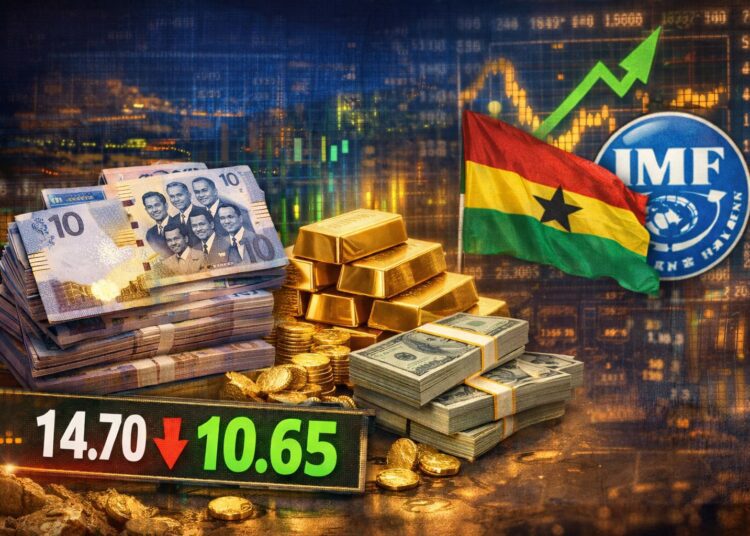
The Ghanaian cedi has staged one of its most dramatic comebacks in recent history, appreciating by about 27 percent over the past year to trade around 10.65 to the US dollar on the interbank market.
This marks a sharp reversal from its position at the end of 2024, when the local currency was exchanging at approximately 14.70 to the dollar and facing persistent depreciation pressures.
On Tuesday, interbank market data showed the cedi trading at 10.6447 on the buying side and 10.6553 on the selling side. The rally has positioned the cedi as one of the strongest performing currencies in Africa over the period, reigniting optimism among businesses, investors, and households who endured years of exchange rate volatility.
Gold prices and reserves provide strong backing
A major driver of the cedi’s resurgence has been Ghana’s expanding gold inflows, supported by record global gold prices. The government’s Gold for Reserves programme has reportedly mobilised more than 10 billion dollars in value, significantly boosting the country’s foreign exchange buffers.
By converting domestic gold resources into reserve assets, authorities have strengthened the Bank of Ghana’s capacity to intervene in the foreign exchange market. This increased supply of dollars and enhanced reserve cover have helped stabilise the cedi and reduce speculative pressures that previously drove rapid depreciation.
Analysts note that the timing of the programme has been critical, coinciding with strong international demand for gold amid global economic uncertainty.
Tight monetary policy restores confidence
The Bank of Ghana’s firm monetary stance has also played a central role in the currency’s turnaround. Through tight liquidity management and elevated policy rates, the central bank has curtailed excess demand for foreign exchange and dampened inflationary pressures.
Higher interest rates have encouraged investors to hold cedi-denominated assets, improving capital inflows and reducing dollarisation tendencies within the domestic economy. The consistent application of policy signals has been interpreted by markets as a commitment to currency stability, helping rebuild confidence in the cedi.
Economists argue that without this disciplined approach, gains from gold inflows alone would not have translated into such a sustained appreciation.
IMF Programme Strengthens Policy Credibility
Ghana’s ongoing engagement with the International Monetary Fund has further reinforced market confidence. Structural reforms under the IMF-supported programme have focused on fiscal consolidation, debt sustainability, and improved public financial management.
These measures have reduced concerns about excessive government borrowing and unanchored deficits, both of which historically placed downward pressure on the cedi. The IMF programme has also unlocked additional external financing, easing foreign exchange constraints and supporting the balance of payments.
Market participants say the alignment of fiscal and monetary discipline has been essential in sustaining the currency’s rally.
Bank of Ghana interventions calm volatility
Beyond policy tightening, the Bank of Ghana has been active in managing short-term volatility in the foreign exchange market. Strategic interventions have helped smooth sharp fluctuations and deter speculative attacks on the cedi.
Governor Dr. Johnson P. Asiama has received praise from sections of the financial community for providing steady leadership during a period of fragile recovery. Supporters argue that consistent communication and decisive action have restored a measure of predictability to the currency market.
This stability has filtered through to pricing behaviour, helping businesses plan more effectively and reducing pass-through pressures on consumer prices.
Analysts urge caution amid celebration
Despite the impressive rally, analysts are urging caution against excessive optimism. Policy commentator Bright Simons has raised concerns about potential losses associated with gold trading structures, particularly the operations of GoldBod, and has called for transparency and independent probes where necessary.
Such concerns highlight the importance of strong governance frameworks to ensure that gains from gold-backed initiatives are sustainable and do not introduce hidden fiscal or financial risks.
Other analysts warn that currency appreciation driven largely by commodity inflows can be vulnerable to external shocks if global prices reverse.
Long-term sustainability depends on exports
Economists widely agree that sustaining the cedi’s strength will require deeper structural reforms beyond gold and monetary tightening. Export diversification remains a critical challenge, with Ghana still heavily reliant on a narrow range of primary commodities.
Expanding value-added exports in agriculture, manufacturing, and services would help generate more stable foreign exchange earnings. This would reduce the economy’s exposure to commodity price swings and strengthen the cedi over the long term.
Without such diversification, analysts caution that the current rally could face renewed pressure once external conditions change or exceptional inflows subside.
For now, the cedi’s appreciation offers rare relief to importers, consumers, and businesses grappling with high costs over recent years. While risks remain, the move from 14.70 to 10.65 stands as a notable achievement, reflecting the combined impact of gold-backed reserves, disciplined policy, and reform-driven confidence.
The challenge ahead lies in turning this currency rebound into a durable foundation for economic stability and growth.
READ ALSO: Bullish Wave Hits GSE as Investors Party Into Year-End With Nearly 80% Market Surge