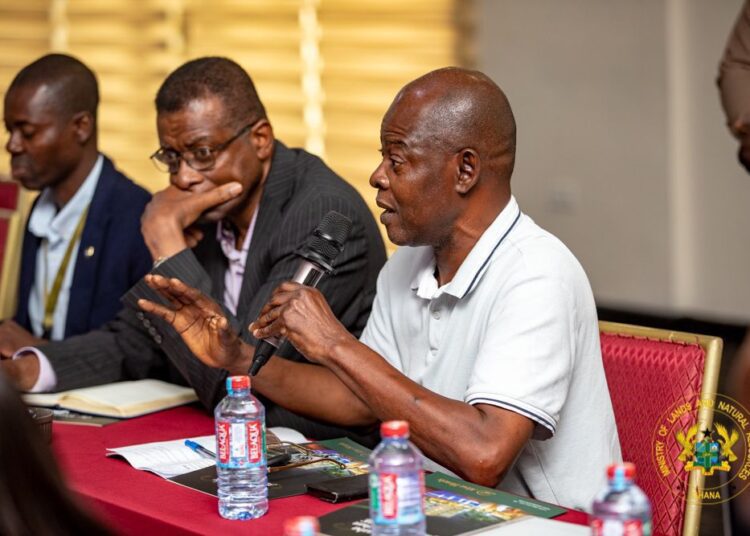
Dr. Steve Manteaw, the Co-Chair of the Ghana Extractive Industries Transparency Initiative (GHEITI), has called for the urgent establishment of a comprehensive mineral revenue management framework.
He argued that as gold prices surge on the global market, the lack of a structured legislative mechanism to govern these windfalls poses a significant threat to Ghana’s macroeconomic stability.
Dr. Manteaw’s proposal centers on the need to insulate the domestic economy from “overheating”—a condition where excessive foreign exchange inflows lead to a rapid appreciation of the cedi, subsequently making Ghanaian non-mineral exports less competitive on the global stage.
“If gold prices continue to go up, and BoG continues to intervene on the forex market, the economy will overheat, and will make Ghanaian exports uncompetitive. This is why we need a mineral revenue management framework that helps to prevent overheating and ensures our economy remains competitive. Such a framework ought to help manage the volatility effect of gold revenues on our budget, take care of the inter-generational interest in the resource, and provide clear rules for investing mineral revenues.”
Dr. Steve Manteaw.
The urgency of this framework is underscored by the current trend where the Bank of Ghana (BoG) continues to intervene in the forex market using gold-backed reserves.
While such interventions are designed to stabilize the currency, Dr. Manteaw warned that without a clear policy on how these revenues are captured and spent, the nation risks falling into the “resource curse” trap.
He posited that a robust management framework would not only address the immediate volatility of gold revenues but also protect the inter-generational interests of Ghanaians.
By harmonizing this new structure with the existing Petroleum Revenue Management Act (PRMA), the state could ensure a unified and disciplined approach to investing natural resource wealth.
Mitigating the “Dutch Disease” through Fiscal Discipline

The primary economic justification for Dr. Manteaw’s proposal lies in the mitigation of “Dutch Disease,” a phenomenon where a boom in one sector leads to the decline of others.
When gold revenues flood the economy without a sterilization mechanism, the resulting “spending effect” can drive up the prices of non-tradable goods and services, leading to inflation. An extractive expert noted that “a mineral revenue framework acts as a shock absorber, decoupling public expenditure from the volatile swings of commodity prices.”
By implementing fiscal rules that dictate how much of the gold revenue can be spent annually versus how much is saved in a stabilization or heritage fund, Ghana can maintain a balanced growth trajectory.
Furthermore, a well-defined framework ensures that the central bank’s interventions are not merely reactive but part of a broader, transparent strategy.
Experts suggest that without these rules, the “resource movement effect” could see labor and capital shift prematurely from agriculture and manufacturing into mining-related services, hollowing out the country’s industrial base.
Dr. Manteaw’s call for “clear rules for investing mineral revenues” is therefore a move to ensure that the current “gold boom” translates into long-term infrastructure and human capital development rather than short-term consumption that erodes national competitiveness.
Harmonization and Inter-generational Equity

A critical component of the proposed framework is its alignment with Ghana’s existing petroleum revenue architecture.
The Petroleum Revenue Management Act (PRMA) has already set a precedent by creating the Ghana Heritage Fund and the Ghana Stabilization Fund.
Extending these principles to the mining sector would create a holistic “Extractive Industries Revenue Management” system.
This harmonization is essential for addressing what Dr. Manteaw described as the “inter-generational interest,” ensuring that the finite mineral wealth of the country provides value for future citizens who will not have access to the physical ore.
The proposed framework would also bring much-needed transparency to the “Domestic Gold Purchase Programme.”
By institutionalizing the rules of engagement between the Ministry of Finance, the Bank of Ghana, and the mining companies, the government can avoid the pitfalls of opaque mineral-backed financing.
As Dr. Manteaw succinctly put it, the nation is at a crossroads where it must “seize the current when it serves” to protect its economic ventures.
Failure to act now could result in a missed opportunity to turn a temporary price spike into a permanent foundation for industrialization and economic resilience.
READ ALSO: Domelevo Calls For Legal Reforms To Sustain Momentum Of ORAL Initiative