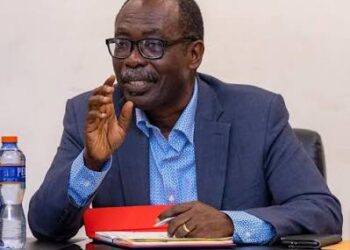
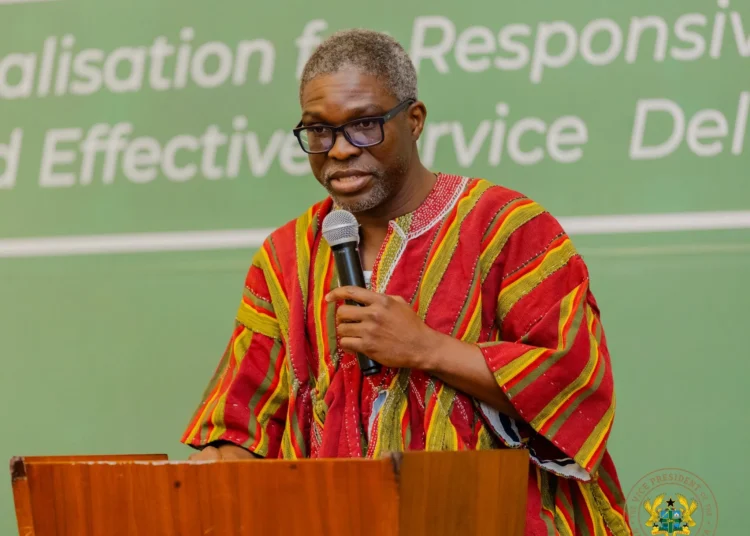
In a bold reassertion of the principles of decentralization, the Executive Secretary of the Inter-Ministerial Coordinating Committee (IMCC) on Decentralisation, Dr. Gameli Hoedoafia, has challenged the narrative that Ghana’s transport woes are a central government failure.
Speaking in an interview, amidst growing public frustration over urban mobility and crumbling local road networks, Dr. Hoedoafia argued that the “culture of overreliance,” on the central government has effectively paralyzed local accountability.
“Transport is one of the areas I will identify as needing improvement. When you look at my remit, the Transport Ministry is not part of the IMCC, but because transport is a local issue and affects everybody, it is important for local governments themselves to deal with it.
“The law empowers local governments to do a lot of these things for themselves and by themselves, and not to sit down waiting for the central government”
Dr. Gameli Hoedoafia, Executive Secretary of the IMCC on Decentralisation
For the IMCC chief, the persistence of transport challenges in various districts is not a symptom of a dysfunctional local government system, but rather a failure of implementation by the officials on the ground.
He maintained that while the Ministry of Transport provides the broad strokes of national policy, the Metropolitan, Municipal, and District Assemblies (MMDAs) hold the legal power and the mandate to execute solutions within their jurisdictions.
The debate comes at a time when urban centers and rural districts alike are grappling with worsening traffic congestion and inadequate public transport infrastructure, with critics frequently pointing to the central government as the primary culprit for these inefficiencies.
However, Dr. Hoedoafia argued that this perspective ignores the statutory role of District Chief Executives (DCEs) and Coordinating Directors. “Yes, the minister sets the policy, but the implementation is the role of the districts,” he added.
As the chief technical and political officers at the local level, these figures are empowered to manage transport-related interventions – from the construction of local feeder roads to the regulation of terminal facilities. By constantly looking toward Accra for directives, Hoedoafia suggested that “local leaders are abdicating their constitutional responsibilities.”
System Under Scrutiny
Despite his defense of the decentralization framework, Dr. Hoedoafia admitted that the functionality of the system is often questioned by the public because the results on the ground are lagging.
He revealed that the IMCC is currently overseeing the transition into the National Decentralisation Policy and Strategy (2026–2030), which aims to strengthen fiscal decentralization and local economic development.
The crux of the issue remains the gap between the legal empowerment of districts and their actual technical capacity or financial willpower to act. While the central government provides the “Road Fund” and other allocations, the IMCC Secretary insisted that the “wait-and-see,” attitude prevalent in many assemblies is the primary bottleneck to progress.
As the government moves forward with its “Reset Agenda” for local governance, the call for a “moral reset” in how districts view their roles is becoming more urgent. Dr. Hoedoafia’s comments serve as a warning to local government actors that the days of blaming the Ministry for district-level failures are numbered.
With the new decentralization policy set to take full effect, the expectation is that MMDAs will move from being passive recipients of policy to active managers of their local economies. If the transport crisis is to be solved, the solution must be found in the offices of the DCEs, not just in the halls of the central ministry.
READ ALSO: GoldBod Calls for Informed Discussion Amidst Split Opinions