
National Anti-Illegal Mining Operations Secretariat (NAIMOS) has executed a series of high-impact raids across the Ahanta West Municipality, dealing a significant blow to “galamsey” networks in the Western Region.
During the operations, the elite taskforce dismantled several active illegal mining enclaves, resulting in the destruction of heavy machinery and the seizure of a sophisticated cache of weapons and logistics.
The operation, first targeted a site at Agonakrom where miners were found polluting a stream that feeds into the critical Hwin River.
Moving with tactical precision, the taskforce later converged on a notorious site nicknamed “Agenda 111” in the Mpohor district so named for its proximity to a government hospital project.
While the miners fled into the dense vegetation upon sighting the taskforce vehicles, NAIMOS operatives successfully immobilized two Sany excavators and destroyed numerous “chanfang” machines that had been used to block and divert the Butre River within a private palm plantation.
“NAIMOS would therefore extend the operations and dominate the Ahanta West and other adjoining Assemblies to ensure that all water bodies are kept off illegal mining activities. It was generally observed from the day’s operations that, most of the mining sites had been abandoned due to the presence of NAIMOS taskforce in the region.”
Mr. Elikem Kotoko, Deputy Forestry Commission CEO
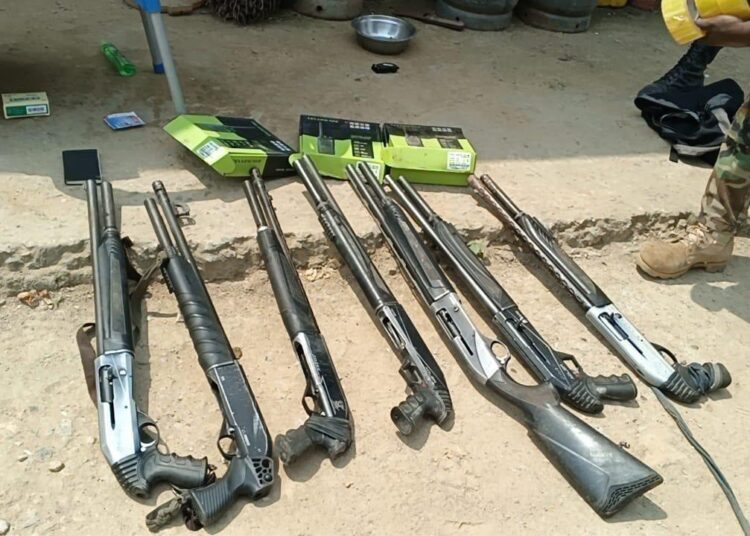
Seizure of Weapons and Logistical Assets

Beyond the destruction of mining equipment, the taskforce conducted a follow-up raid on the private residences of the suspected illegal miners.
This search yielded a concerning discovery: seven pump-action shotguns and 12 BB cartridges, highlighting the increasingly militant nature of “galamsey” operations.
Alongside the weaponry, officials confiscated an unregistered gray Toyota Hilux, electronic communication equipment, and additional water pumping machines used for alluvial mining.
The presence of explosives at the “Agenda 111” site required the intervention of an internal explosive expert to ensure safe disposal.
The taskforce’s strategy of removing monitors and control boards from heavy machinery effectively “bricking” the excavators serves as a high-level deterrent against the re-occupation of these sites.
This specialized approach ensures that even if the physical chassis remains, the high-value technical components are removed from the illicit supply chain.
Strategic Impact on National Anti-Galamsey Efforts

From an extractive industry perspective, these raids represent a critical shift toward intelligence-led enforcement.
By targeting the Hwin and Butre river flow lines, NAIMOS is directly addressing the “environmental deficit” caused by siltation and chemical runoff, which threatens both local agriculture and municipal water treatment plants.
The successful “immobilization and seizure” of assets acts as a financial drain on the shadowy financiers behind these operations, who often rely on the mobility of their equipment to evade local authorities.
Furthermore, this operation aligns with the broader government mandate to protect state infrastructure. The proximity of illegal mining to the “Agenda 111” hospital site underscores the brazen nature of these actors and justifies the taskforce’s commitment to “dominate” the Ahanta West area.
By maintaining a persistent presence, NAIMOS aims to transition from reactive raids to a sustainable model of territorial control, ensuring that reclaimed lands are not immediately re-invaded once the taskforce departs.
Strengthening the Extractive Regulatory Framework

The successful neutralization of the Agonakrom and Mpohor sites serves as a “milestone of inter-agency cooperation” in the fight for environmental sovereignty.
These enforcement actions are vital for restoring the integrity of Ghana’s extractive sector, as they separate legitimate small-scale mining from criminal enterprises that bypass all environmental and fiscal regulations.
For the extractive blogger and industry analyst, the NAIMOS operations signify a tightening of the net around the logistical arteries of illegal mining.
As the taskforce continues its sweep through the Western Region, the focus remains on “neutralizing the threat at its source.”
The removal of the logistical and defensive capabilities of these syndicates specifically the unregistered vehicles and firearms is a prerequisite for the long-term success of the government’s reforestation and water restoration projects.
READ ALSO: COPEC Projects Marginal Petrol Price Drop in February