Ghana’s recent macroeconomic recovery was not achieved in isolation. It unfolded against a rare alignment of favourable global conditions that amplified the impact of tough domestic reforms.
What began as a stabilisation effort has evolved into momentum building, supported by easing global inflation, a weaker United States dollar, buoyant commodity prices, and resilient global growth. Together, these external tailwinds allowed Ghana’s policy reset to gain traction faster and more deeply than many analysts expected.
Single digit inflation, a stronger Ghana cedi, record foreign reserves, and a decisive reduction in the policy rate have become the clearest markers of this transition. For policymakers, the shift represents movement away from crisis containment toward restoring confidence and rebuilding growth.
Monetary Policy Turns a Corner
The Bank of Ghana’s Monetary Policy Committee confirmed the scale of improvement in January 2026. Headline inflation fell to 5.4 per cent in December 2025, returning Ghana to single digit territory for the first time in years. On January 28, 2026, the committee cut the policy rate by 250 basis points to 15.50 per cent, citing significant macroeconomic improvement and well anchored inflation expectations.
This decision reflected disciplined fiscal and monetary coordination under the Mahama administration. However, it was also enabled by a supportive global environment that reduced the cost of adjustment. Lower imported inflation and calmer financial conditions gave the central bank room to ease without destabilising the currency or inflation outlook.
Global Resilience and the AI Investment Wave
The International Monetary Fund projects global growth of 3.3 per cent in 2026, defying earlier fears of a sharp slowdown. Easier financial conditions, easing tariff pressures, and a surge in technology investment linked to artificial intelligence have underpinned this resilience. IMF Chief Economist Pierre Olivier Gourinchas has noted that firms have adapted to trade shocks, while AI related capital expenditure has provided a meaningful offset to global headwinds.
Spending on data centres, semiconductor chips, and cloud infrastructure boosted global investment and loosened financial conditions. These dynamics filtered into frontier markets like Ghana, lowering funding costs and improving risk appetite. Money market rates in Ghana fell sharply, with the 91 day Treasury bill yield hovering near 11.2 per cent in mid January 2026, down from over 27 per cent a year earlier.
The MPC reports that average lending rates declined by about 10 percentage points in 2025. At the same time, real private sector credit growth rebounded to 13.1 per cent. This rare combination of falling nominal rates and rising real credit marked a decisive shift from stabilisation to real sector recovery.
Dollar Weakness and the Cedi Rebound
Currency dynamics played a critical role in Ghana’s reset. A softer US dollar through much of 2025 eased pressure across emerging markets. Against this backdrop, and supported by tight monetary policy, liquidity discipline, and reserve accumulation, the Ghana cedi staged a remarkable recovery.
The Bank of Ghana reports that the cedi appreciated by 40.7 per cent against the US dollar in 2025, following a 19.2 per cent depreciation in 2024. Gross international reserves rose to US$13.8 billion at the end of 2025, equivalent to 5.7 months of import cover, up from US$9.1 billion a year earlier. These buffers now anchor confidence even as global currency conditions remain uncertain.

Commodities and External Balances Align
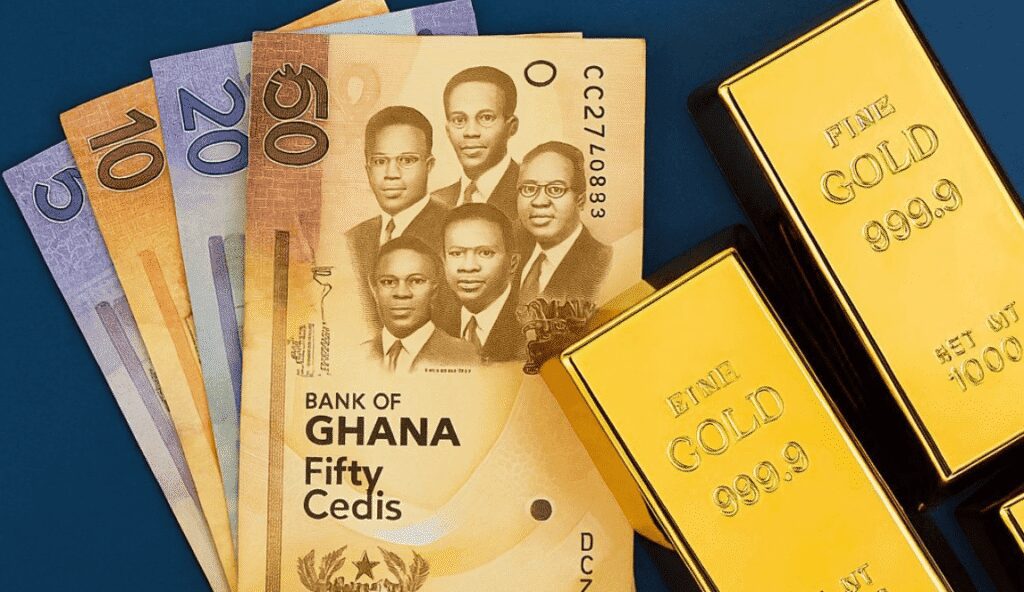
Commodity markets also worked in Ghana’s favour. The World Bank projects further declines in energy and many food prices into 2026, easing inflation pressures worldwide. At the same time, gold prices remained historically elevated, driven by safe haven demand and central bank purchases. This mix suited Ghana as an oil importer and gold exporter.
The MPC reports a provisional current account surplus of US$9.1 billion in 2025 and a balance of payments surplus of US$3.98 billion. Strong gold exports and higher private transfers were key drivers. Cocoa prices normalised from record highs in 2024, correcting sharply in 2025 while remaining above pre 2023 levels. Ghana raised the 2025/26 producer price by about 12 per cent to protect farmer incomes and curb cross border smuggling.
Fiscal Repair and Market Confidence
Fiscal outcomes strengthened markedly. By November 2025, the overall fiscal deficit stood at 0.5 per cent of GDP, well below target. The primary surplus reached 2.8 per cent of GDP, while public debt fell to 45.5 per cent of GDP from 63.1 per cent a year earlier.
This consolidation reopened domestic financing at a lower cost and restored market confidence. Improved global conditions helped, as non resident inflows to emerging markets increased with easing financial conditions. Ghana’s January 2026 Treasury bill auctions, consistently oversubscribed at falling yields, reflected renewed investor trust.
From Stabilisation to Sustainability
Ghana now stands out in Sub Saharan Africa, where many economies continue to grapple with financing constraints and debt service pressures. Single digit inflation, stronger reserves, fiscal discipline, and a credible policy pivot have placed the country among the region’s more stable performers.
The challenge ahead is durability. Fiscal credibility must be entrenched, monetary policy must remain data driven, and non debt foreign exchange inflows must be deepened. Global tailwinds have amplified Ghana’s reset, but sustaining momentum will require converting this favourable moment into lasting structural strength.