

The GAEC AI-driven development agenda took centre stage in Kumasi as the Ghana Atomic Energy Commission reaffirmed its commitment to leveraging Artificial Intelligence to accelerate sustainable development across Ghana and the wider African region.
The pledge was made at the AI for Sustainable Development (AI4SD) Mini Conference hosted by the Kwame Nkrumah University of Science and Technology in Kumasi.
The three-day programme, held under the theme “Leveraging Artificial Intelligence for the Sustainable Development Goals (SDGs),” convened researchers, students, innovators, policymakers and development partners to explore practical AI applications for national transformation.
Opening the conference on behalf of the Commission’s Director General, the Deputy Director General and project lead, Francis Hasford, underscored the urgency of embedding AI within Ghana’s scientific and innovation landscape.
“Artificial Intelligence is no longer a distant or abstract concept. It is rapidly reshaping how we conduct research, manage resources, deliver healthcare, strengthen agriculture, and design policy interventions.”
Francis Hasford, Deputy Director General and project lead of GAEC
AI as a Tool for Sustainable Development

Prof. Hasford emphasised that AI offers developing countries a rare opportunity to leapfrog structural limitations that have historically constrained growth.
However, he cautioned that realising this potential depends on building strong local expertise and ensuring that AI systems are grounded in locally generated data.
In his view, technology imported without contextual adaptation risks failing to address Ghana’s unique development challenges. Instead, he advocated for AI models trained on domestic datasets capable of responding to issues such as food security, environmental degradation and healthcare delivery.
“Knowledge and networks emerging from the conference would significantly advance both national and regional sustainable development targets.”
Francis Hasford, Deputy Director General and project lead of GAEC
Integrating AI into Nuclear and Space Science

As one of Africa’s leading institutions in nuclear science, related technologies and space science, GAEC is positioning AI as a strategic enabler within its core research activities.
Prof. Hasford detailed ongoing projects under the AI4SD initiative, including crop health monitoring and yield prediction using Earth Observation data.
These applications, he explained, are helping researchers transform satellite imagery into actionable insights for farmers and agricultural planners.
The Commission is also applying advanced analytics to biomedical and radiobiological research, environmental monitoring, radiation protection and industrial processes.
“Integrating AI into nuclear science and related technologies enhances GAEC’s ability to transform complex datasets into concrete information in food security, climate change, and public health for policymakers and end-users.”
Francis Hasford, Deputy Director General and project lead of GAEC
He encouraged participants to collaborate with the Commission, calling for joint research projects, shared datasets, pilot applications and scalable solutions capable of delivering measurable impact.
Positioning Ghana in the Regional AI Landscape
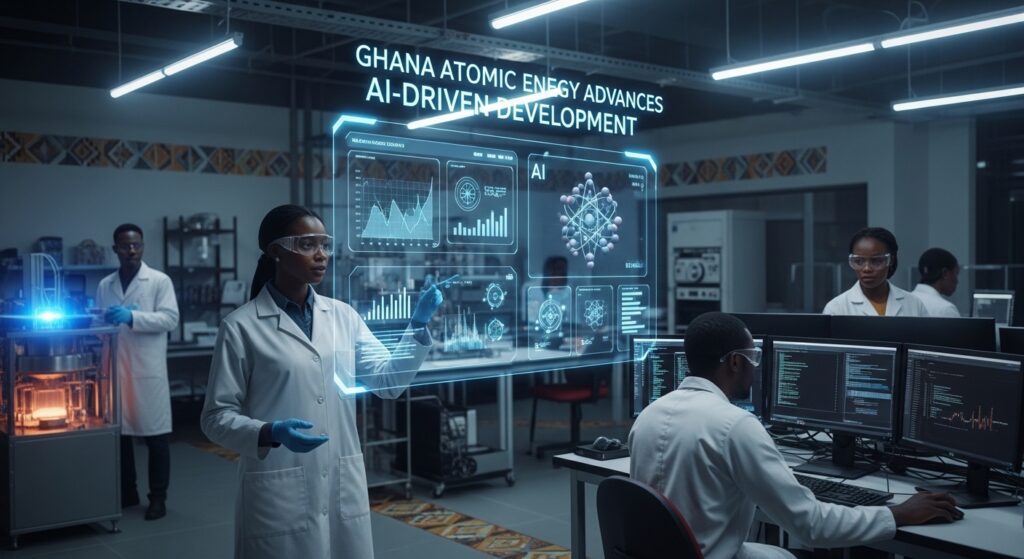
The AI4SD Conference reflects Ghana’s broader ambition to position itself as a regional hub for scientific innovation and digital transformation.
By aligning AI development with the Sustainable Development Goals, stakeholders aim to ensure that technological progress directly addresses pressing socio-economic challenges.
For GAEC, the integration of AI represents both an institutional evolution and a national opportunity. By harnessing data science and machine learning tools within nuclear and environmental research, the Commission seeks to provide policymakers with timely, evidence-based insights.
As discussions concluded in Kumasi, participants left with renewed commitment to translating ideas into implementation.
The emphasis on collaboration, capacity-building and locally relevant innovation suggests that GAEC’s AI-driven development strategy is moving beyond theory into practical application.
With sustained partnerships and investment in human capital, Ghana’s scientific institutions may well become catalysts for AI-powered solutions that drive sustainable growth across the country and the wider region.
READ ALSO: South Korea Closely Monitoring North Korea’s Weapons Development