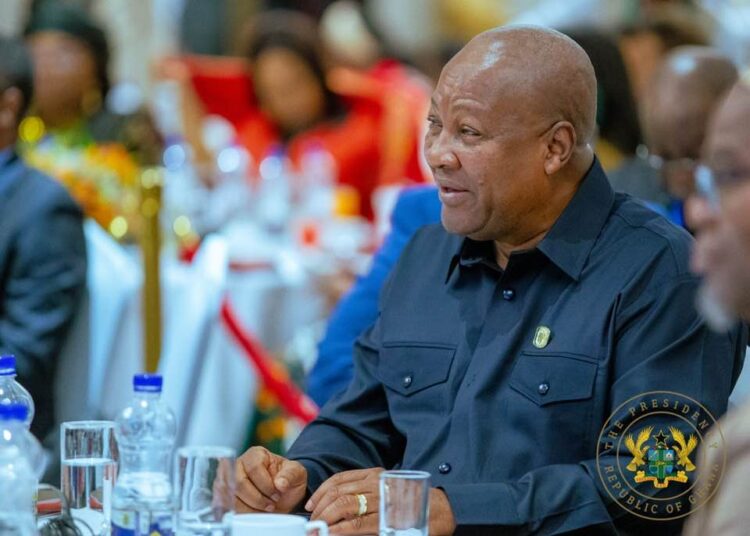
The Ghana Centre for Democratic Development has credited President John Dramani Mahama with restoring funding stability and renewed focus to Ghana’s basic education sector, describing it as a significant outcome of his administration’s first year in office.
This assessment was presented during a one-year governance review led by Dr. Kojo Pumpuni Asante, Director of Policy Engagement and Partnerships at CDD-Ghana.
According to Dr. Asante, one of the most notable developments in education policy over the past year has been the deliberate shift back to strengthening basic education after several years of disproportionate focus on secondary education.
“For a number of years, Free SHS basically absorbed everything. It absorbed all our resources. But you know, if the foundation is weak, It doesn’t matter what you put on it, you are not going to get the learning outcomes that you want”.
Dr. Kojo Pumpuni Asante, Director of Policy Engagement and Partnerships at CDD-Ghana.
Against this backdrop, he described the government’s historic allocation of 9.1 billion Ghana cedis to basic education in the 2025 Budget as a clear signal of policy rebalancing. In his view, the renewed emphasis on basic education represents a corrective step aimed at improving learning outcomes across the system.
Uncapping of GetFund
The CDD-Ghana presentation also highlighted the decision by the Mahama administration to uncap the Ghana Education Trust Fund as a critical reform. Dr. Asante explained that the cap on the fund had constrained education financing and contributed to persistent infrastructure and resource challenges.
By removing the cap, the government has sought to ease funding bottlenecks and improve the sustainability of education investments across all levels. Beyond financing, the assessment addressed structural and non-academic challenges within the education system.

Dr. Asante noted that the administration has begun confronting longstanding policy issues, such as the double-track system at the secondary level. While acknowledging that resolving double-track constraints will take time, he stressed that recognising the problem and initiating steps toward balance reflects a more holistic approach to education planning.
He emphasised that the central challenge facing education policy is achieving an effective balance between basic, secondary, and higher education. In his view, prioritising one segment at the expense of others creates systemic weaknesses.
The CDD-Ghana review suggested that the administration’s renewed attention to foundational education marks an important shift toward addressing this imbalance.
Gender Related Dimensions of Education and Social Policy
The presentation also examined gender related dimensions of education and social policy. Dr. Asante pointed to the passage of the affirmative action law as a major milestone, noting that it provides a legal framework for advancing gender equity across sectors, including education.
He observed that the Ministry of Gender has been active in the past year, particularly in efforts to operationalise the new law. Among the initiatives cited were the establishment of the Gender Equity Committee and ongoing discussions around the legislative instrument needed to fully implement the affirmative action framework.
Dr. Asante also referenced efforts to address practical barriers to girls’ education, including the distribution of sanitary pads to school-going girls, which he described as an important intervention for retention and participation.
However, the CDD-Ghana assessment struck a measured tone, noting that progress on gender equity remains uneven. Dr. Asante acknowledged that while the legal framework is now in place, the more difficult task lies in translating law into sustained institutional practice.

He raised concerns about the adequacy of support systems for survivors of gender based violence and questioned whether enforcement mechanisms are strong enough to deliver meaningful change. In particular, he drew attention to the challenge of implementing gender related budget commitments.
While government statements have reaffirmed targets such as allocating a defined percentage of resources toward gender equity, Dr. Asante questioned how these commitments are being enforced in practice. He argued that without clear accountability mechanisms, policy promises risk remaining aspirational rather than transformative.
Period of Recalibration in Education Policy
Overall, the CDD-Ghana review framed the Mahama administration’s first year as a period of recalibration in education policy. By redirecting attention to basic education, addressing financing constraints, and engaging with structural challenges, the government has taken steps to stabilise a sector that underpins national development.
At the same time, the assessment emphasised that sustaining these gains will require consistent implementation and institutional follow through. Dr. Asante concluded that the education sector’s trajectory under the current administration reflects a broader governance lesson.
Policy success depends not only on ambitious reforms but on the ability to strengthen foundations, balance competing priorities, and move decisively from legislation to implementation.

For CDD-Ghana, the renewed focus on basic education represents progress, but its long-term impact will depend on whether reforms translate into improved learning outcomes and greater equity.
As the Mahama administration moves beyond its first year, CDD-Ghana indicated that education will remain a key benchmark for assessing its governance performance.
The think-tank stressed that continued investment in foundational learning, combined with effective gender mainstreaming and policy enforcement, will be essential if Ghana is to build an education system capable of supporting inclusive growth and social stability.
READ ALSO: GSE Explodes with 804% Turnover Surge