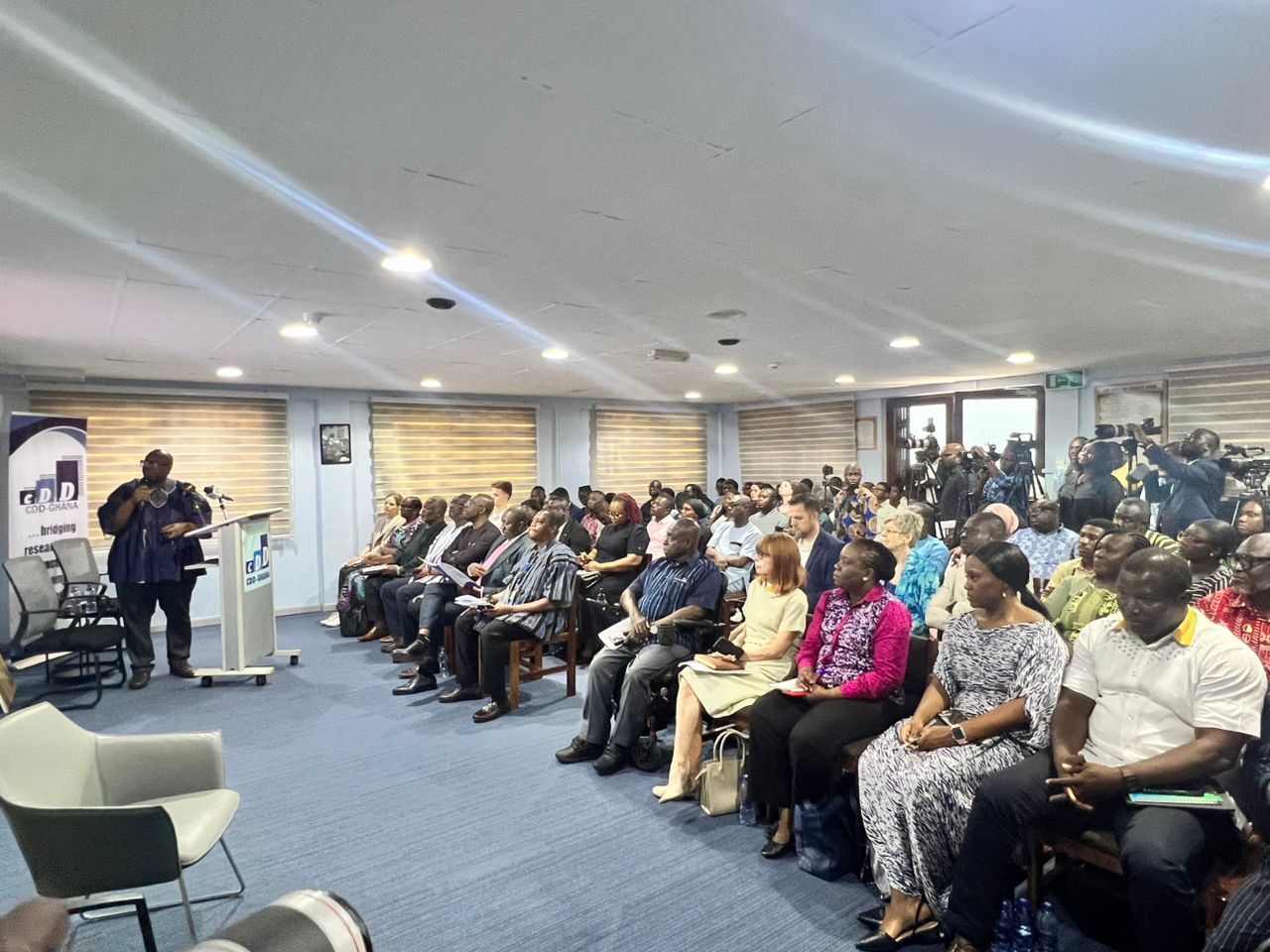
Ghana Centre for Democratic Development (CDD Ghana) has delivered a measured but thought-provoking assessment of the first year of President John Dramani Mahama’s administration, concluding that while macroeconomic gains are evident, deep structural weaknesses continue to threaten long-term stability.
The presentation, led by Professor Atsu Amegashie, reviewed economic performance from January to December 2025. The verdict was balanced: progress has been made, but the foundations of the economy remain fragile.
According to Prof. Amegashie, on the surface, the numbers tell an encouraging story. Fuel prices declined between 4% and 8% during the year. Food inflation dropped sharply from 28.3% at the start of 2025 to 4.9% by year’s end. The stability of the cedi helped stabilize the cost of imported medicines and raw materials, easing pressure on businesses.
He noted that taxes such as the e-levy, betting tax, and emission levy were abolished. The debt-to-GDP ratio fell, largely due to external debt restructuring and what the presenters described as strict fiscal discipline.
Prof Amegashie also hailed the government for the decisive step it has taken to bring down interest rates.
“The debt to GDP ratio fell from 61.8%, 45%. This was largely due to the external debt restructuring. There was strict fiscal discipline, which is to say that the government is spending responsibly. And they recorded a figure from the Ghana Statistical Service, which found that between January 2025 and September 2025, 330,000 people found jobs. And then there was a fall in the interest rate, particularly the fall in treasury bill rates from 30% to 11%. So that means that the Mahama administration has done very well in its first year.”
Professor Atsu Amegashie
Taken together, he stated that these indicators suggest that the administration has stabilized key macroeconomic variables in its first year.

The Debt Debate: Looking Beyond GDP
Despite the improved debt-to-GDP ratio, Prof. Amegashie warned against celebrating too quickly. One of the strongest criticisms was directed at the continued reliance on debt-to-GDP as a primary measure of sustainability.
“We don’t pay or service debt from GDP. We service debt from revenue, not from GDP,” he stressed.
The concern is that while Ghana’s debt-to-GDP ratio has fallen, debt servicing remains heavy. Interest payments account for roughly 25% of government revenue. In practical terms, this means that for every cedi collected, about a quarter goes directly to servicing debt, leaving limited room for education, healthcare, and infrastructure.
Prof. Amegashie argued that comparing a stock measure like debt to a flow variable like GDP can be misleading. Instead, debt service as a proportion of revenue, both flow variables, provides a more accurate picture of fiscal pressure.
Upcoming obligations also raise concerns. Government is projected to pay GHS 20 billion in 2026 and GHS 50.3 billion in 2027 to settle maturing debts and interest. Those figures underscore that while ratios may look healthier, fiscal risks persist.
Job Creation Versus Job Quality
Although 330,000 jobs were reportedly created, unemployment remains high and job quality continues to be a challenge. Over 67% of employment remains in the informal sector.
Drawing comparisons with countries such as Japan, Germany, and Singapore, he emphasized that the public sector is not the primary engine of job creation. “The public sector cannot generate enough jobs. It is still the private sector,” the speaker noted.
This raises critical questions about Ghana’s business environment. If private sector growth is constrained by high costs, regulatory inefficiencies, and uneven tax enforcement, sustainable job creation becomes difficult.
The concept of “jobless growth” was also highlighted by Prof. Amegashie. He noted that an economy can record impressive GDP growth while failing to generate meaningful employment or improve development indicators like teacher-student and doctor-patient ratios.
Galamsey and the Cocoa Crisis
Small-scale gold mining has pushed gold production to 103 tonnes, even outperforming the large-scale mining sector. However, he noted that part of this increase is linked to illegal mining activities, widely known as galamsey. While boosting output figures, galamsey has broader economic consequences, including environmental damage and potential impacts on agriculture.
The cocoa sector remains another structural vulnerability. Quoting Professor H. Kwesi Prempeh of the Ghana Centre for Democratic Development, the discussion noted that Ghana has been in the cocoa business since 1947, yet every downturn in global prices still throws the economy into fiscal stress.
“You know the nature of the business, price volatility, and all. By now, you should be a global leader in managing boom and bust cycles,” Prempeh said. Instead, the sector continues to struggle with volatility and weak institutional resilience.
Structural Bottlenecks in Daily Life
Beyond macro indicators, everyday realities reveal deeper weaknesses. Post-harvest losses for crops like maize, tomatoes, and yams range between 20% and 30% due to poor storage facilities and inadequate roads. Teachers and nurses reportedly face delays in salary payments. Employment data is not consistently updated, limiting effective policymaking.
The inefficiency of the monetary transmission mechanism also drew attention. While treasury rates have fallen significantly, lending rates in commercial banks remain high, limiting access to affordable credit for businesses.
A bakery owner’s experience illustrates the broader challenge. Registered with the Ghana Revenue Authority, he charges VAT on bread and remits it to the state. However, informal competitors who are not registered do not charge VAT, allowing them to undercut prices. This uneven enforcement discourages formalization and limits business expansion.
The overall assessment gave the government a passing mark. Inflation is down, fiscal discipline has improved, and job creation figures show progress. Yet, structural inefficiencies in taxation, debt management, private sector empowerment, and institutional coordination threaten to undermine these gains.
In his concluding remarks, he said “It is nice to look at debt to GDP, inflation, and growth. But we are structured in such a way that we are not able to move to the next step where we see significant improvement in socio-economic indicators.”
All in all, stabilizing the macroeconomy is only the first step. Without tackling structural bottlenecks, Ghana risks repeating a familiar cycle of growth followed by crisis.
READ ALSO: COCOBOD Board Sacrifices Allowances to Support Reforms